Subroutine Conventions
Chapter 10 showed how data moves through a complete program. This chapter concentrates on the rules at each call boundary. find_max receives HL and B, while count_above receives HL, B and C. Both return A. The comment above count_above lists D as clobbered because its running counter remains in D on return. Callers and later edits must follow that contract for the routines to compose correctly.
The register-passing convention
Programs may pass arguments in registers, on the stack or in fixed memory, and the Z80 leaves the choice to the program. This book uses the following register convention because it suits small routines and matches later examples:
- HL carries a 16-bit address or pointer: the start of a table, a buffer, a string.
- BC carries a 16-bit count or value, such as loop counts or word quantities.
- B alone carries an 8-bit count when only one is needed.
- C carries a single-byte argument when something other than the count is needed.
- DE carries a second address, most commonly a destination when HL is the source.
- A carries a single byte that needs a fast path: a byte value, a flag, a character.
Return values follow a matching convention:
- A carries a byte result.
- HL carries a 16-bit result: an address, a computed word.
These roles are conventions, not hardware rules. Following them consistently makes call sites easier to read.
Callee-save and caller-save registers
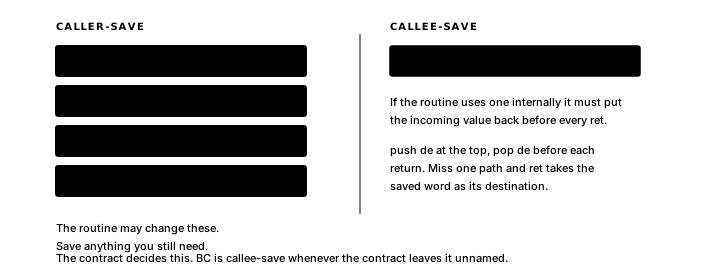
For each register, the contract determines whether its incoming value survives the call.
Caller-save registers may be changed by the routine. In this book, A, F, declared outputs and every register named in Clobbers are caller-save at that call boundary. An input register is also caller-save when the contract says the routine consumes or clobbers it. The caller must save any incoming value that it still needs after the call.
Callee-save registers are the ones whose incoming values survive the call: every register the contract leaves out of its outputs and clobbers. A routine that uses one internally restores it before returning. This is the convention used in this chapter, not a fixed property of BC, DE, HL, IX or IY themselves.
The mechanism is push and pop:
my_routine:
  push bc
  push de
  ; ... body that uses BC and DE internally ...
  pop de
  pop bc
  ret
The stack is LIFO (last in, first out), so the last saved value must be removed first. Popping into the wrong pairs restores the values to different registers.
Chapter 10's find_max borrows C as a temporary, so it clobbers a register that is not one of its inputs. Comparing against (hl) directly removes that temporary and leaves only HL, B and A, which already serve as inputs or output. count_above needs D for its running count throughout the loop, so it preserves the caller's whole DE pair with push de and pop de.
count_above:
  push de            ; save caller's DE (D used internally as counter)
  ld d, 0            ; D = running count
CountAboveLoop:
  ld a, (hl)
  cp c
  jr c, CountAboveSkip   ; A < threshold: skip
  jr z, CountAboveSkip   ; A = threshold: skip (strictly above only)
  inc d
CountAboveSkip:
  inc hl
  djnz CountAboveLoop
  ld a, d            ; return count in A
  pop de             ; restore caller's DE
  ret
The pop must appear on every return path. Missing it leaves the saved word at the top of the stack, so ret uses that word as its destination.
The IX frame for local storage
When a subroutine needs more temporary values than the registers can hold, it can allocate local storage on the stack.
The technique uses IX as a base pointer into the stack.
The prologue establishes the frame:
my_routine:
  push ix            ; save caller's IX
  ld ix, 0
  add ix, sp         ; IX now points to the frame base (top of stack)
Two bookkeeping entries are on the stack already, and any arguments the caller pushed before the call sit above them:
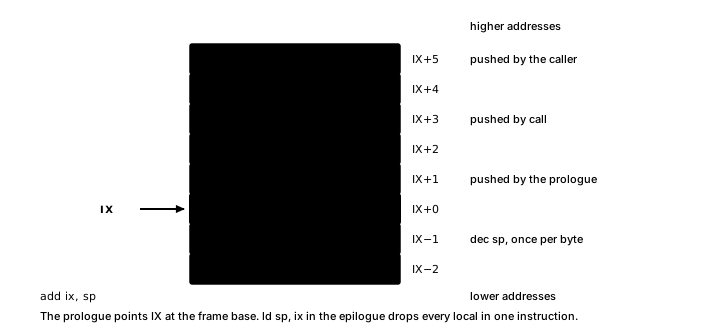
IX+0 and IX+1 hold the saved IX and IX+2 and IX+3 hold the return address, so caller arguments start at IX+4 and locals sit below IX+0.
Local storage decrements SP once for each required byte:
  dec sp
  dec sp             ; allocate 2 bytes of local storage
The two bytes are now at IX−1 and IX−2, where indexed addressing reaches them:
  ld (ix-1), a       ; write first local
  ld a, (ix-2)       ; read second local
The epilogue undoes both steps and restores IX for the caller:
  ld sp, ix          ; restore SP to frame base (discards locals)
  pop ix             ; restore caller's IX
  ret
The ld sp, ix line removes all local storage in one instruction, regardless of how many bytes were allocated.
A caution: the index displacement in (ix+d) is a signed 8-bit value. For locals, d is negative (−1 through −128). For caller-pushed args, d is positive (4 through 127). The maximum frame size is 128 bytes of locals and 124 bytes of arguments.
Register documentation
Plain assembly records a subroutine's register interface in a comment block immediately before the label. The block declares every input, every output and every register the subroutine leaves changed:
Here is that revised body, with the C temporary gone:
; find_max: scan a byte table and return the largest value
; In:  HL = pointer to first byte of table
;      B  = number of bytes to scan
; Out: A  = maximum value found
; Clobbers: B (reaches 0), F, HL (advances past last byte)
find_max:
  ld a, 0
FindMaxLoop:
  cp (hl)
  jr nc, FindMaxSkip
  ld a, (hl)
FindMaxSkip:
  inc hl
  djnz FindMaxLoop
  ret
Clobbers lists every register the routine may leave changed.
The comment block for count_above with push/pop discipline:
; count_above: count bytes in a table that are strictly above a threshold
; In:  HL = pointer to first byte of table
;      B  = number of bytes to scan
;      C  = threshold value
; Out: A  = count of bytes where (byte > threshold)
; Clobbers: B (reaches 0), F, HL (advances past last byte)
; Preserves: C, D, E (DE saved via push/pop)
count_above:
  push de
  ld d, 0
CountAboveLoop:
  ld a, (hl)
  cp c
  jr c, CountAboveSkip
  jr z, CountAboveSkip
  inc d
CountAboveSkip:
  inc hl
  djnz CountAboveLoop
  ld a, d
  pop de
  ret
Preserves lists registers the subroutine explicitly restores.
The caller and routine uphold these comments by convention. A mismatch shows up at runtime, sometimes far from its origin.
Book 1 Chapter 6 covers what AZM provides beyond comments: a structured declaration syntax that the register contract analyzer can read and verify.
Conventions applied to both routines
The two Chapter 10 subroutines now follow the same convention. Their comment blocks describe the call boundary, while their bodies preserve every register that the contract promises to preserve.
; find_max: scan a byte table and return the largest value
; In:  HL = pointer to first byte
;      B  = count (number of bytes to scan)
; Out: A  = maximum value found
; Clobbers: B (reaches 0 after djnz), F, HL (points past last byte)
; Preserves: C, D, E, IX, IY
find_max:
  ld a, 0
FindMaxLoop:
  cp (hl)
  jr nc, FindMaxSkip
  ld a, (hl)
FindMaxSkip:
  inc hl
  djnz FindMaxLoop
  ret
find_max uses only its input registers and A, which is why its body has no push/pop at all.
; count_above: count bytes in a table strictly above a threshold
; In:  HL = pointer to first byte
;      B  = count (number of bytes to scan)
;      C  = threshold value (bytes must be strictly greater to count)
; Out: A  = number of bytes where byte > threshold
; Clobbers: B (reaches 0 after djnz), F, HL (points past last byte)
; Preserves: C, D, E (DE saved via push/pop)
count_above:
  push de            ; D used as counter; save caller's DE
  ld d, 0
CountAboveLoop:
  ld a, (hl)
  cp c               ; compare byte against threshold
  jr c, CountAboveSkip   ; A < C: skip (carry set = unsigned less-than)
  jr z, CountAboveSkip   ; A = C: skip (zero set = equal, not above)
  inc d                  ; A > C: increment counter
CountAboveSkip:
  inc hl
  djnz CountAboveLoop
  ld a, d            ; move count from D into A for return
  pop de             ; restore caller's DE before returning
  ret
The main sequence that calls both:
main:
  ld hl, values
  ld b, 8
  call find_max
  ld (max_val), a

  ld hl, values      ; reload HL - find_max walked it to the end
  ld b, 8            ; reload B - find_max consumed it
  ld c, 64
  call count_above
  ld (above_64), a
  halt
A caller that needs HL or B after find_max returns has to reload them.
From machine rules to assembler checks
Book 2 ends with the rules that routines and callers must uphold in plain Z80 assembly: arguments and results occupy agreed registers, preserved values are restored and every path reaches ret with a balanced stack. A comment records that agreement for callers.
AZM can check the same interface and can name a record layout or instruction idiom once instead of repeating its details at each use. Those assembler features are covered in Book 1:
- Chapter 5, The Layout System, for record types,
sizeof,offsetand cast paths in place of hand-counted byte offsets - Chapter 6, Register Contracts, for
.routineand the analysis that turns a comment block into something the assembler proves - Chapter 7, Ops, Aliases and Source Composition, for
opdeclarations and for building one program out of several files
Book 3 covers arrays and runtime indexing, string handling, recursion, multi-file programs and patterns for programs that outgrow a single file.
Exercise
Push/pop order. With BC = $1111, HL = $2222, AF = $3344 and SP = $C000, these pushes establish the stack contents:
push bc
push hl
push af
The answer should supply the correct three-pop epilogue, restored registers and SP. A second trace using pop bc / pop hl / pop af should give the resulting registers and explain why a balanced SP alone does not prove correct restoration.