Machine Code
A program is a sequence of bytes in memory.
Opcodes and Operands
The opcode byte, sometimes with a prefix byte, identifies the instruction and its operand form. Some instructions consist only of an opcode. Others include additional operand bytes carrying a constant, memory address or displacement.
A few examples from the Z80 instruction set:
| Byte sequence | Instruction | What it does |
|---|---|---|
$3E n | ld a, n | Load the constant value n into A |
$06 n | ld b, n | Load the constant value n into B |
$47 | ld b, a | Copy A into B |
$80 | add a, b | Add B to A; result goes into A |
$32 lo hi | ld (nn), a | Store A at the 16-bit address nn |
$3A lo hi | ld a, (nn) | Load A from the 16-bit address nn |
$76 | halt | Suspend execution until interrupt or reset |
Address operands always follow the Z80's little-endian convention: low byte first, high byte second. The address $8000 appears in the instruction stream as $00 $80. For a searchable reference of the full Z80 instruction set, see Appendix 8.
A Complete Hex Program
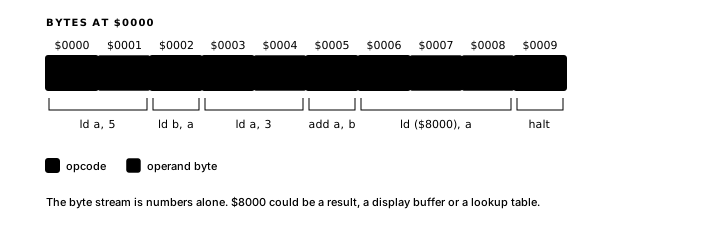
Here is a complete Z80 program written entirely as bytes, placed in memory starting at address $0000.
$0000:  3E 05        ; LD A, 5         - load 5 into A
$0002:  47           ; LD B, A         - copy A into B; B now holds 5, A holds 5
$0003:  3E 03        ; LD A, 3         - load 3 into A; B still holds 5
$0005:  80           ; ADD A, B        - A = A + B = 3 + 5 = 8
$0006:  32 00 80     ; LD ($8000), A   - store A at address $8000
$0009:  76           ; HALT
Stepping Through It
The CPU starts with PC = $0000.
PC = $0000: The byte there is $3E. The Z80 recognises this as a two-byte instruction: "load the next byte into A." It reads the following byte, $05 and loads 5 into A. PC advances to $0002.
PC = $0002: The byte is $47: "copy A into B." One byte, opcode only. B becomes 5; A remains 5. PC advances to $0003.
PC = $0003: $3E $03 loads 3 into A. B is unchanged and still holds 5. PC advances to $0005.
PC = $0005: $80 adds B to A. The Z80 adds the contents of B (5) to the contents of A (3) and puts the result (8) into A. The flags register is updated: Zero is clear (8 ≠ 0), Carry is clear (8 < 256), Sign is clear (bit 7 of 8 is 0). PC advances to $0006.
PC = $0006: $32 $00 $80 stores A at a 16-bit address. The opcode $32 is followed by two address bytes: $00 (low) and $80 (high), giving address $8000. The value 8 is written to memory location $8000. PC advances to $0009.
PC = $0009: $76 is HALT. Normal instruction execution stops until an interrupt or reset. Address $8000 now contains $08.
The Cost of Raw Machine Code
The program above was ten bytes. Real programs are thousands. Every address is a bare number. $8000 could be a result variable, a display buffer or a lookup table, and the byte stream records only the number. Inserting one instruction may shift downstream addresses; a missed manual update sends the program to the wrong address, and it runs on from there. You learn what 3E 05 47 3E 03 80 32 00 80 76 does by decoding it one byte at a time.
Machine code contains jumps, calls, loops and conditionals; in raw bytes each one is an address you calculate by hand and an instruction pattern you recognise by eye.
Variables and Labels
From the CPU's point of view, a variable is just a byte (or several bytes) of memory at some address. The only way to refer to it is by its numeric address.
In the program above, the result was written to the fixed address $8000. But $8000 is embedded as raw bytes in the instruction at $0006. If you later decide the result should live at $8100 instead, you must find that instruction and change bytes $07 and $08 by hand. If you have fifty instructions referencing the same address, you change fifty places.
Assembly solves this with labels. A label is a name that the assembler associates with a particular address at assembly time. Everywhere you write the label, the assembler substitutes the correct address automatically. If the variable moves, you update the label's definition and every reference updates with it.
In a Z80 assembler a label definition looks like this:
Result:          ; the assembler records "Result" as the current address
.db 0 ; allocate one byte at this address, initial value 0(.db stands for "define byte". .dw defines a 16-bit word.) From this point on, writing ld (Result), a in the code is equivalent to writing ld ($8000), a, with the assembler supplying the address.
Labels also name positions within the code, the targets of jumps and branches. Instead of writing jp $0034, you write jp loop_top and the assembler works out the address of loop_top itself.
Assembly language gives these byte patterns instruction names and replaces manually calculated addresses with labels. The next chapter rewrites this program in AZM so you can compare the source with the bytes it produces.
Exercise
Decode a byte stream. Decoding this program should place each instruction beside its starting address:
3E 12 47 3E 05 80 32 10 80 76The completed trace should also give the final values in A and B and the byte stored at $8010.