Appendix 1 — Directive Reference
The table lists AZM directives and declaration keywords. Dotted directives use canonical lowercase forms and are case-sensitive. See Chapter 7 for the alias layer that normalises legacy undotted forms.
| Directive | Syntax | What it does | Ch. |
|---|---|---|---|
.org | .org expr | Sets the assembly address counter to expr; assembly-time only | 3 |
.equ | NAME .equ expr | Binds NAME to the constant value of expr; assembly-time only | 3 |
.if | .if expr | Assembles the following branch when expr is non-zero | 3 |
.else | .else | Selects the alternate branch of a conditional block | 3 |
.endif | .endif | Closes a conditional block | 3 |
.db | .db expr[,expr…] | Emits one or more 8-bit values; accepts string literals | 4 |
.dw | .dw expr[,expr…] | Emits one or more 16-bit little-endian values | 4 |
.ds | .ds count[,fill] | Reserves count bytes; optional fill byte; accepts type expressions | 4, 5 |
.include | .include "path" | Inserts the named source file at this point | 7 |
.import | .import "path" | Loads a source unit and exposes declarations marked with @ | 7 |
.routine | .routine [noreturn] [in ...] [out ...] [maybe-out ...] [clobbers ...] [preserves ...] | Starts a routine and declares its register contract | 6 |
.contracts | `.contracts strict | audit | off` |
.rcignore | .rcignore finding "reason" | Suppresses one local finding with required reason text | 6 |
.expectout | .expectout carriers | Marks outputs intentionally consumed from the next emitted instruction in the same file | 6 |
.align | .align n | Advances the address to the next multiple of n, inserting zero bytes | 3 |
.cstr | .cstr "text" | Emits string bytes followed by a $00 terminator (C-style) | 4 |
.pstr | .pstr "text" | Emits a length byte followed by string bytes (Pascal-style) | 4 |
.istr | .istr "text" | Emits string bytes with bit 7 set on the final byte | 4 |
.binfrom | .binfrom addr | Marks the start address of the flat binary output range | 3 |
.binto | .binto addr | Marks the end address of the flat binary output range | 3 |
.end | .end | Marks the end of source; AZM stops assembling at this point | — |
.type | Name .type … .endtype | Opens a record layout declaration block | 5 |
.endtype | .endtype | Closes a .type block | 5 |
.union | Name .union … .endunion | Opens a union layout declaration block | 5 |
.endunion | .endunion | Closes a .union block | 5 |
.field | name .field TypeExpr | Declares a field of any type inside a .type or .union block | 5 |
.byte | name .byte | Declares a one-byte scalar field inside a .type or .union block | 5 |
.word | name .word | Declares a two-byte scalar field inside a .type or .union block | 5 |
.addr | name .addr | Declares a two-byte address field inside a .type or .union block | 5 |
.typealias | Name .typealias TypeExpr | Transparent assembler-time alias for a layout type expression | 5 |
.enum | Name .enum Member[,…] | Declares a group of integer constants with qualified names (Name.Member) | 3 |
op / end | op name(params) … end | Declares an inline instruction-expansion op | 7 |
Directive aliases
Project-specific forms such as DEFB, DEFW and RMB require a project alias file loaded with --aliases. See Chapter 7.
Built-in aliases (normalized before parsing):
| Alias | Canonical |
|---|---|
ORG | .org |
EQU | .equ |
DB | .db |
DW | .dw |
DS | .ds |
INCLUDE | .include |
END | .end |
ALIGN | .align |
CSTR | .cstr |
PSTR | .pstr |
ISTR | .istr |
BINFROM | .binfrom |
BINTO | .binto |
Register contract carrier notation
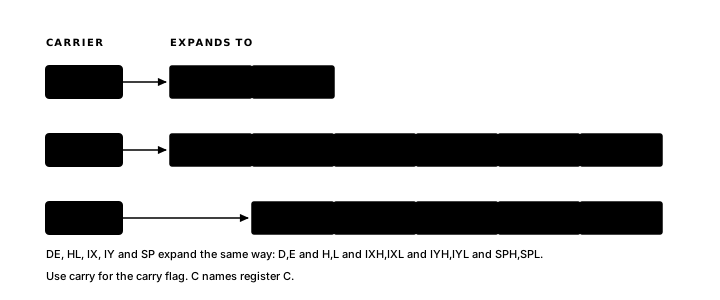
Carriers in a .routine directive are comma-separated register names, flag names or register pair names. Register pairs expand to their constituent 8-bit registers during analysis:
| Pair notation | Expands to |
|---|---|
BC | B,C |
DE | D,E |
HL | H,L |
IX | IXH,IXL |
IY | IYH,IYL |
SP | SPH,SPL |
AF | A,carry,zero,sign,parity,halfCarry |
F | carry,zero,sign,parity,halfCarry |
Individual flag names are carry, zero, sign, parity and halfCarry. C names register C. Chapter 6 describes the complete contract format.