Diagnostics and Output
AZM prints diagnostics before exiting. A successful assembly writes the enabled output artifacts and exits 0. An assembly error prevents successful program outputs such as .bin and .hex, although a requested register-contract report or source annotation may still be written to help resolve the failure.
Diagnostic format
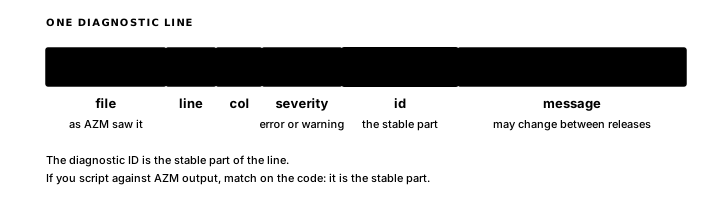
AZM prints diagnostics with file name, line number, column, severity and a diagnostic ID:
program.asm:14:5: error: [AZMN_SYMBOL] 8-bit value out of range: 300.
program.asm:23:1: error: [AZMN_SYMBOL] duplicate symbol: COUNT
program.asm:31:8: warning: [AZMN_REGISTER_CONTRACTS] CALL CHECK_FOO may modify D,E, but the pre-call value is used later.
The diagnostic ID (AZMN_PARSE, AZMN_SYMBOL and so on) is the stable matching key for scripts that consume AZM output; the message text is not stable.
Reading a failing build
A loop branches forward around a handler block. At 140 bytes between the jr and its target:
        .org $0100

ScanLoop:
        ld   a,(hl)
        cp   SENTINEL
        jr   nz,SkipHandler

        ; ... handler code, 140 bytes ...

SkipHandler:
        inc  hl
        djnz ScanLoop
Running azm scan.asm reports:
scan.asm:6:9: error: [AZMN_SYMBOL] jr nz target out of range for rel8 branch (140, expected -128..127).The column, 9, points at the jr nz rather than its operand.
A jr encodes a signed 8-bit offset: maximum forward reach is 127 bytes. The corresponding jp form carries a 16-bit target address:
jp nz,SkipHandler ; jp carries a 16-bit target addressWarnings vs errors
AZM exits 0 when assembly succeeds: no parse errors, no semantic errors, no range errors and no register contract errors in error or strict mode.
AZM exits 1 when assembly produces an error diagnostic:
- A parse error: the source line falls outside the grammar
- A semantic error: unknown symbol, duplicate symbol, type error
- A range error: the value overflows the encoding slot
- A register contract error in
--rc erroror--rc strictmode Warnings, including register contract warnings in--rc warnmode, leave the exit code alone.
Invalid command-line arguments and uncaught artifact-writing failures exit 2 and print the command usage. Source-reading failures are reported as source diagnostics and exit 1.
Output formats
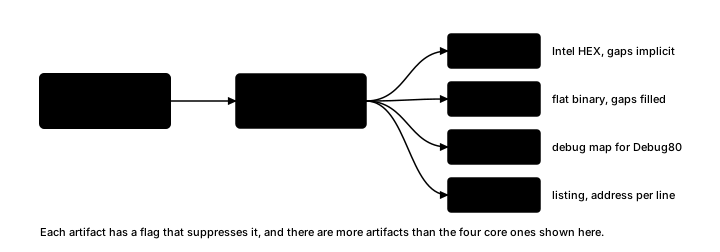
A single assembly run can produce several output files. By default, all use the source file's base path. --output selects a new base path for every enabled artifact. Its extension must match the primary --type.
Flat binary (.bin)
The flat binary contains the assembled bytes in address order. The file starts at the lowest assembled address and runs to the last assembled byte.
azm --type bin program.asm
azm --type bin --output build/program.bin program.asm
When two .org directives have a gap between them, the binary fills the gap with zero bytes. .binfrom and .binto trim the binary to a relevant range:
        .binfrom $0100
        ; ... code ...
        .binto $0200
An unfilled .ds block at the very end of a source file leaves the binary as long as the last byte written. A .ds count,fill block writes the fill byte and extends it.
Intel HEX (.hex)
Intel HEX records contain the same bytes as the binary, organized as text records with address fields and checksums. HEX is the standard format for serial bootloaders, EPROM programmers and most Z80 development boards.
azm --type hex program.asmHEX represents gaps by emitting records only for address ranges that contain assembled bytes. The default primary output type is hex.
Debug80 map (.d8.json)
The .d8.json file is a JSON metadata file that Debug80 reads to correlate binary addresses with source lines. It records source paths, address ranges, listing rows and symbols. The producer/consumer format is documented in the Debug80 source map format reference.
azm --source-root . --output build/program.hex src/program.asmWith --source-root, file paths in the map are written relative to the given root, making the map portable across machines. The --nod8m option suppresses the map when Debug80 is not in use.
Assembler listing (.lst)
The listing shows every source line next to its assembled address and bytes in asm80 layout.
                            .org $8000

                    COUNT   .equ 3

                    main:
8000   06 03                ld   b,COUNT        ; loop counter
                    loop:
8002   78                   ld   a,b
8003   D3 01                out  ($01),a
8005   10 FB                djnz loop
8007   76                   halt

                    message:
8008   48 45 4C 4C 4F 00          .db  "HELLO",0
                    buffer:
800E                        .ds  4

COUNT       0003
buffer      800E
loop        8002
main        8000
message     8008
In each row, the four hex digits on the left are the address, followed by the emitted machine-code bytes and the source line. Lines that emit no bytes (blank lines, comments, .equ definitions and labels on their own line) have an empty gutter. An unfilled .ds reservation also has an empty gutter and prints its address alone. A line that emits more than eight bytes wraps: the first eight appear beside the source text, and the remaining bytes continue on address-and-bytes rows with a blank source column.
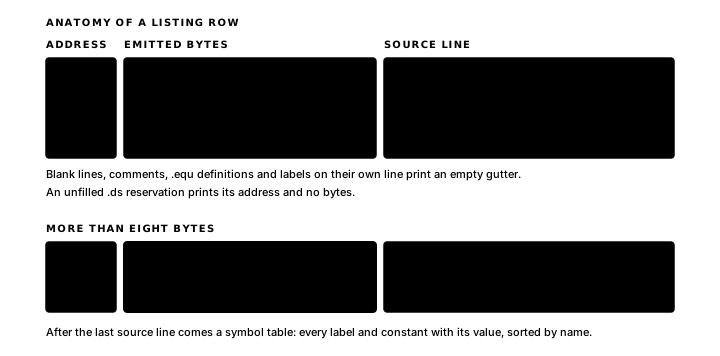
Included and imported files are listed inline at their inclusion point, so the listing reads in the same order the assembler consumed the program. After the last source line comes a symbol table: every label and constant with its value, sorted by name.
The listing is written by default. The --nolst option suppresses it.
Suppression flags
Any artifact can be suppressed independently:
azm --nod8m               # no .d8.json
azm --nobin               # no .bin
azm --nohex               # no .hex
azm --nolst               # no .lst
Example (binary only):
azm --type bin --nohex --nod8m --output out.bin program.asmRegister contract artifacts
Register contracts are normally read through compiler diagnostics from --rc warn, --rc error and --rc strict. The artifact flags below run the analysis independently, so they work at the default --rc off. The exception is --reg-report, which needs at least --rc audit before the report has any routines to list:
.regcontracts.txt (register contract report):
azm --rc audit --reg-report program.asmWrites program.regcontracts.txt, listing declared routines with inferred inputs, outputs, clobbers and findings. The --reg-report-format json option supplies structured findings to other tools:
azm --rc audit --reg-report --reg-report-format json program.asmJSON reports can be used as baselines:
azm --rc audit --reg-baseline baseline.regcontracts.json --reg-ratchet program.asmRatchet mode fails when current register-contract findings are new or changed relative to the baseline.
.asmi (inferred register contract interface):
azm --rc audit --reg-interface program.asmWrites program.asmi with inferred extern contract records. Other projects that call into the code can load this file with --interface.
Lowered ASM80 source (.z80)
azm --asm80 program.asmThis writes a .z80 file with AZM-specific features translated to plain ASM80 syntax. The output can be compared byte for byte with ASM80 output or shared with an ASM80 user.
ASM80-compatible lowered output does not support .import. Using --asm80 with a program that imports source produces an AZMN_ASM80 diagnostic and keeps the import boundary intact.