Arrays and Loops
Chapter 1 kept every value in registers. Sorting and searching need indexed storage: many bytes in a row, one element selected by offset. The complete program in examples/02_insertion_sort.asm sorts eight bytes, then searches the result.
Sorting and searching one table
The example starts with eight scores in RAM in arbitrary order. Displaying them requires ascending order, followed by the index of the first score that is at least 5.
The same representation supports two algorithms:
- Insertion sort: build a sorted prefix; insert each new element into its place.
- Linear search: walk from index 0 until
values[i] >= thresholdor you run out.
Array representation
A byte array is a label, a length and consecutive bytes in memory:
.org $8000
values:
    .db 9, 4, 6, 2, 8, 1, 7, 3
ARRAY_LEN .equ $ - values
values is the base address, the address of values[0], not the first element's numeric value. $ is the current assembly address, so $ - values is the number of bytes the .db line just emitted. Writing ARRAY_LEN .equ 8 instead would mean counting the initialisers by eye and recounting them after every edit.
Layout types provide self-documenting sizes when an array needs uninitialized storage (Book 1 Chapter 5):
values:
    .ds byte[8]
The sort example uses .db with initial data, making the original unsorted order visible before execution reaches halt.
Indexing with HL
Reading values[i] when i fits in one byte takes four steps:
- The base address goes into HL, or into DE when HL is already in use.
- BC holds offset
i, with B = 0 and C = i. add hl, bcadvances HL to element i.ld a, (hl)loads the element into A.
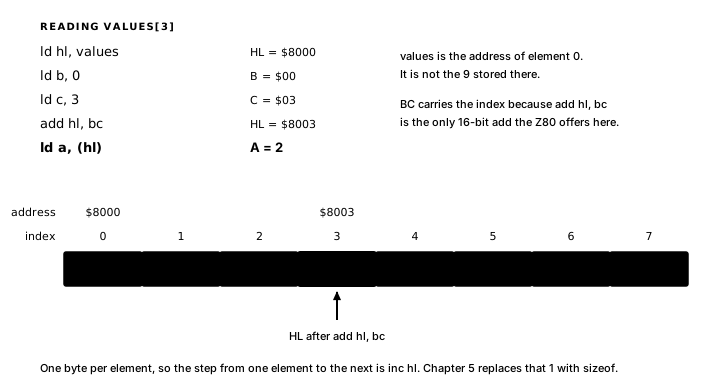
For sequential scans, inc hl after each read is cheaper than recomputing base + i.
Loop invariants
An invariant is a statement that stays true every time control reaches a particular label.
Insertion sort outer loop (label _outer, index in C):
Before each outer iteration, bytes
values[0 .. c-1]are sorted ascending.
Inner shift loop (label _inner, next candidate derived from sort_j):
The key byte sits in
key_byte.sort_jis one greater than the next index to inspect. Elements already passed on the right have been shifted one place, while the untouched prefix remains sorted.
Linear search (label _scan):
If the loop has run k times, every element among
values[0 .. k-1]is belowthreshold.
Insertion sort
Pseudocode:
for i from 1 to length-1:
    key = values[i]
    j = i - 1
    while j >= 0 and values[j] > key:
        values[j+1] = values[j]
        j = j - 1
    values[j+1] = key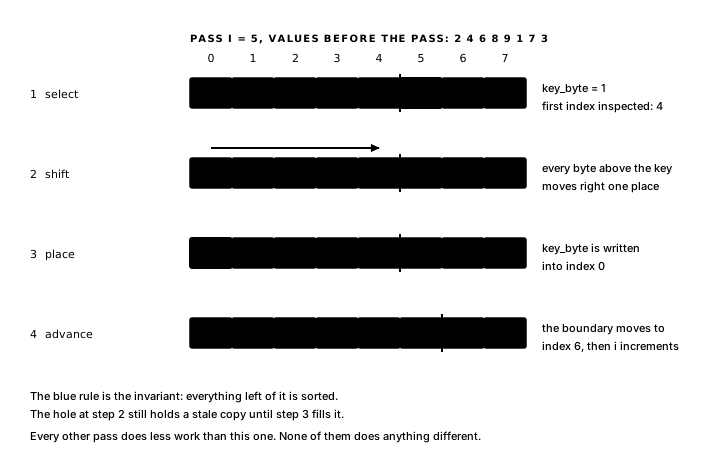
Keeping the base in DE
Keeping only HL would discard the base address. DE holds the base for the whole routine; HL is recomputed from DE and the current index.
Length arrives in B, but the inner loops also need B, so the routine stores the length in workspace. Its scratch bytes follow the table in the same .org $8000 block. AZM maintains a forward-only placement cursor for each segment, so a later data .org places bytes at the cursor and leaves the earlier ones where they are:
found_index:
    .ds byte
key_byte:
    .ds byte
sort_index:
    .ds byte
sort_j:
    .ds byte
sort_len:
    .ds byte
Entry (B reaches memory through (hl), since ld (nn), a is the Z80's only absolute byte store):
insertion_sort:
    push hl
    pop de
    ld hl, sort_len
    ld (hl), b
    ld c, 1
Copying HL into DE takes two instructions: push hl / pop de here, or ld d, h / ld e, l.
Loading the key
    ld a, c
    ld (sort_index), a
    push de
    pop hl
    ld b, 0
    add hl, bc          ; HL = base + i (C = i)
    ld a, (hl)
    push af
    ld hl, key_byte
    pop af
    ld (hl), a
    ld a, c
    ld (sort_j), a
Inner shift
The inner loop compares values[j] with key_byte. An element greater than the key moves right by one index:
_inner:
    ld a, (sort_j)
    dec a
    ld (sort_j), a
    cp $FF
    jr z, _place
    push de
    pop hl
    ld c, a
    ld b, 0
    add hl, bc          ; HL = &values[j]
    push hl
    ld hl, key_byte
    ld a, (hl)
    pop hl
    cp (hl)
    jr nc, _place
    ld a, (hl)
    inc hl
    ld (hl), a
    jr _inner
Placing the key
sort_j preserves j while B and C form a 16-bit table offset. When j < 0 or values[j] <= key, write key_byte at values[j+1]. sort_index then restores the outer-loop index after C has been reused for address arithmetic.
The complete implementation is in examples/02_insertion_sort.asm.
After halt, memory at $8000 should read:
01 02 03 04 06 07 08 09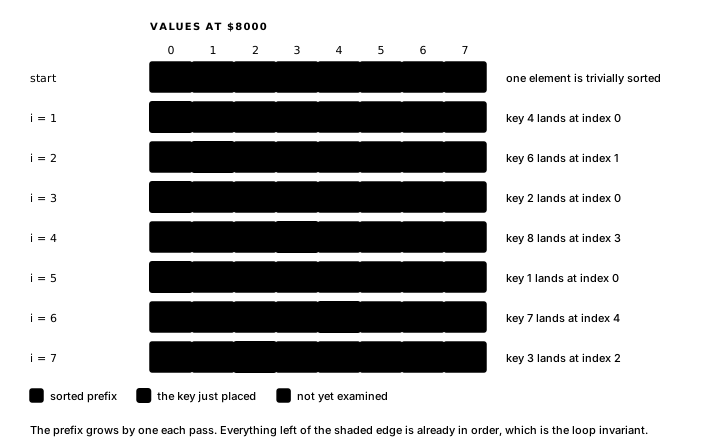
Linear search
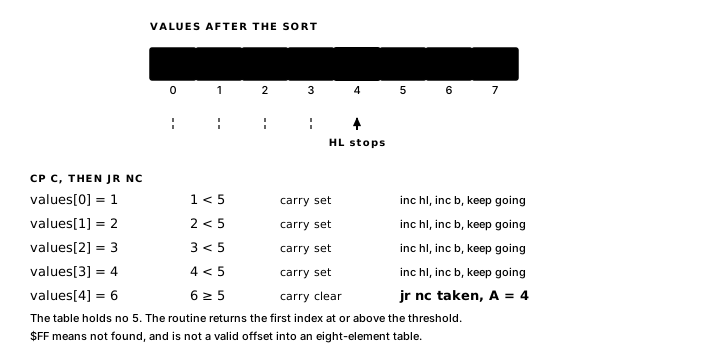
After sorting, find the first index where values[i] >= C:
; find_byte_ge: first index where values[i] >= C, or $FF if none
.routine in HL,C out A clobbers F,B,HL
find_byte_ge:
    ld b, 0
_scan:
    ld a, (hl)
    cp c
    jr nc, _found
    inc hl
    inc b
    ld a, b
    cp ARRAY_LEN
    jr c, _scan
    ld a, $FF
    ret
_found:
    ld a, b
    ret
cp c / jr nc uses the unsigned sense from Book 2: cp subtracts, so carry is set when A < C and clear when A ≥ C. jr nc therefore takes the branch on a match. $FF means not found: a sentinel chosen because an 8-element table only ever uses indices 0 to 7.
With threshold 5 on the sorted table (1, 2, 3, 4, 6, 7, 8, 9), the first element of at least 5 is the 6 at index 4. found_index at $8008 should hold $04.
main: orchestration
.org $0000
main:
    ld hl, values
    ld b, ARRAY_LEN
    call insertion_sort

    ld hl, values
    ld c, THRESHOLD
    call find_byte_ge
    ld (found_index), a
    halt
The second call reloads HL because the insertion_sort contract lists it as clobbered.
Layout types for record elements
This chapter uses plain .db because each element is one byte. When elements are records:
Score .type
value   .byte
name    .field byte[16]
.endtype

leaderboard:
    .ds Score[8]
Stride becomes sizeof(Score) and field offsets use offset(Score, value), the subject of Chapter 5.
Inspecting the sort
After examples/02_insertion_sort.asm reaches halt, values should be in ascending order and found_index should be 4 for threshold 5:
| File | What to verify |
|---|---|
examples/02_insertion_sort.asm | Sorted bytes at values, found_index = 4 for threshold 5 |
azm examples/02_insertion_sort.asmOne outer iteration in the emulator shows key_byte holding the selected value while the sorted prefix grows.
Exercise
Insertion-sort trace. A trace starting with 9, 4, 6, 2, 8, 1, 7, 3 should show the whole table after outer iterations i = 1, i = 2 and i = 3. Each row should identify the sorted prefix, followed by a statement of the outer-loop invariant.