Records
Chapter 2 indexed bytes in a table. A table of records packs several fields together, such as coordinates, queue indices and flags, with a stride larger than 1.
Field offsets kept only in comments can drift away from the data they describe. AZM's .type blocks define the representation once, and the algorithm uses offsets computed from that layout.
Layout types, which Book 1 Chapter 5 covers, drive field reads and writes through HL and IX. The example in examples/05_ring_buffer.asm uses them to build a ring buffer, a fixed-size FIFO queue over a byte table.
A queue that moves only its indices
A FIFO queue (first in, first out) needs:
- storage for N elements
- a write index (where the next push goes)
- a read index (where the next pop comes from)
- a count of how many elements are valid (or equivalent logic)
A ring buffer avoids shifting the whole table on every pop. Its fixed byte array stays in place while indices in workspace RAM move: push writes at head and advances, while pop reads at tail and advances. An index wraps to 0 when it reaches capacity.
Defining the layout once
A record is a packed field list inside .type / .endtype:
RingState .type
head    .byte
tail    .byte
count   .byte
.endtype
Field lines describe layout; storage comes from .ds, .db or .dw:
RING_CAP .equ 8

ring_buf:
    .ds RING_CAP

ring_state:
    .ds RingState
ring_state reserves sizeof(RingState) bytes: three bytes for head, tail and count in order. .ds RING_CAP and .ds byte[8] reserve the same eight bytes; the count inside [ ] must be a literal, so a named capacity goes in the plain form.
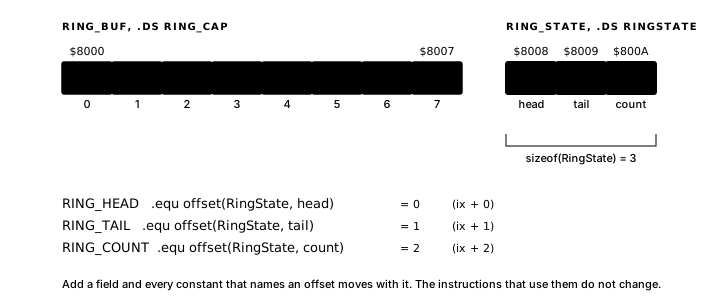
Named compile-time constants make field offsets usable in instructions:
RING_HEAD   .equ offset(RingState, head)
RING_TAIL   .equ offset(RingState, tail)
RING_COUNT  .equ offset(RingState, count)
STATE_SIZE  .equ sizeof(RingState)
Adding a field to RingState causes every .equ based on offset to update at the next assembly.
sizeof and .ds Type[n]
sizeof(Type) is the record's exact packed size in bytes. For scalars:
| Type | sizeof |
|---|---|
byte | 1 |
word | 2 |
addr | 2 |
For arrays in size positions, literal lengths multiply:
BUF_BYTES .equ sizeof(byte[8]) ; = 8If the capacity is a named constant, use the constant directly:
BUF_BYTES .equ RING_CAP.ds accepts a type expression wherever it needs a byte count:
ring_buf:
    .ds RING_CAP

ring_state:
    .ds RingState
The second reserves sizeof(RingState) bytes, whatever the field list currently sums to. With a literal length you can also write .ds byte[8]; that documents element width when capacity is fixed in source. Initialized data still uses .db / .dw; .ds only reserves space.
Labels stay untyped: ring_state is an address. A routine passes that address in a register and applies offset(RingState, field) constants at the access site, which is where the layout enters.
Reading and writing fields
HL plus offset
When HL points at the start of a RingState record:
  ld de, RING_COUNT
  add hl, de
  ld a, (hl)            ; A = count
For offsets 0–127, the constant fits in (ix + d) form, which is usually shorter.
IX-relative access
Loading the record base into IX once allows each field access to use a symbolic displacement:
  ld ix, ring_state
  ld a, (ix + RING_HEAD)
  ld (ix + RING_COUNT), a
Each displacement is whatever offset computes from the current field list, so reordering RingState changes the generated displacements while this code stays as written.
Run-time index into the byte table
head and tail are dynamic indices (0 .. RING_CAP−1). The address of ring_buf[head] is formed at runtime:
  ld a, (ix + RING_HEAD)
  ld hl, ring_buf
  ld b, 0
  ld c, a
  add hl, bc            ; HL = ring_buf + head
  ld a, e               ; byte to store (saved in E)
  ld (hl), a
Runtime indices require instructions such as add hl, bc; AZM evaluates layout arithmetic at assembly time.
Layout casts for constant addresses
When the index and field path are known at assembly time, a layout cast folds the address into one expression:
ld hl, <RingState>ring_state.countParts:
<RingState>: layout to applyring_state: base label.count: field path
The assembler computes ring_state + offset(RingState, count) and emits ld hl, imm16.
For an array of records with a constant index:
ld hl, <byte[8]>ring_buf[3]That is ring_buf + 3 when the element type is byte. For a table of structures:
ld hl, <Sprite[16]>sprite_table[2].flagsexpands to sprite_table + 2 * sizeof(Sprite) + offset(Sprite, flags).
The bracketed index must be an assembly-time literal, so a register there is an error:
ld hl, <byte[8]>ring_buf[hl] ; error: HL is not a constantLayout casts suit call sites with fixed indices, including initialization, debug checks and table-driven dispatch with .equ indices. HL/BC arithmetic is required when a push or pop keeps the index in a register.
The long form and the cast must agree:
  ld hl, ring_state + offset(RingState, count)
  ld hl, <RingState>ring_state.count
Ring buffer structure
The ring buffer keeps data in its byte array and control in the indices and count:
RingState .type
head    .byte       ; next write index
tail    .byte       ; next read index
count   .byte       ; bytes currently stored
.endtype

ring_buf:
    .ds RING_CAP

ring_state:
    .ds RingState
Invariants:
0 <= count <= RING_CAPheadandtailare each in0 .. RING_CAP - 1- the oldest byte is at
ring_buf[tail]whencount > 0 - the next free slot for push is
ring_buf[head]whencount < RING_CAP
When count == RING_CAP, push returns with carry clear. When count == 0, pop returns with carry clear.
Memory diagram
After pushing $11, $22, $33 and then popping all three, the buffer may still hold those bytes in RAM, but count is 0 and the logical queue is empty:
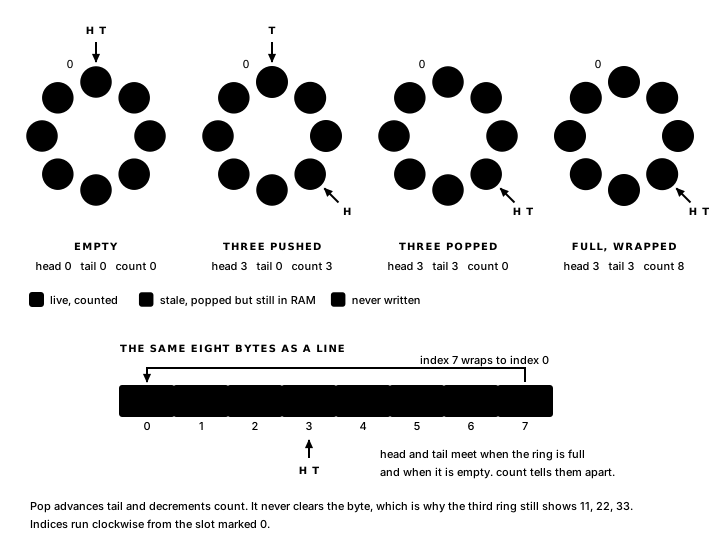
When head or tail would become RING_CAP, the index wraps to 0:
ring_advance_index:
    inc a
    cp RING_CAP
    ret c                 ; still in range
    xor a                 ; wrap to 0
    ret
When RING_CAP is a power of two (8, 16, 32, …), and RING_CAP - 1 after inc a can replace cp / xor, reducing the wrap to one instruction. The compare form works for any capacity and is what the example uses.
ring_push and ring_pop
Push
; ring_push: append one byte; carry set on success, carry clear when full
.routine in A,IX out carry clobbers A,zero,sign,parity,halfCarry,BC,DE,HL
ring_push:
    ld e, a
    ld a, (ix + RING_COUNT)
    cp RING_CAP
    jr nc, _full
    ld a, (ix + RING_HEAD)
    ld hl, ring_buf
    ld b, 0
    ld c, a
    add hl, bc
    ld a, e
    ld (hl), a
    ld a, (ix + RING_HEAD)
    call ring_advance_index
    ld (ix + RING_HEAD), a
    ld a, (ix + RING_COUNT)
    inc a
    ld (ix + RING_COUNT), a
    scf
    ret
_full:
    or a
    ret
The carry flag reports whether the byte was pushed.
Pop
; ring_pop: remove oldest byte; carry set on success, carry clear when empty
.routine in IX out A,carry clobbers zero,sign,parity,halfCarry,BC,DE,HL
ring_pop:
    ld a, (ix + RING_COUNT)
    or a
    jr z, _empty
    ld a, (ix + RING_TAIL)
    ld hl, ring_buf
    ld b, 0
    ld c, a
    add hl, bc
    ld e, (hl)
    ld a, (ix + RING_TAIL)
    call ring_advance_index
    ld (ix + RING_TAIL), a
    ld a, (ix + RING_COUNT)
    dec a
    ld (ix + RING_COUNT), a
    ld a, e
    scf
    ret
_empty:
    or a
    ret
FIFO order: bytes leave in the same order they arrived because tail chases head around the ring.
Register contracts on routines
Book 1 Chapter 6 covers the .routine directive and register contracts.
| Tag | Meaning |
|---|---|
.routine in | Registers the caller must set before call |
.routine out | Registers and flags that carry meaningful values across returning exits |
.routine clobbers | Registers the routine destroys |
The .routine directive appears immediately before the callable entry. @name: is reserved for symbols exported from a source unit; call sites use the plain symbol name, such as call ring_push.
For ring_push and ring_pop, the human ; line states the meaning of success and failure, while .routine out names the carrier as carry. The shown ring_pop returns A = 0 on its empty path, but carry still determines whether A contains a popped byte.
The register-contract checker provides machine verification:
azm --rc warn examples/05_ring_buffer.asmmain: test sequence
The example runs this sequence:
- Clears
ring_statethrough IX. - Pushes
$11,$22,$33, then pops three times (FIFO). - Stores the last pop in
pop_result(expect$33). - Pushes eight more bytes to fill the ring, then attempts a ninth push with
$CC. - Stores
push_ok= 0 if that push failed (carry clear), 1 if it incorrectly succeeded.
After halt, the expected values are:
| Label | Address | Expected |
|---|---|---|
pop_result | $800B | $33 |
push_ok | $800C | $00 (ring full) |
ring_state.count | $800A | $08 |
Records inside records
When a field is itself a layout, .field embeds it:
Pos .type
x       .byte
y       .byte
.endtype

Actor .type
tile    .byte
pos     .field Pos
.endtype

POS_X .equ offset(Actor, pos.x)
Nested paths work in offset and in layout casts: <Actor>player.pos.x. For an array inside a record, combine the array field offset, element stride and element field offset:
offset(Scene, sprites) + 2 * sizeof(Sprite) + offset(Sprite, color)In current AZM an offset path names fields, so an index into a record array belongs in the arithmetic above.
Unions (.union / .endunion) share the same offset rules; the union's size is the largest member.
Inspecting the queue state
| File | What to verify |
|---|---|
examples/05_ring_buffer.asm | FIFO pop $33, push_ok = 0 on full ring |
azm examples/05_ring_buffer.asm
azm --rc warn examples/05_ring_buffer.asm
A single-step trace of ring_push shows head and count changing through (ix + RING_HEAD) while HL targets the corresponding cell in ring_buf.
Exercise
Layout arithmetic. The written calculation should give sizeof(RingState) and the offsets of head, tail and count. A second calculation with flags .byte after count should give the new size and offsets for comparison with the listing.