Source Composition
Every algorithm so far has fitted in one .asm file. Book 1 Chapter 7 explains AZM's source-composition mechanisms: textual .include and module-style .import with explicit @ exports. This chapter applies that material by moving the Chapter 3 string walk into a library while the application retains control of code and data placement. The two-file build is examples/07_include_demo.asm with examples/lib/strings.asm.
Splitting an algorithm library
Chapter 3's strlen_u8 is twenty lines. Once copy, compare, ring-buffer helpers and Chapter 1's GCD join it, the listing becomes difficult to navigate and reusing the string walk means copying it into the next program.
The growing program needs two forms of structure:
- Physical split: edit strings in one file, main flow in another.
- Logical contract: callers still know which registers to set before
call.
The example uses .include for the physical split and register contracts for the shared routine interface.
The example's include boundary
The directive:
.include "lib/strings.asm"treats lib/strings.asm as source at that exact line.
Paths resolve relative to the file that contains the .include, then through any directories supplied with -I. In the example tree, 07_include_demo.asm lives in examples/ and includes lib/strings.asm:
book3/examples/
  07_include_demo.asm
  lib/
    strings.asm
From the book3/ directory:
azm examples/07_include_demo.asmThe include still resolves relative to 07_include_demo.asm, not to the shell's working directory.
Placement in one assembly unit
The two physical files still form a single program: one address space, one set of global labels and one coordinated .org sequence.
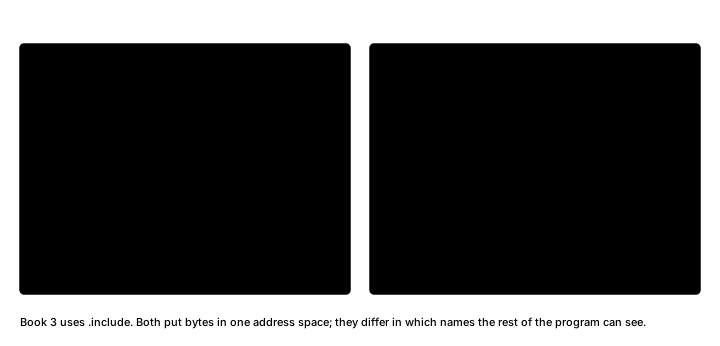
Typical layout:
| File | Holds |
|---|---|
main.asm (or 07_include_demo.asm) | main, halt, RAM labels, .org for data |
lib/strings.asm | Subroutines only; main and .org stay in the application file |
constants.asm (optional) | .equ shared by several includes |
The .include directive determines where the library code lands. It often appears after main and before data or at the bottom of the code section. Forward references allow call strlen_u8 in main even when the .include line appears later.
Consequences for the library
- Non-local declarations join the including source unit, while
_namelabels remain local to their nearest non-local owner. - Register contracts still live in
.routinedirectives on callable entries. - Recursive include/import chains are rejected with a source diagnostic. Keep the include graph acyclic by pointing every edge the same way: the application includes libraries.
The string library
The included implementation begins with a header comment that states the calling convention. The library contains Chapter 3's length walk:
; strlen_u8: count bytes before null (terminator not counted)
.routine in HL out A clobbers F,B,HL
strlen_u8:
    ld b, 0
_loop:
    ld a, (hl)
    or a
    jr z, _done
    inc hl
    inc b
    jr _loop
_done:
    ld a, b
    ret
Four rules define this library's boundary:
- Subroutines only, plus any private helpers (
ring_advance_indexstyle);mainandhaltlive in the application file. - Placement stays with the application. A library uses
.orgonly to pin code at a fixed address, which Book 3 rarely needs. - Every shared routine gets a register contract, following Book 1 Chapter 6 and Book 3 Chapters 1 to 3.
- Routine entries have
.routinedirectives. Prefix a label with@only when the library exports it for.import.
The application keeps main, placement and storage:
DemoData .type
message  .field byte[8]
str_len  .byte
.endtype

DEMO_BASE .equ $8000

.org $0000
main:
    ld hl, message
    call strlen_u8
    ld (str_len), a
    halt

.include "lib/strings.asm"

.org DEMO_BASE
message:
    .db "HELLO", 0

.org DEMO_BASE + offset(DemoData, str_len)
str_len:
    .ds byte
The message text is six bytes but the field reserves eight, so str_len keeps its address when the message changes. offset(DemoData, str_len) is where that decision lives; a second .org $8008 would be the same number written down a second time, free to drift when the field widens.
Adding more string walks
The same lib/strings.asm can also contain Chapter 3's strcpy_u8, strcmp_u8 and str_find_char. Programs then include one library path instead of duplicating each walk.
Optional constants header: if several files need CHAR_L or RING_CAP, a tiny lib/strings.equ (or constants.asm) that only contains .equ lines can be included from both the app and the library.
Register contracts across files
With .include, each shared routine still has the same callable interface it had in one file:
| Mechanism | What it guarantees |
|---|---|
.routine in / .routine out / .routine clobbers | Register roles at call and ret |
.routine immediately before a label | Analyzer entry point for --rc warn |
| Prefix on globals | str_ on string routines, ring_ on buffer helpers — reduces label collisions |
.equ in one included header | Single source for buffer size and field offsets |
Comment block at top of lib/*.asm | Human-readable summary: "String convention: HL pointer, A length" |
For strlen_u8, HL receives the input, call enters the routine, A carries the result and every register in clobbers is treated as destroyed unless the caller preserved it.
Private helpers use ordinary non-local names when several routines in the source unit call them.
Symbol collisions
Because included text shares one source-unit namespace, a non-local label such as buffer or count may be defined once across all the included files. The usual remedies are:
- Workspace labels can carry a prefix:
demo_buffer,demo_str_len. - Library routines can carry a prefix such as
str_strlen_u8if two included libraries both definestrlen_u8. A rename also requires updates to register contracts and everycallsite. - Owner-local branch labels such as
_loopand_foundlet another routine reuse those spellings under its own owner.
When AZM reports a duplicate label, the conflicting declarations across the .include branches need distinct non-local names.
A separate boundary for external code
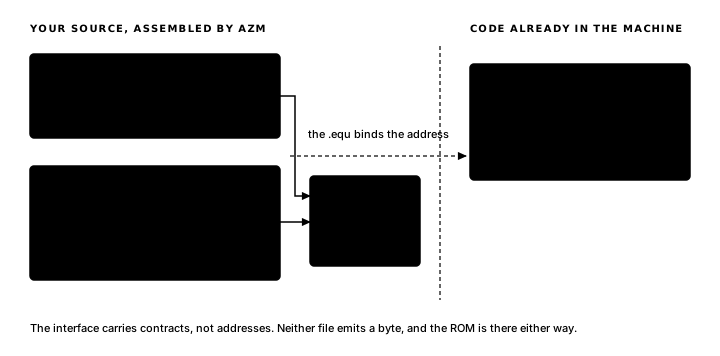
The string routines contribute bytes to the current ROM image. Monitor ROM, BIOS and emulator stubs already exist at fixed addresses, so an .asmi interface supplies their register contracts to --rc warn.
Book 1 Chapter 6 covers .asmi files, which contain contract records alone:
extern MON_PRINT_CHAR
in A
clobbers A
end

extern MON_GET_KEY
out A
out zero
clobbers carry
end
The interface is loaded during assembly:
azm --interface monitor.asmi --rc warn main.asmThe program calls MON_PRINT_CHAR like any other label. The analyzer reports a value kept live in A across a call whose contract says clobbers A. A platform-manual change updates the .asmi; call sites continue to use the same symbol.
The interface supplies contracts; the addresses come from the platform manual as .equ bindings:
MON_PRINT_CHAR .equ $0010
MON_GET_KEY    .equ $0018
Those sample addresses are placeholders. A real program uses the entry points documented by its target monitor.
The two mechanisms carry different material into the build:
| Feature | .include "lib.asm" | .asmi + extern |
|---|---|---|
| Delivers | Source pasted into your program | Contracts only |
| Code in output | Yes, your bytes | No, you supply the address binding separately |
| Typical use | Your reusable subroutines | ROM / monitor / third-party binary |
Address space after halt
The include expands before anything is placed, so the library's bytes sit at the point its .include line appeared and the call to it is an ordinary address:
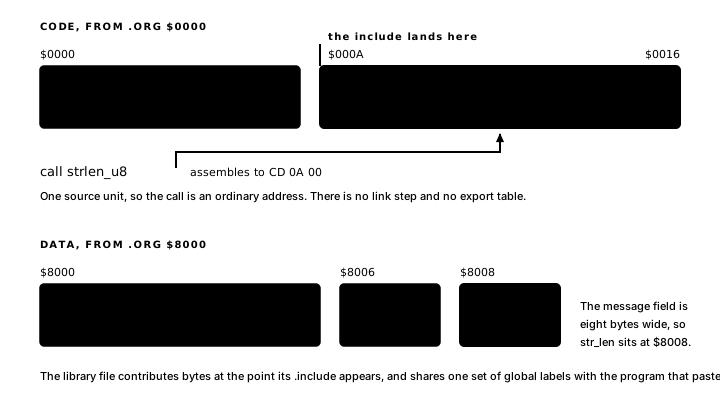
The RAM state matches Chapter 3's single-file demo, now produced from two source files.
Building the two-file example
| File | Role |
|---|---|
examples/07_include_demo.asm | main + .include + data/results |
examples/lib/strings.asm | Shared strlen_u8 with register contracts |
azm examples/07_include_demo.asm
azm --rc warn examples/07_include_demo.asm
A trace through strlen_u8 shows the library labels at the include point in the listing and leaves str_len equal to 5 at $8008.
Exercise
Include graph and placement. An include graph should show main.asm including constants.asm, lib/strings.asm and lib/ring.asm once each. It should mark the source position at which each library emits bytes and identify the edge that would create a cycle if ring.asm included main.asm.