Register Contracts
A loop can hold its counter in B and call a subroutine before djnz decrements that counter. If the subroutine overwrites B, djnz reads the changed value. The resulting binary assembles successfully but runs the wrong number of iterations.
The caller and callee have a register collision. AZM's register contracts detect such collisions at assemble time by making register use between routines explicit and machine-checkable. Analysis requires routine boundaries, register effects and external calls in a form the assembler can prove.
The .routine directive makes each analysis boundary explicit and records the routine's inputs, outputs, clobbers and preserved carriers.
A concrete collision
B is the iteration counter; HL points to the current tile in memory:
ScanTiles:
        ld      b,8
ScanLoop:
        ld      a,(hl)
        call    RenderTile
        inc     hl
        djnz    ScanLoop
        ret
RenderTile draws one tile. Inside, it uses B as a row counter:
RenderTile:
        ld      b,8
_row:
        ; ... draw one row of tile A ...
        djnz    _row
        ret
After RenderTile returns, B is 0. The outer djnz wraps it to 255 and branches, but the next call resets B to 8 and again returns with it at 0. The outer loop runs forever.
Terms
caller: the code that executes call NAME. In the example above, ScanTiles is the caller of RenderTile.
callee: the subroutine named by that call. RenderTile is the callee.
clobber: to overwrite a register value the caller still needed. RenderTile clobbers B because ScanTiles reads B after the call returns.
preserves: a register exits with the same value it had on entry. Pushing on entry and popping on exit is one way to preserve a register; not writing the register at all is another.
live: a register is live at a point in the code if its value will be read before the next write to it. B is live at the call RenderTile because djnz reads B after the call returns.
The contract that exposes the clobber
A contract above RenderTile makes the clobber explicit:
.routine clobbers B
RenderTile:
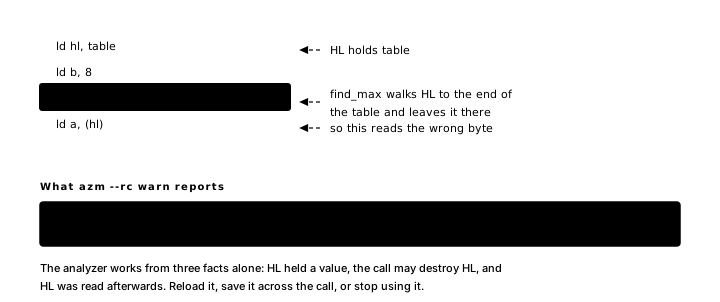
With this contract in place and register contracts enabled, AZM inspects every call to RenderTile. At the call in ScanTiles, B holds the loop counter, a value the caller reads after the call returns. AZM reports the conflict:
scan.asm:7:9: warning: [AZMN_REGISTER_CONTRACTS] CALL RenderTile may modify B, but the pre-call value is used later.Repair options
The collision has three repair options.
Option 1: save and restore in the caller
ScanTiles:
        ld      b,8
ScanLoop:
        ld      a,(hl)
        push    bc          ; save B before the call
        call    RenderTile
        pop     bc          ; restore B
        inc     hl
        djnz    ScanLoop
        ret
Option 2: have the callee preserve B
.routine preserves B
RenderTile:
        push    bc
        ld      b,8
_row:
        ; ... draw one row of tile A ...
        djnz    _row
        pop     bc
        ret
Option 3: restructure so each value has a register of its own
The collision disappears if B moves to RAM or one of the routines uses a different register.
Routine boundaries: .routine
Register contract analysis proves facts inside routine regions. A .routine directive before the entry label establishes the region:
.routine clobbers A,B
RenderTile:
        ; ... body ...
        ret
Callers write call RenderTile. The directive is pure declaration; the emitted bytes and the label's visibility come from the code alone.
.routineapplies to the next non-local label and starts its body- The next
.routinecloses the current body and starts another - Consecutive non-local labels before the first instruction are aliases for one routine
- A later non-local label closes the routine and begins ordinary code or data
Leading-underscore labels identify branches owned by the routine:
.routine in HL clobbers B
ScanRow:
        ld      b,8
_bitLoop:
        rl      (hl)
        inc     hl
        djnz    _bitLoop
        ret
Another routine may also declare _bitLoop; AZM gives each declaration a distinct owner-qualified identity in debug metadata.
Export is independent from routine analysis:
.routine in A out A clobbers F
@NormaliseByte:
        and     $7f
        ret
@NormaliseByte: exports NormaliseByte from an imported source unit. The same routine could use a plain NormaliseByte: label when it is only needed inside its source unit.
Owner-local branches must remain inside their routine. Direct JP, JP cc, JR and JR cc transfers to another declared routine are analyzed as tail calls. A call is appropriate when control returns to the caller; a tail jump applies when the callee returns directly to the original caller.
Enabling register contracts
Register contract analysis is controlled by --rc:
azm --rc off program.asm        # no register contract analysis
azm --rc audit program.asm      # analyze contracts without failing the build
azm --rc warn program.asm       # print warnings but still build
azm --rc error program.asm      # fail on proven conflicts
azm --rc strict program.asm     # fail on anything AZM cannot prove safe
The default mode is off. strict goes beyond error by requiring AZM to prove every call safe, so unknown routine boundaries and stack effects become failures.
During a Debug80 edit-and-restart loop, audit or warn reports contract findings while the build continues. strict is appropriate once the routine boundaries and external interfaces are in place.
Debug80's own Register Contracts dropdown offers three of these five: Off, Audit and Enforce, which is error. Reaching warn or strict from Debug80 means setting registerContracts in debug80.json. The dropdown overrides that value for any build started from the panel.
Source policy directives
.contracts changes policy for the source file that contains it:
.contracts auditAccepted modes are strict, audit and off. In a translation unit built from .include files, AZM applies the directive to routines and diagnostics owned by that included file, not only to the root entry file.
Project configuration can also assign policies with file globs; the most specific matching rule wins. A glob takes precedence over the .contracts directive, which takes precedence over --rc. Each physical file may contain only one .contracts directive. A mode other than off runs the analysis even when no --rc flag is given.
An .rcignore directive immediately before a finding suppresses it and records the reason:
.routine in HL
Dispatch:
        .rcignore unknown_control_flow "legacy dispatcher jumps through HL"
        jp      (hl)
The finding name must match the reported register-contract finding kind. Every suppression must carry reason text.
Inferred register effects
Given a routine body, AZM infers:
- Inputs (
in): registers and flags whose incoming value is read before any write - May-writes: registers and flags that the body may change
- Output candidates (
maybe-out): written values that a caller later consumes and that require review
An output candidate becomes a semantic output only when a .routine out clause, .expectout or --accept-out confirms it. The inference follows the routine's control-flow graph. It handles push/pop pairs, branch paths, cross-routine tail calls and nonreturning cycles. ROM services and separately assembled code need explicit .asmi or profile contracts.
When a .routine directive declares contract clauses, AZM also checks that declaration against the routine body. A register omitted from the contract is treated as preserved for callers. If the body may write that register, AZM reports declaration_contract_mismatch:
.routine out A
Worker:
        ld      a,1
        ld      b,2          ; B was not declared as out or clobbered
        ret
The mismatch can be resolved by declaring B as a clobber or by removing the write from the body. Here the contract records the clobber:
.routine out A clobbers B
Worker:
        ld      a,1
        ld      b,2
        ret
Bare .routine leaves every carrier to inference. AZM infers the body summary and can update the directive during a --contracts run.
Caller-side conflict checking
At each call site, AZM intersects:
- The set of registers and flags that are live after the call (used by the caller before being overwritten)
- The callee's may-modify set (clobbers plus outputs that change the value)
If the intersection is non-empty, AZM reports a diagnostic.
        ld      de,BOARD_ROWS
        ld      b,ROW_COUNT
CheckLoop:
        ld      a,(de)
        call    CHECK_SOMETHING    ; if CHECK_SOMETHING clobbers DE or B: warning
        inc     de
        djnz    CheckLoop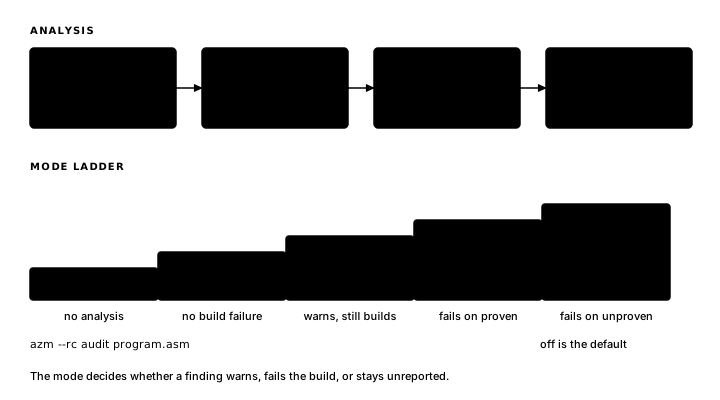
Stack discipline
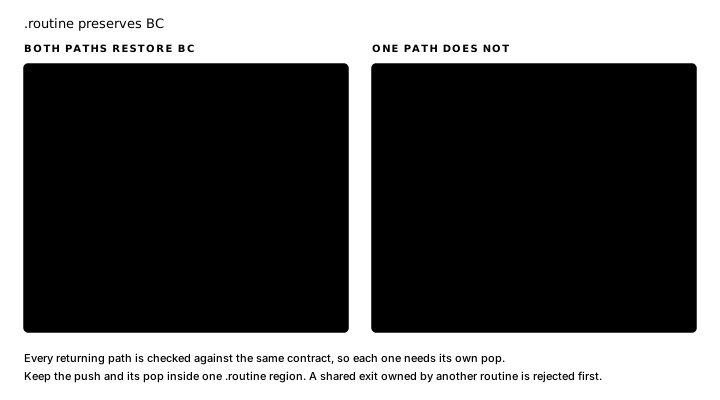
A routine that saves registers must restore them on every path that returns. AZM can check that when the save and the restore sit inside the same routine region:
.routine preserves BC
DrawRows:
        push    bc
        ; ... uses B and C temporarily ...
        pop     bc
        ret
A push/pop save-restore pair must remain inside the same .routine region. Each returning path must restore the stack before ret.
The following structure crosses routine regions:
.routine preserves BC
CopyName:
        push    bc
        jr      z,_sharedFail
        pop     bc
        ret

.routine
LoadConfig:
        ; ...
_sharedFail:
        pop     bc
        ret
CopyName pushes BC, then branches to _sharedFail, which is owned by LoadConfig. AZM reports the cross-owner local reference before register-contract analysis.
Moving the shared exit inside the same routine region gives the analyzer a complete stack path:
.routine preserves BC
CopyName:
        push    bc
        jr      z,_fail
        pop     bc
        ret
_fail:
        pop     bc
        ret

.routine
LoadConfig:
        ; separate routine region
        ret
If two routines share a larger cleanup sequence, declare that sequence as a callable .routine with its own contract.
Source contract syntax
.routine is the source directive for a machine-readable register contract.
A source contract contains zero or more clauses on the same directive line. Register lists inside a clause are comma-separated:
; Tests candidate piece placement against walls, floor and board rows.
; D contains candidate x coordinate, E contains candidate y coordinate.
; Carry returned set when placement is blocked.
.routine in DE out carry clobbers A
CheckCollisionAtDe:
Blank lines and ordinary comments may appear between the directive and label:
.routine in DE out carry clobbers A

; Carry is returned set when the placement is blocked.
CheckCollisionAtDe:
One routine has one .routine directive. Long source lines rely on the editor's normal wrapping because a second .routine starts a second routine.
Malformed carrier lists are rejected:
; wrong
.routine in A HL
.routine in A,NOT_A_REGISTER

; right
.routine in A,HL out A clobbers F
Contract keys
Six contract keys are recognized:
| Key | Meaning |
|---|---|
noreturn | Declares that the routine transfers control away for good |
in | Registers/flags whose incoming value the routine reads |
out | Registers/flags that carry meaningful returned values |
maybe-out | Inferred output candidates that need review before promotion |
clobbers | Registers/flags the routine destroys (no restore) |
preserves | Registers/flags the routine restores to their entry value |
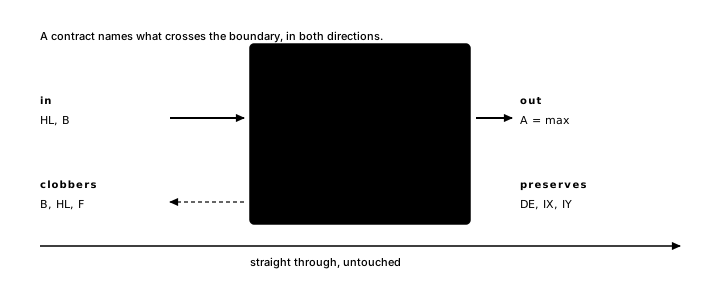
The keys describe the boundary from the caller's point of view:
inmeans the caller must provide this carrier before the calloutmeans the caller may intentionally consume this carrier after the call
Carrier lists
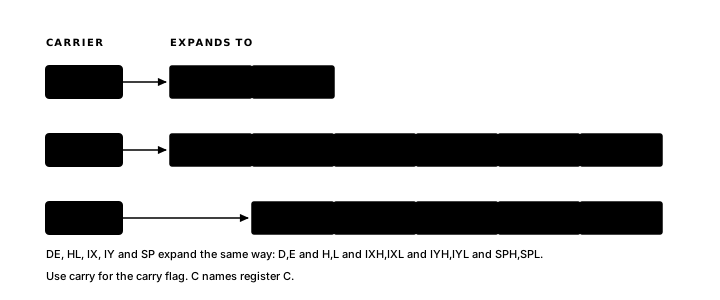
.routine in A,DE,HL out carry clobbers BCRegister pair names expand to their constituent 8-bit registers for analysis: BC to B,C, DE to D,E and so on. See Appendix 1 for the full carrier-notation table. Flags are named individually:
.routine out carry,zero clobbers Acarry names the carry flag, whereas C names register C. The individual flag names are carry, zero, sign, parity and halfCarry. F may be used as shorthand for the flag set.
Individual flag names state precisely which status a routine returns:
.routine in A,HL out carry clobbers BC
CheckTile:
Two flag conventions recur. Carry set reports success, cleared reports failure:
; TryRead: reads one byte into A. Carry set on success, clear when empty.
.routine in HL out A,carry clobbers BC,HL
TryRead:
        ; ...
        scf                     ; success
        ret
_empty:
        or      a               ; clears carry
        ret
Zero reports an emptiness or equality test. or a sets it from a byte already in A and leaves that byte as it stands:
; IsEmpty: zero set when the count byte is zero.
.routine out zero clobbers A
IsEmpty:
        ld      a,(Count)
        or      a
        ret
A contract records the carrier; the comment above the directive records what the flag means. Carriers are named as carry, so out F.C is rejected with invalid .routine out carrier list.
A register pair expresses a value that the routine treats as a unit:
.routine in DE out HL clobbers A
FindRecord:
Inputs and outputs on the same carrier
A routine that transforms a register in place (reads it as input, returns it modified) lists it in both in and out:
; Normalises the coordinate pair in DE.
.routine in DE out DE clobbers A
NormaliseDe:
Caller-site hints
An .expectout immediately before a call marks one call site as intentionally consuming inferred outputs:
        .expectout DE
        call    NormaliseDe
        ld      a,(de)
.expectout DE tells the analyzer that the next emitted instruction intentionally consumes DE as a callee-produced output. The instruction must be in the same physical source file.
Generating contracts from inference
Once routine labels are in place, AZM can infer contracts and write them back into source:
azm --contracts --rc audit program.asmAZM infers a contract for each declared routine and inserts or updates its .routine directive. Human prose comments above the directive remain in place.
Because AZM infers these contracts from the instruction stream, they are a starting point that must be checked against the routine's intended interface.
When AZM infers a written value that could be either a clobber or an output, it may write maybe-out:
.routine in A maybe-out A clobbers B
MaskA:
Every maybe-out requires a decision. When the value is intentionally returned, --accept-out promotes it:
azm --accept-out MaskA:A --rc audit program.asmWhen the value is internal to the routine, it remains a clobber; alternatively, the routine can be rewritten to make the effect clear.
.routine directives can be written or edited directly. A later --contracts run updates the directive from current inference.
Generating .asmi interface files
azm --rc audit --reg-interface program.asmThis writes program.asmi with extern contract records for declared routines. Other projects that call these routines can load the file with --interface.
External contracts
When you call a ROM monitor routine or a library routine assembled separately, external contracts give the analyzer the routine's register behaviour:
extern MON_PUTC
in A
clobbers A
end

extern MON_GETC
out A
out zero
endazm --interface mon3.asmi --rc strict program.asmStrict mode treats missing routine bodies and missing external contracts as build failures. A direct-call target outside the translation unit needs either an .asmi file or its source brought in.
azm --reg-profile mon3 program.asmThe mon3 profile provides built-in summaries for MON-3 RST services, including selector-based API calls through RST $10.
.asmi files can also describe RST services selected through register C:
service rst $10 C $53 MON_BANK_CALL
in C
clobbers B,C,D,E,H,L
end
The >= form describes a project-owned service range:
service rst $10 C >= $60 TECMATE_EXPANSION_SERVICE
in C
out A,carry
clobbers B,C,D,E,H,L,zero,sign,parity,halfCarry
end
The exact-service form applies when AZM can prove the selector value in C. The range form applies when the proven selector is at or above the configured lower bound.
A practical workflow
The register-contract editing cycle is:
- A routine is written or edited.
- While the code is still moving,
azm --rc audit program.asmreports findings while the build continues. azm --contracts --rc audit program.asmadds or regenerates.routinecontracts.azm --rc error program.asmmakes proven conflicts fail the build.- Once routine boundaries and external interfaces are in place,
azm --rc strict program.asmalso requires AZM to prove the remainder safe. - Routine structure, contracts and interfaces are then corrected until strict mode passes.
Many strict-mode findings in one area often indicate incomplete routine boundaries. Shared exits, cross-boundary jumps and unrecorded monitor calls may need explicit boundaries or external contracts.
Text reports
AZM can also write a report with --reg-report, producing program.regcontracts.txt by default. This is a generated artifact, so projects normally add it to their ignore rules unless they intentionally retain a baseline.
azm --rc audit --reg-report program.asmJSON supplies structured findings to tools and CI jobs:
azm --rc audit --reg-report --reg-report-format json program.asmJSON reports can become baselines. A ratchet build compares the current findings with a previous JSON report and fails if new or changed findings appear:
azm --rc audit --reg-report --reg-report-format json program.asm
azm --rc audit --reg-baseline baseline.regcontracts.json --reg-ratchet program.asm
Conservative autofix
--fix applies conservative source repairs for clear register contract conflicts:
azm --fix --rc warn program.asmAZM identifies call sites where the callee clearly returns a register that the caller later uses. It inserts an .expectout directive above the call to record that dependency. AZM also rewrites .routine directives from its inference, promoting maybe-out to out where the evidence is unambiguous.
--fix edits the contract directives alone, so the assembled output is identical.
After --fix runs, the diff still requires inspection. An inferred contract records what the code does today, which may differ from the intended interface. Where they differ, the intended contract should replace the inference; the next build will report any mismatch between that declaration and the routine body.
Analysis scope and limits
Register contract analysis tracks:
- Register and flag values through straight-line code and simple loops
- Push/pop preservation pairs on all return paths
The following cases require external contracts, manual annotations or separate review:
- RAM aliasing (what another call might overwrite in program storage)
- Indirect call targets (call through register)
- Interrupt handler effects
- Self-modifying code
Common diagnostic messages
Register contract conflict:
program.asm:47:9: warning: [AZMN_REGISTER_CONTRACTS] CALL DRAW_FRAME may modify B, but the pre-call value is used later.The conflict can be resolved by saving around the call, moving the call outside B's live range or correcting the contract if DRAW_FRAME preserves B.
Unconfirmed output:
With --require-expectout, an inferred output dependency that has not been confirmed becomes an error:
program.asm:58:9: error: [AZMN_REGISTER_CONTRACTS] CALL NORMALISE_COORD writes D,E and caller reads it later, but NORMALISE_COORD does not declare D,E as output; add `.expectout {D,E}` above the call to confirm the dependency and promote the callee output.This diagnostic occurs when a routine reads and writes the same registers. Two interpretations remain: the pre-call values must survive, or the post-call values are intentional results. An .expectout {D,E} directive confirms the second interpretation at this call site. For a routine that transforms the registers at every call site, --accept-out NORMALISE_COORD:D,E or .routine in DE out DE records that interface.