Eight Queens Capstone
The preceding chapters sorted tables, walked strings, packed flags into bytes, built a ring buffer, used recursive calls, split files with .include and followed .word links through data structures. This chapter combines those techniques in one program: eight queens on an 8x8 board.
The puzzle places eight queens so no two share a row, column or diagonal. There are exactly 92 distinct solutions if you treat reflected and rotated boards as different; the example counts all of them and stores the total in RAM.
call, ret and branches provide all control flow in flat AZM.
The complete build is examples/09_eight_queens.asm.
Backtracking one row at a time
A queen attacks along its row, column and both diagonals. On an 8x8 board with eight queens, each row must hold exactly one queen. That cuts the search space sharply: the search chooses which column goes on row 0, then row 1 and so on down the board, eight choices per row.
If row r uses column c, the search records three constraints:
- Column
cis taken; no other row may use it. - The forward diagonal (row + col constant) is threatened.
- The backward diagonal (row − col constant) is threatened.
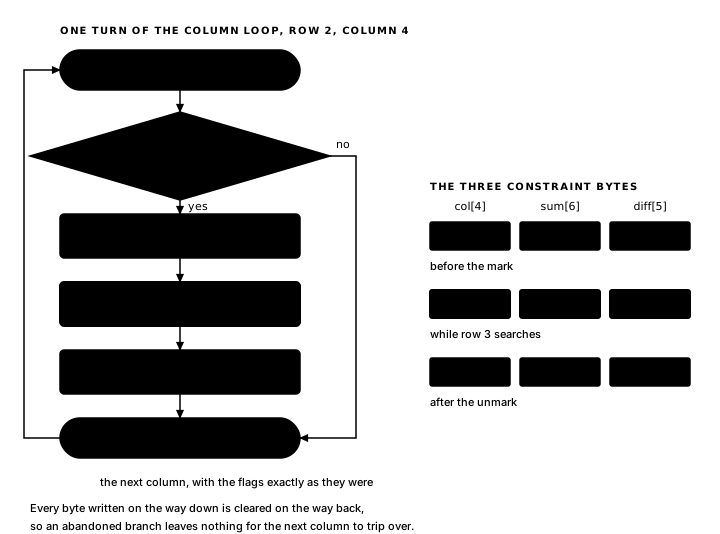
When all three checks pass for (r, c), record the placement, recurse to row r + 1 and when that returns, undo the marks before trying the next column. That undo step is backtracking. Any flag left set makes a free square look occupied and prunes valid branches from the search.
Board representation as one record
Six fields live in workspace RAM:
| Field | Size | Role |
|---|---|---|
solutionCount | sizeof(word) | Running total, 92 when the search finishes |
queenCols | sizeof(ColFlags) | Current search path: one tentative column per row |
solutionCols | sizeof(ColFlags) | Last completed solution copied from queenCols |
constraints.colUsed | sizeof(ColFlags) | Slot.Free or Slot.Taken per column |
constraints.diagSumUsed | sizeof(DiagFlags) | Forward diagonal index row + col |
constraints.diagDiffUsed | sizeof(DiagFlags) | Backward diagonal index row - col + DIAG_BIAS |
Two array aliases carry the only literal counts in the program, and everything else is derived from them:
ColFlags  .typealias byte[8]     ; one flag per column, so also the board size
DiagFlags .typealias byte[15]    ; one flag per diagonal: 2 * BOARD_SIZE - 1

BOARD_SIZE .equ sizeof(ColFlags)
DIAG_BIAS  .equ BOARD_SIZE - 1
DIAG_BIAS is one less than the board size, so the smallest backward-diagonal index is 0 when row = 0 and col = BOARD_SIZE - 1.
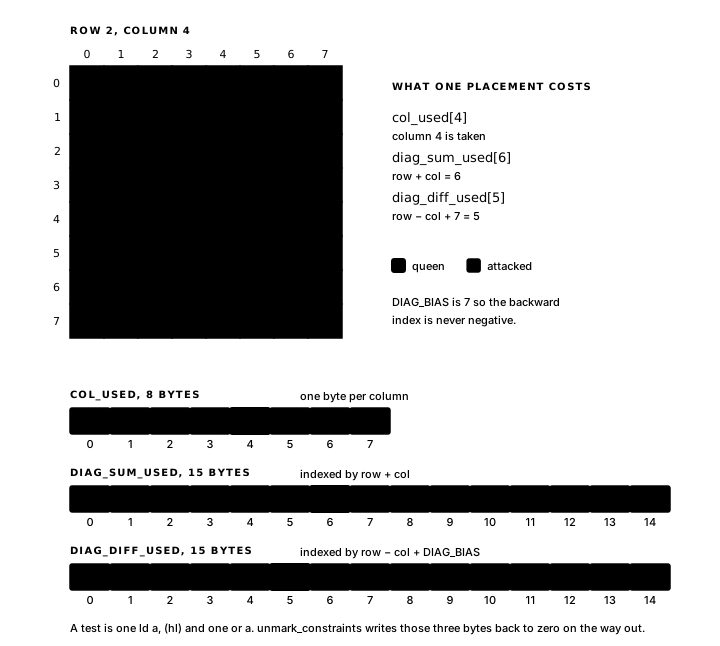
The search repeatedly tests whether a column or diagonal is already taken. Chapter 4's masks could pack all eight column flags into one byte. The example instead uses one byte per column so every test is ld a, (hl) / or a / jr nz.
The three flag tables are one record
clear_constraints zeroes the three flag tables in a single ldir-style pass. That pass depends on contiguous tables in a known order. The layout declaration records both properties:
Constraints .type
colUsed      .field ColFlags
diagSumUsed  .field DiagFlags
diagDiffUsed .field DiagFlags
.endtype

QueenWorkspace .type
solutionCount .field word
queenCols     .field ColFlags
solutionCols  .field ColFlags
constraints   .field Constraints
.endtype
The whole workspace is then one reservation, and each old label becomes a layout cast that folds to the same immediate address:
solution_count .equ <QueenWorkspace>queens_ws.solutionCount
queen_cols     .equ <QueenWorkspace>queens_ws.queenCols
solution_cols  .equ <QueenWorkspace>queens_ws.solutionCols
col_used       .equ <QueenWorkspace>queens_ws.constraints.colUsed
diag_sum_used  .equ <QueenWorkspace>queens_ws.constraints.diagSumUsed
diag_diff_used .equ <QueenWorkspace>queens_ws.constraints.diagDiffUsed

.org $8000
queens_ws:
    .ds QueenWorkspace
Every ld hl, col_used in the rest of the program still assembles to ld hl, imm16; the difference is that the immediate now comes from the field list. Widening the board to 10 columns is a change to ColFlags and DiagFlags, after which the addresses, the clear length and BOARD_SIZE all follow.
queenCols changes as the search tries placements. count_solution copies all BOARD_SIZE bytes to solutionCols, preserving the last completed board after backtracking continues.
Free and taken as an enum
A flag byte holds one of two values, so it gets a name for each:
Slot .enum Free, TakenSlot.Free is 0 and Slot.Taken is 1. mark_constraints stores ld a, Slot.Taken, which is the same 3E 01 as ld a, 1 was. unmark_constraints keeps xor a because it is one byte rather than two, with a comment noting that zero is Slot.Free. Enum members must be qualified; Taken alone is rejected.
Constraint checks as small routines
The hot path is divided into routines with explicit .routine contracts, the same discipline used for gcd_u16, ring_push and factorial_u8.
Column free (index col_used with C):
; col_free: is column C unused?
.routine in C out zero clobbers A,B,HL,sign,parity,halfCarry,carry
col_free:
    ld hl, col_used
    ld b, 0
    add hl, bc
    ld a, (hl)
    or a
    ret
Indexing a flag table is Chapter 2's four instructions, and the program writes them at three sites. One parameterised op names the calculation once:
op flag_addr(tbl imm16, idx reg8)
  ld hl, tbl
  ld d, 0
  ld e, idx
  add hl, de
end
imm16 matches the table label and reg8 matches the index register, so flag_addr col_used, c and flag_addr queen_cols, b both expand to ld hl / ld d, 0 / ld e / add hl, de with the operands substituted.
col_free keeps its own version because ld b, 0 / add hl, bc is a byte shorter when the index is already in C and B is free.
Diagonal addressing carries an extra step: the index is computed from the row and the column. diag_sum_free, mark_constraints and unmark_constraints all need the same six instructions, and so do their backward-diagonal counterparts, so two more ops cover the six sites:
op diag_sum_addr()
  ld a, b
  add a, c              ; forward diagonal index = row + col
  ld e, a
  ld d, 0
  ld hl, diag_sum_used
  add hl, de
end

op diag_diff_addr()
  ld a, b
  add a, DIAG_BIAS
  sub c                 ; backward diagonal index = row - col + DIAG_BIAS
  ld e, a
  ld d, 0
  ld hl, diag_diff_used
  add hl, de
end
The bias keeps the backward index non-negative: row - col runs from -(BOARD_SIZE - 1) to BOARD_SIZE - 1, and adding DIAG_BIAS slides that range to 0 .. sizeof(DiagFlags) - 1.
The forward-diagonal routine applies the address calculation and tests the selected byte:
; diag_sum_free: is forward diagonal (row+col) unused?
.routine in B,C out zero clobbers A,DE,HL,sign,parity,halfCarry,carry
diag_sum_free:
    diag_sum_addr
    ld a, (hl)
    or a
    ret
The listing file prints the six expanded instructions and their bytes beside the diag_sum_addr line, and --rc warn analyses those instructions, which is why the contract still declares DE and HL clobbered.
Each failed check jumps to _next_col in the row driver, continuing the column loop.
Marking, recursion and unmarking
When all three tests pass, mark before call place_row and unmark after it returns:
    push bc
    call mark_constraints
    pop bc

    push bc
    inc b
    call place_row
    pop bc

    push bc
    call unmark_constraints
    pop bc
mark_constraints writes Slot.Taken into col_used[c] and both diagonal bytes, and records the column number in queen_cols[row]. unmark_constraints clears the three flags and leaves queen_cols alone. The next trial may overwrite queen_cols, so only solution_cols is a stable completed board.
push bc around each helper preserves B = row and C = column across calls that clobber AF and HL.
Recursive place_row
Contract: B = current row, 0 to BOARD_SIZE - 1. At row BOARD_SIZE, a full placement was found; increment the global counter. Otherwise try every column on this row.
; place_row: assign a queen to row B; count solutions at row BOARD_SIZE
; Self-call; max depth PLACE_MAX_DEPTH; max stack PLACE_MAX_STACK_BYTES bytes.
.routine in B clobbers AF,BC,DE,HL
place_row:
    ld a, b
    cp BOARD_SIZE
    jr nz, _try_cols
    call count_solution
    ret
_try_cols:
    ld c, 0
_col_loop:
    ld a, c
    cp BOARD_SIZE
    jr nc, _row_done
    ; ... col_free, diag_sum_free, diag_diff_free ...
    ; ... mark, inc b, call place_row, unmark ...
    inc c
    jr _col_loop
_row_done:
    ret
Base case: B has reached BOARD_SIZE, so every row is assigned. count_solution copies the current path to solution_cols, then bumps the 16-bit solution_count at $8000.
Recursive step: valid column → mark → inc b → call place_row → unmark → next column.
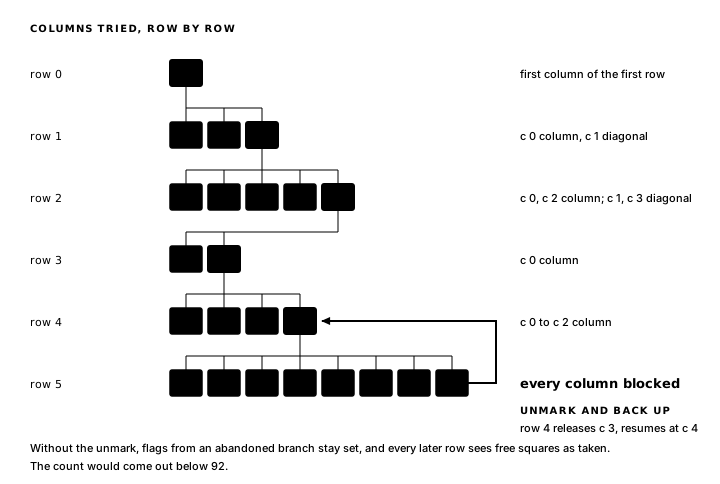
Depth is at most nine place_row calls (rows 0..8). Each of the eight trial rows keeps a saved BC pair while the next row runs. At row 8, the nested count_solution call temporarily adds one more return address. Constants make the exact budget visible:
PLACE_STEP_BYTES      .equ 4
PLACE_BASE_BYTES      .equ 4
PLACE_MAX_DEPTH       .equ BOARD_SIZE + 1
PLACE_MAX_STACK_BYTES .equ BOARD_SIZE * PLACE_STEP_BYTES + PLACE_BASE_BYTES
STACK_TOP             .equ $9FFF
For an 8x8 board, the deepest path occupies 8 × 4 + 4 = 36 bytes.
Stopping at the first solution
Stopping after the first solution requires a found byte in workspace. count_solution sets it, and the column loop checks it after call place_row. A non-zero value causes an early ret from each active place_row frame, propagating the result upward because one ret exits only one frame.
main and clear_constraints
.org $0000
main:
    ld sp, STACK_TOP
    call clear_constraints
    xor a
    ld (solution_count), a
    ld (solution_count + 1), a
    ld b, 0
    call place_row
    halt
clear_constraints zeroes sizeof(Constraints) bytes in one loop, which covers col_used and both diagonal tables:
clear_constraints:
    ld hl, col_used
    ld bc, sizeof(Constraints)
Every completed path writes all BOARD_SIZE queen_cols entries before they are copied to solution_cols, so the clear can skip both column arrays.
Memory after halt
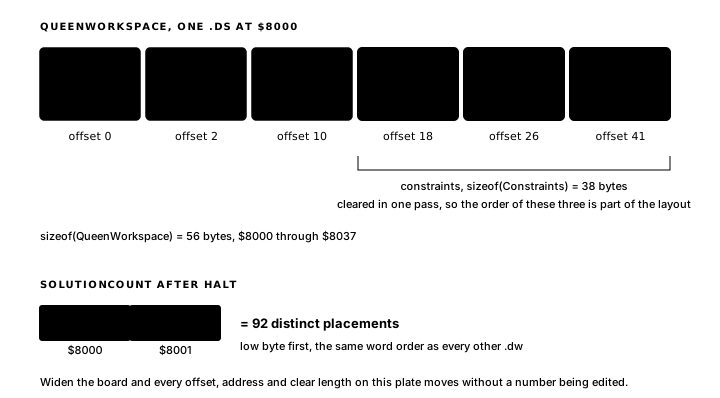
After execution reaches halt, $005C in solution_count confirms that the search completed. A single-step trace with column 0 accepted on row 0 shows diag_sum_used and col_used changing to $01, then clearing during backtracking after a deeper row fails.
Book 3 techniques in the capstone
| Earlier idea | Here |
|---|---|
| Byte arrays + indexing (Ch. 2) | col_used, diagonal tables |
| Bit thinking (Ch. 4) | Optional bitboard exercise |
| Records / workspace (Ch. 5) | QueenWorkspace at $8000, addressed by layout cast |
| Enums (Book 1 Ch. 3) | Slot.Free and Slot.Taken in the flag tables |
| Ops (Book 1 Ch. 7) | flag_addr, diag_sum_addr, diag_diff_addr |
| Recursion + stack (Ch. 6) | place_row self-call, SP init |
Small routines with .routine contracts (Ch. 1, 7) | col_free, mark_constraints, … |
| Pointers (Ch. 8) | Pure tables here |
Running the complete search
| File | What to verify |
|---|---|
examples/09_eight_queens.asm | solution_count = $005C (92); solution_cols holds one complete placement |
azm examples/09_eight_queens.asm
azm --rc warn examples/09_eight_queens.asm
Representation and invariants
The capstone combines arrays, constraint flags, recursion and register contracts. Across the earlier chapters, records, separate source files and pointer layouts provide other representations for problems that need them.
A new buffer, parser or game board begins with its representation and .routine contracts. Emulator traces then show whether each implementation step preserves the stated invariant.
Exercise
Constraint trace. For tentative placements (row, col) of (0, 0), (1, 2) and (2, 4), a trace should give queen_cols[0..2] and every set index in col_used, diag_sum_used and diag_diff_used, including the arithmetic for both diagonal indices.