Ops, Aliases and Source Composition
Op declarations name reusable instruction idioms. Directive aliases let AZM read directive spellings from other assemblers. .include and .import compose a program from several files.
Op declarations
An op is a named instruction idiom that expands inline at each call site into ordinary Z80 instructions.
The op carries its own bytes at each site, so the cost is the instructions themselves and the register effects belong to the surrounding routine.
Simple zero-operand ops
op clear_a()
  xor  a
end

op nop_pair()
  nop
  nop
end
Invocation:
        clear_a
        nop_pair
Register contract analysis sees the expanded instructions: clear_a is analyzed as xor a, including its flag effects.
Op invocations can also appear inside a chained instruction line:
clear_a \ retOp bodies accept the same form:
op clear_and_return()
  xor a \ ret
end
Parameterized ops
Ops can take operands matched by class:
op load8(dst reg8, val imm8)
  ld   dst,val
end
At the call site load8 a,42, the assembler matches a to reg8 and 42 to imm8, then substitutes them into the body:
        load8  a,42     ; expands to: ld a,42
        load8  b,$FF    ; expands to: ld b,$FF
Operand classes
| Class | Matches |
|---|---|
reg8 | 8-bit registers: A, B, C, D, E, H, L |
reg16 | 16-bit registers: BC, DE, HL, SP |
imm8 | 8-bit immediate value |
imm16 | 16-bit immediate value |
cc | Condition codes: NZ, Z, NC, C, PO, PE, P, M |
idx16 | IX or IY indexed memory operand: (IX+d), (IY+d) |
ea | Effective address expression |
mem8 | Memory dereference for byte-form op overloads |
mem16 | Memory dereference for word-form op overloads |
mem8 and mem16 currently match the same memory operand shapes. They document the intended width, so an overload family needs some other difference to tell two otherwise identical signatures apart.
Tokens outside this list are fixed tokens, exact literals the call site must reproduce verbatim.
Overloaded ops
Multiple op declarations with the same name but different operand shapes define an overloaded family. AZM selects the matching overload at each call site:
op increment(dst reg8)
  inc  dst
end

op increment(dst reg16)
  inc  dst
end increment a ; uses reg8 overload
increment hl ; uses reg16 overloadWhen overload selection fails, AZM reports an ambiguity or no-match diagnostic.
Branch labels inside op bodies
When an op body needs internal branch labels, AZM generates unique labels to prevent collisions across multiple expansions:
op safe_div(result reg8, divisor imm8)
  ld   a,divisor
  or   a
  jr   z,DivSkip
  div_logic
DivSkip:
end
Pseudo-opcodes for instruction-set gaps
Some idioms exist to fill a gap in the instruction set. Copying DE into HL takes two 8-bit moves, since the Z80's register-to-register loads are all 8-bit:
op ld_hl_de()
  ld   h,d
  ld   l,e
end
A reg16 parameter leaves this ungeneralised: the matcher supplies the pair name alone, so a generic body has no ld h,d to write. Each supported pairing needs its own declaration: ld_hl_de, ld_de_hl, ld_bc_hl.
Where the instruction does exist, a parameterized op still names the intent:
op clear16(r reg16)
  ld   r,0
end

        clear16  hl     ; expands to: ld hl,0
        clear16  bc     ; expands to: ld bc,0
A named op can identify the condition implemented by an instruction sequence. Here, cp c followed by jr c and jr z means "skip unless A is strictly above C":
op jr_if_not_above(threshold reg8, target imm16)
  cp   threshold
  jr   c,target
  jr   z,target
end
The listing keeps the invocation as its source line and attributes the expanded bytes to it.
Ops vs subroutines
An op is appropriate for:
- Small idioms where call overhead is significant relative to the body
- Register and flag effects that must match the expanded instructions exactly
- Expansions that must remain visible in the output
A subroutine is appropriate for:
- Bodies that are several instructions long and called many times (code size matters)
- Routines that need their own register contract, declared with
.routine - Callee-side register preservation
For a body of N instructions used at K call sites, a subroutine stores the body once and adds one ret and one call per site: N + 1 + K encodings. An op emits N × K. At K = 1, the op is always smaller. At K = 2, the subroutine is smaller when N exceeds 3.
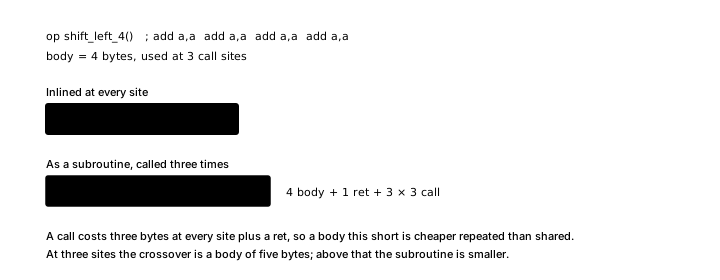
That count measures instruction encodings, not bytes; Z80 instructions occupy one to four bytes each. At run time, the subroutine also executes a call and a ret per invocation, while the op executes only its body.
Nested ops and cycle detection
An op body can invoke another op. AZM expands nested ops fully at the call site.
Recursive expansion is detected and produces an error:
op loop_forever()
  loop_forever    ; error: recursive op expansion
end
AZM detects mutual recursion between two ops as well as direct recursion.
Op diagnostics
No overload matches:
error: [AZMN_PARSE] No matching op overload for "load8" with provided operands.
call-site operands: (HL, 42)
available overloads:
  - load8(dst reg8, val imm8) (program.asm:1) ; dst: expects reg8, got HL
HL is a 16-bit register; reg8 requires an 8-bit register. The mismatch can be resolved by changing the call site or adding a reg16 overload.
Expansion cycle:
error: [AZMN_PARSE] Cyclic op expansion detected for "loop_op".
expansion chain: loop_op (program.asm:1) -> helper (program.asm:5) -> loop_op (program.asm:1)
Arity mismatch:
error: [AZMN_PARSE] No op overload of "load8" accepts 1 operand(s).
available overloads:
  - load8(dst reg8, val imm8)
Op declarations in include files
Op names are global; they share the namespace with labels and .equ constants. A dedicated op file, included before any code that uses it, keeps these declarations together:
        .include "hardware.asm"
        .include "layout.asm"
        .include "ops.asm"
Op names must avoid Z80 mnemonics. clear_a is valid; ld produces a parse error. AZM convention uses underscore-separated lowercase names such as shift_left_4, negate_a and memcopy.
Aliases and compatibility
Aliases map legacy directive heads to canonical AZM directives. Source written for assemblers that use DEFB, DEFW, RMB or other directive heads can use aliases without changing every line.
The built-in alias profile
AZM's built-in aliases normalize exact undotted uppercase forms before parsing:
| Alias | Canonical |
|---|---|
ORG | .org |
EQU | .equ |
DB | .db |
DW | .dw |
DS | .ds |
The full built-in list is in Appendix 1. Alias names are case-sensitive: DB alone normalizes to .db, while db and Db stay as written. Canonical directives use lowercase dotted forms.
Project-specific alias files
Directive forms beyond the built-in set belong in a project JSON file:
{
  "extends": "azm",
  "directiveAliases": {
    "DEFB": ".db",
    "DEFW": ".dw",
    "DEFS": ".ds",
    "RMB":  ".ds",
    "FCB":  ".db"
  }
}
"extends": "azm" loads the built-in profile as the base. The --aliases option then loads the project file:
azm --aliases project.aliases.json program.asmAlias rewrite scope
Aliases normalize the directive head: the first token of a statement after an optional label. Operands, expressions, register names, instruction mnemonics and op names pass through unchanged.
DEFB "Hello",0 ; normalized to: .db "Hello",0Instruction mnemonic changes, such as source using MOV for LD, need a source transformation pass before assembly.
Source files and composition
.include copies text into the current source unit. .import instead exposes selected @ declarations from another source file while keeping its other non-local declarations private.
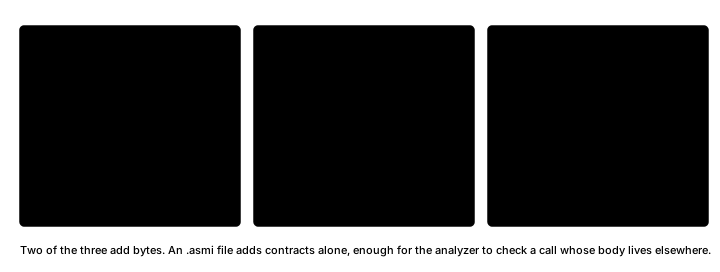
.include
.include "path" inserts another source file inline at that point, as if its contents had been written there. The file path is relative to the including file; -I adds further search directories.
All included files share one source unit. Non-local labels and constants must be unique in that unit. Owner-local labels can repeat under different non-local owners.
Op declarations and layout types typically live in dedicated include files, pulled in before the code that uses them:
        .include "hardware.asm"    ; port addresses and memory-mapped I/O
        .include "layout.asm"      ; type declarations
        .include "ops.asm"         ; op declarations
.import
.import supports explicit exports:
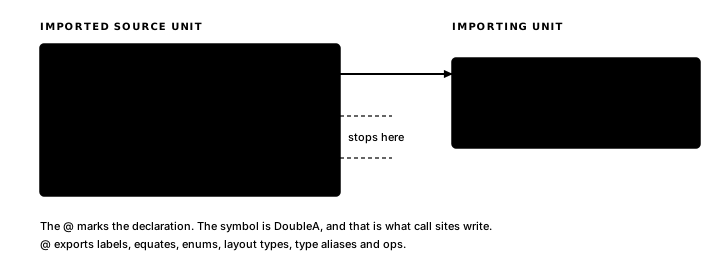
.import "math.asm".import loads another source file as a module-like unit. Its bytes are emitted at the import point. Declarations beginning with @ are visible to the importing unit; plain non-local declarations remain inside the imported unit.
An exported declaration is a plain identifier with @ in front of it. The @ is declaration syntax rather than part of the name, so @DoubleA: declares the symbol DoubleA and call sites write call DoubleA. Exported names take PascalCase after the @. An owner-local label belongs to its routine rather than to the file's interface, so @_clamp: is an error.
; main.asm
        .org    $4000
        .import "math.asm"

Start:
        ld      a,10
        call    DoubleA
ret; math.asm
.routine in A out A clobbers F
@DoubleA:
add a,a
ret
.routine in A out A clobbers F
ClampA:
cp 100
ret c
ld a,100
retDoubleA is exported because it is declared as @DoubleA:. Code in main.asm calls it as DoubleA. ClampA remains private to math.asm.
.routine declares the analysis boundary and contract. @ exports the following label.
A reference to a private imported label from outside its source unit produces a visibility diagnostic. The call can remain inside the imported file, or the helper can become public when it forms part of the file's interface:
; math.asm - ClampA is now part of the module's interface
.routine in A out A clobbers F
@ClampA:
        cp      100
        ret     c
        ld      a,100
        ret
Source labels replace $-qualified helper names such as math$ClampA. $ is the current assembly address by itself and starts hexadecimal literals such as $4000. AZM tracks imported declarations by source-unit identity and emits that identity in D8 metadata.
Import order and paths
Imported source assembles at the point where .import appears:
        .org    $4000
        .import "module.asm"

Start:
        ret
.import resolves paths the same way as .include: first relative to the file that contains the directive, then through include search paths passed with -I.
azm -I include src/main.asmRepeated imports of the same resolved file are loaded and emitted once:
.import "keyboard.asm"
.import "keyboard.asm"      ; same resolved file, emitted once
Repeated includes are still textual and repeatable:
.include "constants.asm"
.include "constants.asm"    ; expanded twice
Recursive include/import chains are rejected with a source diagnostic.
Import limits
.import has the following limits:
.import "file.asm"is the whole of the import syntax: no aliasing, no qualified references, no re-export- Plain declarations in an imported source unit are private to that unit;
@exports labels, equates, enums, layout types, type aliases and ops - Different imported source units may reuse the same private declaration names
$-qualified private names are internal debug-map display names, not source syntax.includebehaviour is unchanged
Native AZM outputs support .import: .bin, .hex and .d8.json. Debug80 map output records imported physical files and source line segments, so emitted bytes still map back to the correct source file. ASM80-compatible lowered .z80 output does not support .import; requesting --asm80 for a program that uses it produces an explicit AZMN_ASM80 diagnostic.