Pointer Structures
Chapter 5 packed several fields into one record, but every byte still lived in a table indexed by number. This chapter chains nodes through stored addresses: each record holds data plus a .word link to the next node, or zero for "none".
A pointer is a 16-bit address copied into a .word field. examples/08_linked_list.asm builds a static three-node list, walks it to sum and find values, then inserts a pre-allocated spare node at the head.
Changing shape by rewriting links
A ring buffer (Chapter 5) keeps all elements in one byte array and moves indices. Inserting in the middle of a plain array means copying bytes, expensive on a small machine.
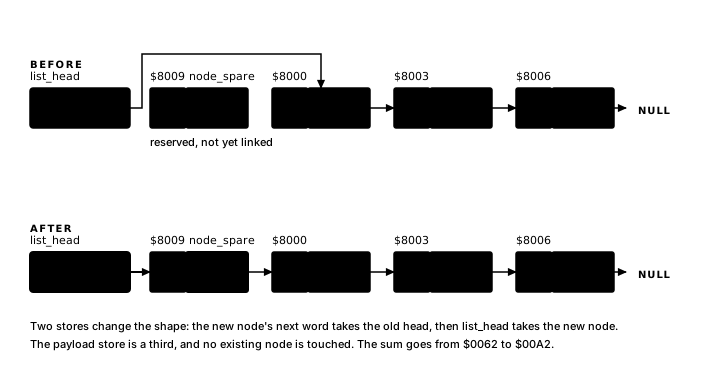
A singly linked list stores each element in its own small record. Insertion at the head takes only a few stores: the new node links to the old head, and list_head receives the new node's address.
The trade is explicit: each node costs an extra two bytes for the link, and reaching "element 4" means following four links from the head, or hitting null on the way.
Node layout: data plus link
The .type declaration describes the shape once:
ListNode .type
value   .byte
next    .word
.endtype

LIST_VALUE  .equ offset(ListNode, value)
LIST_NEXT   .equ offset(ListNode, next)
NODE_SIZE   .equ sizeof(ListNode)
NODE_SIZE comes out as 3 for this field list: one data byte, then a little-endian 16-bit link. The link field uses .word because it holds a full address, the same width as word and addr, which Book 1 Chapter 5 covers. AZM also offers .addr when you want the layout name to say "this field is a pointer"; the example uses it for the find_node result byte pair, distinguishing an address from a count.
Null is the address 0. A missing next node is stored as .dw 0. At run time you test the pointer in HL with:
    ld a, h
    or l
    jr z, _at_end
or l sets Z only when both H and L are zero: the same 16-bit zero test used throughout the course.
Static nodes in fixed RAM
Every node in Book 3 is a named label, connected to its neighbours at assembly time or in main:
node_a:
    .db $10
    .dw node_b
node_b:
    .db $22
    .dw node_c
node_c:
    .db $30
    .dw 0

list_head:
    .dw node_a
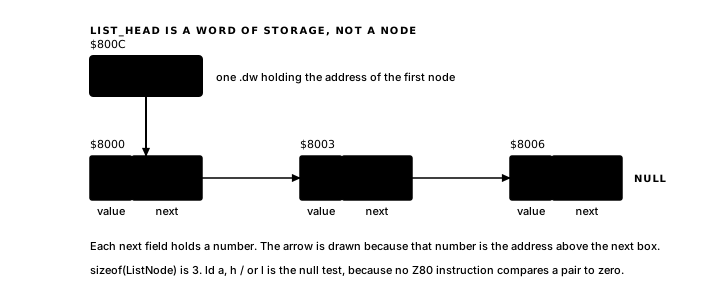
list_head is not a node; it is one word of storage that holds the address of the first node. The three nodes can live anywhere in RAM; only the links define order.
You can also reserve uninitialized nodes and fill them in code:
node_spare:
    .ds ListNode
Memory diagram
After assembly, RAM holds this:
Loading the head pointer into HL
Book 2 Chapter 4's absolute word load applies:
ld hl, (list_head)That expands to a read of the little-endian word at list_head. HL now points at node_a's first byte (the value field at offset 0).
Reading only the link field of the node currently in HL requires the field offset:
    ld bc, LIST_NEXT
    add hl, bc
    ld e, (hl)
    inc hl
    ld d, (hl)
    ex de, hl          ; HL = next node address
Low byte first, then high byte. That is Z80 little-endian order.
The advance step
Both walks below end with the same move: replace HL with the node its next field names. It reads the two link bytes low first and parks the low byte in C, because HL is still the address of the link until both bytes are in hand:
ld bc, LIST_NEXT
add hl, bc            ; HL = &node.next
ld a, (hl)
ld c, a               ; C = low byte of next
inc hl
ld a, (hl)
ld h, a               ; H = high byte of next
ld l, c
Eight instructions, written inline at both sites. Both routines declare BC under clobbers because of it.
Traverse: list_sum_u16
Summing the list is a while-shaped loop (Chapter 2's invariant style): HL is the current node; DE holds the running 16-bit sum because each payload is one byte but the total can exceed 255.
; list_sum_u16: sum value bytes along list starting at HL (null = 0)
.routine in HL out HL clobbers AF,BC,DE
list_sum_u16:
    ld de, 0
_sum_loop:
    ld a, h
    or l
    jr z, _sum_done
    ld a, (hl)
    add a, e
    ld e, a
    jr nc, _sum_no_carry
    inc d
_sum_no_carry:
    ld bc, LIST_NEXT
    add hl, bc            ; HL = &node.next
    ld a, (hl)
    ld c, a               ; C = low byte of next
    inc hl
    ld a, (hl)
    ld h, a               ; H = high byte of next
    ld l, c
    jr _sum_loop
_sum_done:
    ex de, hl
    ret
Invariant at _sum_loop: DE is the sum of all value bytes in nodes strictly before the node HL points at (if any). When HL is null, DE is the full sum returned in HL via ex de, hl.
For the static chain $10, $22, $30, the result is $0062 (98). The example stores it in list_sum.
HL is not an index; it is a full address that changes to unrelated addresses as you follow next.
Find: list_find_u8
Search reuses the same advance pattern, keeping the target byte in D while BC is reused to address and load each link:
; list_find_u8: find first node with value A; HL = node or 0, carry set if found
.routine in HL,A out HL,carry clobbers A,zero,sign,parity,halfCarry,BC,D
list_find_u8:
    ld d, a
_find_loop:
    ld a, h
    or l
    jr z, _missing
    ld a, (hl)
    cp d
    jr z, _found
    ld bc, LIST_NEXT
    add hl, bc            ; HL = &node.next
    ld a, (hl)
    ld c, a               ; C = low byte of next
    inc hl
    ld a, (hl)
    ld h, a               ; H = high byte of next
    ld l, c
    jr _find_loop
_found:
    scf
    ret
_missing:
    ld hl, 0
    or a
    ret
Carry set means HL points at a node whose value matches. Carry clear means HL is 0, including the empty list case when list_head was 0.
The demo searches for $22 and expects find_hit = 1 and find_node equal to the address of node_b.
Head insertion: list_push_head
Insert at head needs a free node address (here node_spare), a byte value in A and the current head word:
; list_push_head: prepend node DE with value A; updates list_head
.routine in A,DE clobbers BC,DE,HL
list_push_head:
    push af
    ld hl, (list_head)
    ld c, l
    ld b, h              ; BC = old head
    pop af
    ld (de), a           ; new node's value field
    ex de, hl            ; HL = new node
    push hl
    inc hl
    ld (hl), c           ; next, low byte
    inc hl
    ld (hl), b           ; next, high byte
    pop hl               ; HL = new node base again
    ld (list_head), hl
    ret
The insertion consists of four steps:
push afholds the incoming value while the old head is read.- BC receives the old head link, with the low byte in C and the high byte in B.
pop afrestores the payload for storage at(de), andex de, hlmakes the new node available for storing BC intonext.- HL now holds the new node address and is stored in
list_head.
After ld de, node_spare / ld a, $40 / call list_push_head, the list order is spare → a → b → c. The new sum is $00A2 (162).
    ld de, node_spare
    ld a, $40
    call list_push_head
Layout casts for node fields
When the node address and field path are known at assembly time, layout casts from Chapter 5 still apply:
    ld hl, <ListNode>node_b.value
    ld a, (hl)

    ld hl, <ListNode>node_b.next
    ld e, (hl)
For the head variable:
ld hl, <word>list_headThe bracketed index is an assembly-time literal, so runtime traversal advances with add hl, bc and LIST_NEXT.
Register contracts on pointer routines
Pointer routines follow the same .routine declarations as the ring buffer and factorial helpers:
| Tag | Role for lists |
|---|---|
.routine in | HL = current node or head pointer; A or DE for push/find |
.routine out | HL = sum, found node or 0; carry for find |
.routine clobbers | Include every register the link walk destroys |
The contract documents whether zero in HL means end-of-list or "not found". Here both use HL = 0, with carry distinguishing a successful find.
azm --rc warn examples/08_linked_list.asmOptional: BST insert with two .word links
A binary search tree adds a second link per node: left and right children, each a .word (zero if absent).
TreeNode .type
value   .byte
left    .word
right   .word
.endtype
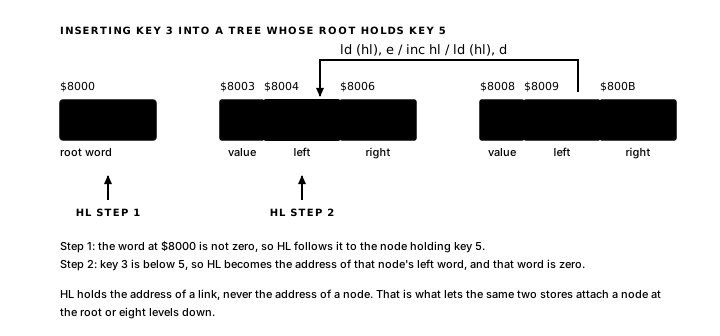
An insertion routine needs the address of a link word, not merely the node address. HL starts at the address of the root word. Each iteration loads the node address stored there. A zero word is an empty slot, so the routine writes the new node address into that link. Otherwise it compares the key and changes HL to the address of the existing node's left or right word.
TREE_VALUE .equ offset(TreeNode, value)
TREE_LEFT  .equ offset(TreeNode, left)
TREE_RIGHT .equ offset(TreeNode, right)

; bst_insert_u8: attach pre-initialized node IX for key A
; In: HL = address of root/child link word, IX = new node, A = key
; Duplicate keys leave the tree unchanged.
.routine in HL,IX,A clobbers AF,C,DE,HL
bst_insert_u8:
    ld c, a
_walk:
    ld e, (hl)
    inc hl
    ld d, (hl)
    dec hl
    ld a, d
    or e
    jr z, _attach

    ex de, hl             ; HL = existing node
    ld a, (hl)            ; value is the first field
    cp c
    ret z
    ld de, TREE_LEFT
    jr nc, _descend       ; key < node value
    ld de, TREE_RIGHT
_descend:
    add hl, de            ; HL = address of chosen child link
    jr _walk

_attach:
    push ix
    pop de
    ld (hl), e
    inc hl
    ld (hl), d
    ret
The caller initializes the new node's value and clears both child words before the call. The control flow is a loop, so tree height affects iteration count rather than stack depth. A complete implementation also needs a node pool and a root word.
State at halt
    ld hl, (list_head)
    call list_sum_u16
    ld (list_sum), hl

    ld a, $22
    ld hl, (list_head)
    call list_find_u8
    ...

    ld de, node_spare
    ld a, $40
    call list_push_head

    ld hl, (list_head)
    call list_sum_u16
    ld (sum_after), hl

halt| Label | Expected |
|---|---|
list_sum | $0062 (98) |
find_hit | $01 |
find_node | address of node_b |
sum_after | $00A2 (162) |
Inspecting the list walk
| File | What to verify |
|---|---|
examples/08_linked_list.asm | Sum 98 ($0062), find $22, sum 162 ($00A2) after head insert |
azm examples/08_linked_list.asm
azm --rc warn examples/08_linked_list.asm
A single-step trace of list_sum_u16 shows HL jumping from node_a to node_b to node_c by loading next, rather than by adding a stride to a table base.
Exercise
Node representation. A layout calculation should give sizeof(ListNode) and both field offsets. A diagram of the list after $40 is inserted at the head should label list_head, every stored link word and the null link, followed by an explanation of the source and byte-level effects of changing next .word to next .addr.