Getting Started with AZM
AZM is an enhanced Z80 assembler for the Debug80 toolchain. It turns assembly source into machine-code bytes and adds modern assembler-time features for larger programs: layout types, register contracts, op declarations, directive aliases, diagnostics, output artifacts and Debug80 source maps.
This manual defines the rules for those assembler features. AZM Book 2 — Z80 Fundamentals introduces the Z80 itself.
Installing AZM
AZM requires Node.js 20 or later. A global installation makes the azm command available from any project:
npm install -g @jhlagado/azmThe version command confirms that the installation is available:
azm --versionFrom a source checkout, the following commands build and run the local CLI directly:
npm ci
npm run build
npm run azm -- examples/hello.asm
A first AZM program
Here is a small but complete AZM source file:
; counter.asm - increment a counter eight times

        .org $0100

LIMIT   .equ 8

Main:
        ld      b,LIMIT
        ld      hl,Counter
_loop:
        inc     (hl)
        djnz    _loop
        halt

Counter:
        .db 0
Assembly
The entry file is always the last argument:
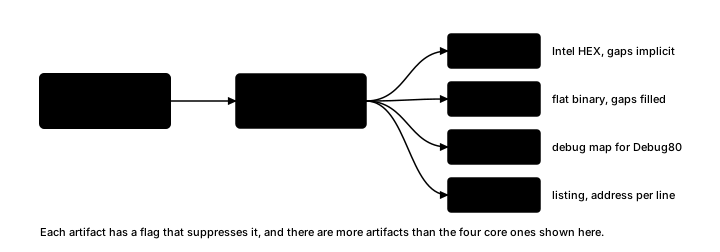
azm counter.asmBy default, AZM writes four output files next to the source:
| File | Contents |
|---|---|
counter.hex | Intel HEX |
counter.bin | Flat binary |
counter.d8.json | Debug80 source map |
counter.lst | Assembler listing |
Chapter 8 covers output selection, suppression flags, Debug80 source paths, exit status and artifact formats.
Assembler output
The first instruction, ld b,LIMIT, assembles to $06 $08 at $0100. ld hl,Counter assembles to $21 $09 $01 at $0102, encoding the address $0109 in little-endian order. inc (hl) is $34 at $0105, and djnz _loop is $10 $FD at $0106. halt is $76 at $0108. The final .db 0 places a zero byte at $0109.
Placing data after the final instruction keeps the executable entry near the start of the binary, which suits loaders that begin execution at the load address. AZM resolves forward references, so ld hl,Counter at the top can name a label defined further down.
Source file extensions
AZM accepts .asm and .z80 source extensions and parses them identically. Debug80 can discover either extension as a target source file. Files named main.asm or main.z80 are suggested as likely entry points. The conventional extension for new source is .asm; .z80 also supports source shared with ASM80-compatible tools.
.asmi files carry external register contract records for library routines whose source is assembled separately. The --interface option loads them. Chapter 6 covers the format.
The Debug80 connection
Debug80 is the companion debugging tool for this toolchain. It reads the .d8.json file that AZM emits alongside each binary. The map contains addresses, symbols and source line positions, allowing Debug80 to show the source line at the program counter, resolved symbol values and routine definitions.
When assembly takes place outside Debug80, the .d8.json file still appears next to the binary. The --nod8m option suppresses it when no source map is required.