Recursion
Chapter 5 kept all state in registers, workspace bytes or a RingState record. Recursion calls the current subroutine again with a smaller input, while a base case stops the chain.
The hardware stack holds one return address per active call. Its capacity must be budgeted at assembly time, because an overflow silently overwrites whatever lies below the stack.
examples/06_factorial.asm compares recursive and iterative factorial, then recursively sums a byte table.
Smaller versions of the same job
Many definitions refer to themselves:
- n! = n × (n-1)! for n > 0, and 0! = 1.
- The sum of a byte table is the first byte plus the sum of the rest.
- Towers of Hanoi: moving n disks means moving n-1 disks twice around one move of the bottom disk.
Each case splits the input into a smaller instance of the same problem plus a small amount of local work. The base case is the size where you return immediately.
Iterative loops from Chapters 1–2 already do this with registers and workspace. Recursion makes the "smaller problem" explicit as another call.
The stack as an explicit resource
For recursion, the stack is managed like any other fixed resource:
- SP initialization occurs before the first
call(ld sp, STACK_TOP). - Bytes per active level include the return address (2), plus any
push, IX frame ordec splocals added by that level. - A compile-time depth bound records the largest argument the program is designed to receive.
- The resulting total, either exact or the conservative
max_depth × largest_frame_bytesbound, must fit belowSTACK_TOPand above the program's workspace and data.
Stack budget for factorial_u8
Each recursive step (for n > 0) does:
    push bc          ; 2 bytes - save n in B (C is collateral)
    dec b
    call factorial_u8
    pop bc
Each non-base level therefore adds four bytes: two for saved BC and two for the next recursive return address. The base call adds only its two-byte return address, because the base path returns before the push bc. Source constants name both parts:
FACT_STEP_BYTES      .equ 4
FACT_BASE_BYTES      .equ 2
FACT_MAX_DEPTH       .equ FACT_N + 1
FACT_MAX_STACK_BYTES .equ FACT_N * FACT_STEP_BYTES + FACT_BASE_BYTES
STACK_TOP            .equ $9FFF
The demo uses FACT_N = 5: five non-base levels and one base call occupy 22 bytes at the deepest point. FACT_MAX_DEPTH is six, but multiplying six by a uniform four-byte frame would overstate the requirement: the base level's frame is two bytes.
Recursive factorial and its iterative twin
Recursive version
Contract: B = n (unsigned), A = n!, with 0! defined as 1. An 8-bit result limits the demos to n ≤ 5, because 6! = 720 needs more than eight bits.
; factorial_u8: unsigned B! into A (0! = 1; safe for B <= 5 in 8 bits)
; Self-call; max depth FACT_MAX_DEPTH; max stack FACT_MAX_STACK_BYTES bytes.
.routine in B out A clobbers F,BC,DE
factorial_u8:
    ld a, b
    or a
    jr z, _one
    push bc
    dec b
    call factorial_u8
    pop bc
    ld c, b
    call mul8_a_by_c
    ret
_one:
    ld a, 1
    ret
Base case: b = 0 → A = 1 and ret.
Recursive step: save n on the stack, compute (n-1)! in A, restore n into B, multiply A by n via mul8_a_by_c, return.
This form of recursion unwinds through work after the inner call returns. The stack still holds outer return addresses until each level finishes its multiply.
Iterative version
Same contract, one loop:
; factorial_iter_u8: same contract as factorial_u8, iterative
.routine in B out A clobbers F,BC,DE
factorial_iter_u8:
    ld a, b
    or a
    jr z, _iter_one
    ld e, 1
    ld c, b
_iter_loop:
    ld a, c
    or a
    jr z, _iter_done
    ld a, e
    push bc
    call mul8_a_by_c
    ld e, a
    pop bc
    dec c
    jr _iter_loop
_iter_done:
    ld a, e
    ret
_iter_one:
    ld a, 1
    ret
Stack depth stays O(1) for every n in the 8-bit range.
Recursive and iterative forms
| Aspect | factorial_u8 | factorial_iter_u8 |
|---|---|---|
| Stack depth | grows with n | constant |
| Registers across inner work | must save n (push bc) | E and C are locals in one frame |
| Readable structure | matches the math definition | matches a for-loop |
| Risk on small RAM | overflow if depth × frame too large | multiply still needs care for range |
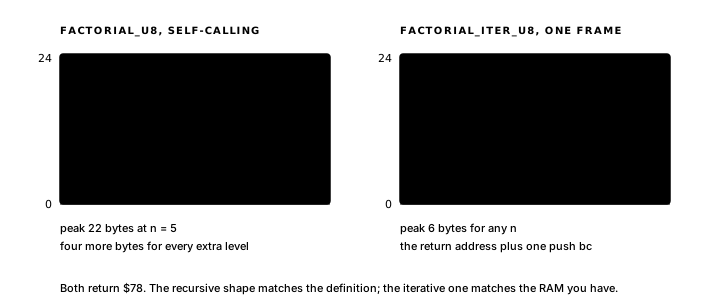
main calls both with B = 5 and stores to fact_rec and fact_iter. After halt, both bytes at $8000 and $8001 should read $78 (120).
Preserving results across inner calls
The outer level still needs B = n for the multiply. That is why push bc / pop bc wrap the recursive call: the callee may clobber B, and the multiply helper clobbers further registers listed in its .routine block.
A routine making a second recursive call before storing the first result has the same problem with HL, the register used for 16-bit results in Book 3. One storage pattern is:
    call first_rec
    ld (ix-1), l        ; or push HL, workspace word, etc.
    ld (ix-2), h
    call second_rec
    ; reload first result before combining
The IX frame from Book 2 Chapter 11 is the structured way to hold those slots when a routine needs several locals that must survive multiple calls (for example, Towers of Hanoi with two recursive counts before combining). This chapter's factorial only needs one saved register pair; push bc is enough.
Recursive list walk: sum_u8_rec
Summing a byte table recursively matches Chapter 2's array indexing, but the accumulation happens on unwind:
- Base: zero bytes left → HL = 0.
- Step: add
numbers[0]to the sum ofnumbers[1..].
NUMS_LEN .equ 5

demo_nums:
.db 2, 3, 5, 7, 9; sum_u8_rec: sum bytes table[0 .. A-1] into HL (A = count on entry)
; Self-call; four bytes per non-base level plus a two-byte base return address.
.routine in HL,A out HL clobbers AF,BC,DE
sum_u8_rec:
or a
jr z, _zero
ld b, a
ld a, (hl)
push af
inc hl
dec b
ld a, b
call sum_u8_rec
pop af
ld e, a
ld d, 0
add hl, de
ret
_zero:
ld hl, 0
retBase case: A = 0 → HL = 0.
Recursive step: read the head byte, push af to hold it while the tail sum runs in HL, recurse with A - 1, then pop the head into A and promote it into DE (ld e, a / ld d, 0) before add hl, de.
Each non-base level keeps one two-byte AF value and has one two-byte recursive return address. The base call adds its two-byte return address alone. For NUMS_LEN = 5, maximum occupancy is therefore 5 × 4 + 2 = 22 bytes.
From main:
    ld hl, demo_nums
    ld a, NUMS_LEN
    call sum_u8_rec
    ld (sum_rec), hl
sum_rec at $8002 should hold $001A (26). A single-step trace of the routine shows HL growing after each ret during the unwind.
Register contracts on recursive entries
Recursive routines use the same register contract shape as every other routine (Book 1 Chapter 6):
- human
;line stating the job - one
.routinedirective within,out,maybe-out,clobbersorpreservesas needed - a non-local entry label, exported with
@only when another source unit imports it
Self-calls add two documentation requirements:
- The human comment identifies recursion (
; Self-call; ...), making the need for stack arithmetic explicit. - The stack budget appears in
.equconstants (FACT_STEP_BYTES,FACT_BASE_BYTES,FACT_MAX_DEPTH) or in the comment block, where a reader working on the routine will find it.
Register contracts (azm --rc warn) still check each call site against the callee contract. They do not yet multiply depth by frame size; overflow prevention stays your compile-time inequality and testing on hardware. When a recursive routine uses an IX frame, include IX in clobbers unless the epilogue restores it, same rule as Book 2 Chapter 11.
Internal labels use owner-local names such as _one and _zero.
Stack-overflow failure
Stack overflow on the Z80 is silent. SP decrements through your globals; stores from later push or ld (ix+d), a corrupt unrelated bytes; ret pops garbage into PC.
Symptoms you might see in the emulator:
- correct results for small inputs, nonsense for large ones
- execution running past
haltbecause PC jumped into data - workspace or table bytes changing while stepping through unrelated code
Book 3 uses four defenses:
- input caps expressed with
.equand explained in comments - a stack top kept away from
.org $8000data, such as$9FFFor the board's RAM limit - an iterative version when input-driven data makes depth unbounded
- a frame count established before deep recursion is used in the capstone
Memory diagram: stack growth on a call chain
factorial_u8(5) before the deepest call returns:
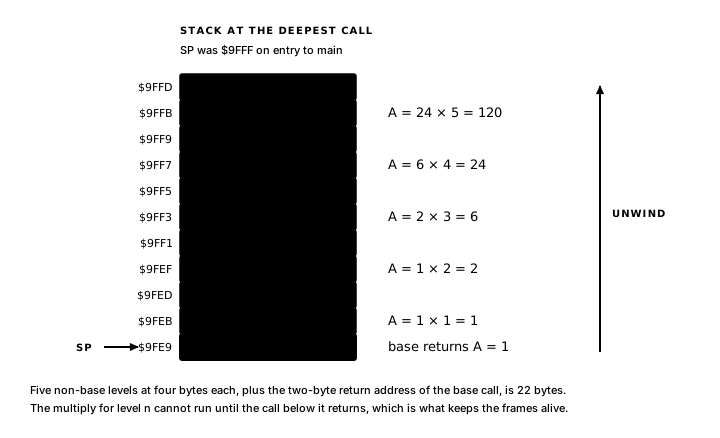
Only SP walks; the data at $8000 stays where it is.
main orchestration
.org $0000
main:
    ld sp, STACK_TOP

    ld b, FACT_N
    call factorial_u8
    ld (fact_rec), a

    ld b, FACT_N
    call factorial_iter_u8
    ld (fact_iter), a

    ld hl, demo_nums
    ld a, NUMS_LEN
    call sum_u8_rec
    ld (sum_rec), hl

    halt
Inspecting the call chain
| File | What to verify |
|---|---|
examples/06_factorial.asm | fact_rec = fact_iter = $78 (120); sum_rec = $001A (26) |
azm examples/06_factorial.asm
azm --rc warn examples/06_factorial.asm
A trace of factorial_u8 with FACT_N = 3 exposes the pushes on the way down and the multiplies on the way up. The complete file can then run to halt.
Exercise
Factorial trace and range. A trace of factorial_u8(4) should show the recursive calls and unwind multiplications. A second run with FACT_N = 6 needs a predicted byte for both factorial routines and an explanation of why matching bytes do not establish that 6! was represented exactly.