Bit Patterns
Chapters 2 and 3 treated each byte as one number. Hardware status registers, UART flags and packed record fields assign separate meanings to individual bits. examples/04_bit_flags.asm tests, sets, clears and extracts flags from one status byte.
Eight flags in one byte
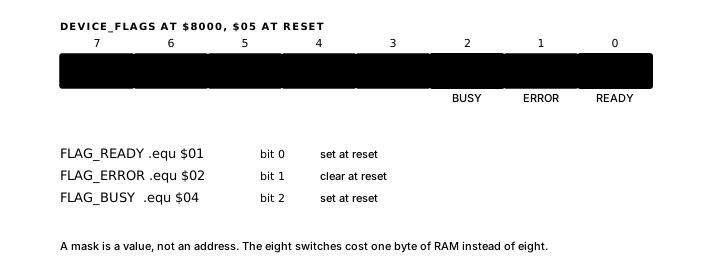
A device reports ready, error and busy in a single status register at $8000. The example has four requirements:
- An LED reflects whether ready was set at startup.
- An error can be recorded while ready stays set.
- Busy clears after the operation finishes.
- A separate byte stores the error bit as
$00or$01for a later test.
Named bit masks let one byte hold the eight flags, at the cost of masking or shifting whenever code accesses one of them.
Bit positions as an enum, masks as shifts
A flag has two numbers: its position (0, 1, 2) and its mask ($01, $02, $04). Written as six separate .equ lines they can disagree. An enum names the positions once, and each mask is a shift of the position it belongs to:
StatusBit .enum Ready, Error, Busy

FLAG_READY .equ 1 << StatusBit.Ready
FLAG_ERROR .equ 1 << StatusBit.Error
FLAG_BUSY  .equ 1 << StatusBit.Busy
.enum assigns 0 to the first member, 1 to the second and so on, so StatusBit.Busy is 2 and FLAG_BUSY folds to $04 at assembly time. Members are always qualified: Busy on its own is an error, and StatusBit.Busy is the spelling AZM accepts. Inserting a member renumbers every position after it, and the masks follow.
FLAG_READY is not a memory address; it is the value $01 substituted wherever it appears. Combining flags at assembly time is or:
INITIAL .equ FLAG_READY | FLAG_BUSY ; $05At run time you still load the live byte from (device_flags) into A.
AND, OR, XOR on A
| Instruction | Effect on bits |
|---|---|
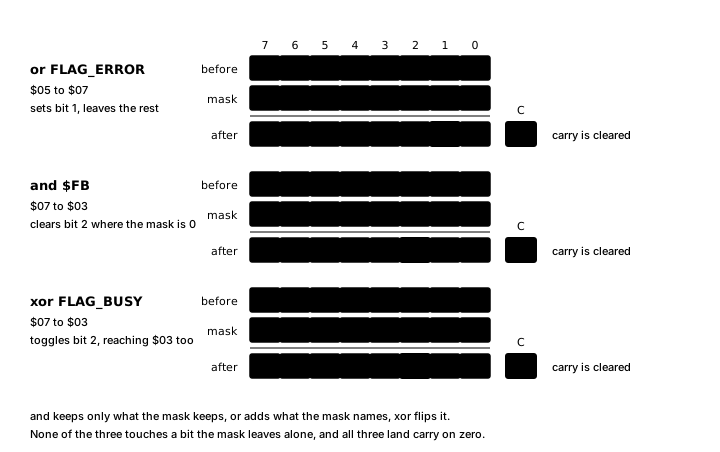
or mask | Sets every bit where mask is 1; leaves other bits unchanged |
and mask | Clears every bit where mask is 0; keeps bits where mask is 1 |
xor mask | Toggles bits where mask is 1 |
Set bit 1 (error):
    ld a, (device_flags)
    or FLAG_ERROR
    ld (device_flags), a
Test bit 0 (ready), leaving the stored byte alone:
    ld a, (device_flags)
    and FLAG_READY
    ; Z set -> ready bit was clear
Clear bit 2 (busy): clearing requires and with the inverted mask. For FLAG_BUSY ($04), the clear mask is $FB:
    ld a, (device_flags)
    and $FB
When A already holds the live flag byte, copy it before loading and inverting the clear mask:
    ld b, a
    ld a, FLAG_BUSY
    cpl
    and b
cpl complements A ($04 → $FB).
op for flag idioms
An op can name a short sequence that repeats within one file. Its instructions expand inline at each use. Book 1 Chapter 7 covers op declarations.
op bit_set(mask imm8)
  or mask
end

op bit_clr(mask imm8)
  ld b, a
  ld a, mask
  cpl
  and b
end

op bit_test(mask imm8)
  and mask
end
The status byte must be in A before the test:
    ld a, (device_flags)
    bit_test FLAG_READY
    jr z, _not_ready
bit_test expands to a single and mask on A.
Shifts: move bits, watch carry
Logical shifts move bit positions for multiply/divide tricks and for isolation:
| Instruction | What moves |
|---|---|
rlca / rrca | Rotate A circularly; the bit that wraps is also copied into carry |
rla / rra | Rotate A through carry: A and the carry form a 9-bit ring |
sla r | Shift left; bit 0 ← 0; high bit → carry |
srl r | Shift right; high bit ← 0; low bit → carry |
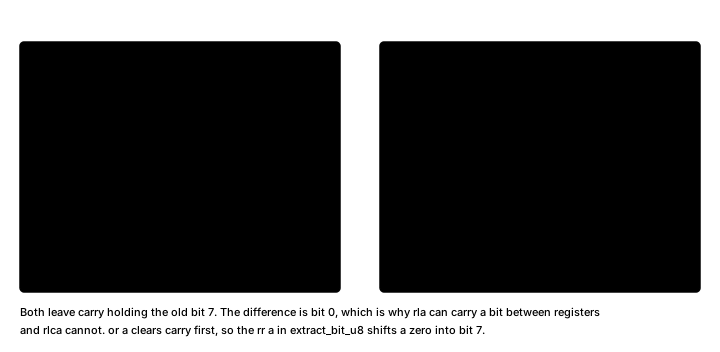
Extract bit 1 into bit 0 after masking:
; extract_bit_u8: error bit as 0 or 1 in A
.routine in A out A clobbers F
extract_bit_u8:
    and FLAG_ERROR
    rr a
    ret
One rr a moves that bit into position 0. Result in error_bit should be $01 when the error flag is set.
For a general bit index n, loop n times with srl a, or use the Z80 bit n, r instruction (sets Z if bit clear) when a branch is all you need.
bit n, r for branches only
    ld a, (device_flags)
    bit StatusBit.Busy, a
    jr nz, _still_busy
bit takes a bit position, not a mask. StatusBit.Busy supplies position 2, while FLAG_BUSY would mean bit 4. The assembler emits CB 57, the same two bytes as bit 2, a.
bit sets flags and leaves A alone. and mask is the appropriate form when storage requires a numeric 0/1 in A.
Trace: flags from $05 to $03
Initial value: $05 = ready + busy ($01 | $04).
| Step | A | Action |
|---|---|---|
| test ready | $05 | and $01 → NZ → ready_lit = 1 |
| set error | $07 | or $02 |
| clear busy | $03 | and $FB clears bit 2 |
| extract error | $01 | and $02, rr a |
After halt, (device_flags) should be $03, (ready_lit) $01, (error_bit) $01.
Packed flags inside records (preview)
Chapter 5 stores structs as bytes. A status nibble and a type nibble can share one byte:
  bit 7 6 5 4 3 2 1 0
       [  type  ][flags]
offset and sizeof tell you which byte; the masks in this chapter work inside it.
main in the example
.org $0000
main:
    ld a, (device_flags)
    bit_test FLAG_READY
    ...

    ld a, (device_flags)
    bit_set FLAG_ERROR
    ld (device_flags), a

    ld a, (device_flags)
    bit_clr FLAG_BUSY
    ld (device_flags), a

    ld a, (device_flags)
    call extract_bit_u8
    ld (error_bit), a
    halt
Inspecting the flag byte
After examples/04_bit_flags.asm runs, device_flags should be $03, ready_lit should be 1 and error_bit should be 1:
| File | What to verify |
|---|---|
examples/04_bit_flags.asm | device_flags = $03, ready_lit = 1, error_bit = 1 |
azm examples/04_bit_flags.asmAZM writes examples/04_bit_flags.lst by default. The bit_set invocation remains visible as the source line, with the two bytes emitted by its or expansion shown beside it.
Exercise
Mask trace. A trace starting with A = $05 should show A after setting error, clearing busy and toggling ready in that order. Each value should appear in binary beside the mask used for that step.