Strings
Chapter 2 walked a byte table with a fixed length in B. Text in memory usually carries its end inside the data: a sentinel byte stops the walk. The complete program in examples/03_string_length.asm measures, copies, compares and searches one null-terminated string.
Finding where the text ends
The examples cover three common operations: finding a message length before formatting a screen line, copying a label into a buffer and locating the first '/' in a path.
Representation: null-terminated bytes
A null-terminated string (C-style) is a sequence of byte values followed by a zero byte $00, which marks the end of the text.
.org $8000
message:
    .db "HELLO", 0
buffer:
    .ds byte[8]
message points at 'H'.
AZM also accepts a string directive that appends the terminator automatically (Book 2 Chapter 3):
message:
    .cstr "HELLO"
Both forms emit the same bytes: 48 45 4C 4C 4F 00.
Length vs capacity
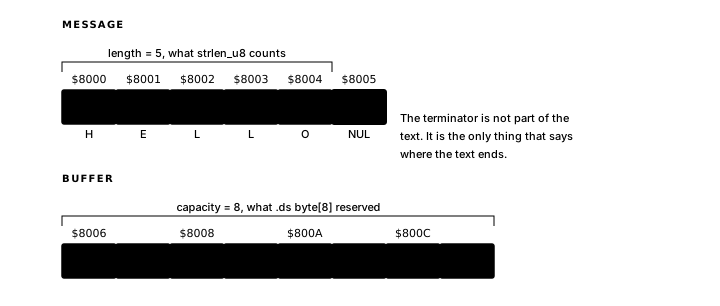
Length and capacity describe different limits:
| Concept | Meaning |
|---|---|
| Length | Characters before the null — five for "HELLO". |
| Capacity | Bytes reserved in RAM — eight in buffer above. |
strcpy must not write past capacity if the source is longer than the destination buffer. This chapter copies into a buffer sized for the demo; Chapter 5's records are a natural place to store (capacity) beside (data).
The alternative: length in byte zero
Byte 0 holds the count, bytes 1..n hold the text. That saves a scan for length but shifts every pointer (HL must skip the count byte). Null-terminated layout is the convention in this book because the walk is uniform; every algorithm uses the same ld a,(hl) / or a / jr z spine.
String calling convention
Unless a routine says otherwise, Book 3 string routines use:
| Role | Register | Notes |
|---|---|---|
| Current / source pointer | HL | Points at next byte to read |
| Destination pointer | DE | Used by copy and compare |
| Search character | C | Compared with cp c |
| Length or index result | A | 0–255; these routines handle strings of up to 255 bytes |
| Not found sentinel | A = $FF | Same idea as Chapter 2 search |
Callee-save: push BC/DE/HL when you use as scratch any register the .routine block leaves out of clobbers.
Invariant for traversal (owner-local label _loop or _scan):
HL points at the next byte to examine. All bytes before HL in this string have already been processed.
The core loop: test for zero and keep the byte
    ld a, (hl)
    or a
    jr z, _at_end
    ; ... use A as the character ...
    inc hl
or a sets the Zero flag from A's value and leaves A intact. It occupies one byte, one fewer than cp 0.
strlen_u8: count before the null
; strlen_u8: count bytes before null (does not include terminator)
.routine in HL out A clobbers F,B,HL
strlen_u8:
    ld b, 0
_loop:
    ld a, (hl)
    or a
    jr z, _done
    inc hl
    inc b
    jr _loop
_done:
    ld a, b
    ret
The loop invariant: at _loop, B equals the number of non-null bytes already passed.
The 8-bit result limits this routine to strings of at most 255 bytes. Longer strings make B wrap to zero before the terminator.
For message above, str_len at $800E should hold $05 after halt.
strcpy_u8: copy byte-by-byte through the null
Copying uses two pointers: HL reads, DE writes.
; strcpy_u8: copy null-terminated string HL -> DE (terminator included)
.routine in HL,DE out DE clobbers AF,HL
strcpy_u8:
_copy:
    ld a, (hl)
    ld (de), a
    inc hl
    inc de
    or a
    jr nz, _copy
    ret
The last iteration copies the zero terminator so later code can scan buffer with the same null-terminated walk.
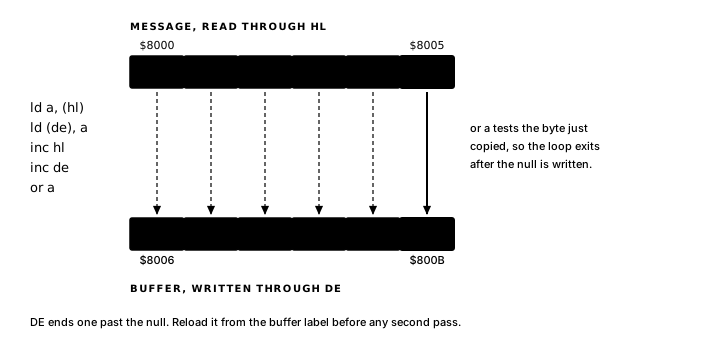
After call strcpy_u8, DE points one byte past the null, so main reloads both pointers before the compare: ld hl, buffer and ld de, message.
str_find_char: linear search with an index
Chapter 2's find_byte_ge returned the first index where values[i] >= C. String search is the same walk with a different test:
; str_find_char: index of first C in string, or $FF if absent
.routine in HL,C out A clobbers F,B,HL
str_find_char:
    ld b, 0
_scan:
    ld a, (hl)
    or a
    jr z, _missing
    cp c
    jr z, _found
    inc hl
    inc b
    jr _scan
_found:
    ld a, b
    ret
_missing:
    ld a, $FF
    ret
Invariant at _scan: every byte at index < B differs from C.
For 'L' in "HELLO", find_index should be $02 (0-based).
strcmp_u8: walk two strings together
Lexicographic compare reads one byte from each string until bytes differ or both are null.
; strcmp_u8: 0 if equal, 1 if HL string greater, $FF if less
.routine in HL,DE out A clobbers F,BC,HL,DE
strcmp_u8:
_loop:
    ld a, (hl)
    push af
    ld a, (de)
    pop bc
    cp b
    jr c, _greater
    jr nz, _less
    or a
    jr z, _equal
    inc hl
    inc de
    jr _loop
_less:
    ld a, $FF
    ret
_greater:
    ld a, 1
    ret
_equal:
    xor a
    ret
Order matters: compare characters before you decide both strings ended. A holds the DE character and B holds the HL character, so cp b computes DE - HL. Carry therefore means the HL string is greater. If both bytes are zero, Z remains set and _equal returns 0. If one string is a prefix of the other, the zero byte orders the shorter string before the longer one.
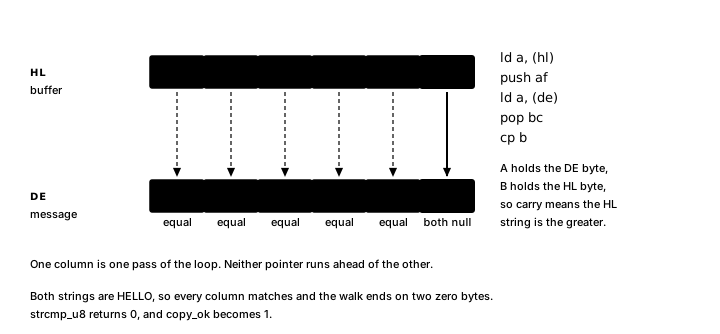
The example copies message into buffer, then compares the two buffers. copy_ok at $800F should be $01.
Preparing for print: digits and terminators
Display routines need ASCII, so a small integer is converted digit by digit. A decimal-output loop divides the value by 10, adds '0' to each remainder, stores the digits backward into a small buffer and appends a null terminator.
Sketch of the invariant for decimal output into a byte buffer at DE:
HL (or DE) points at the next free byte leftward; the digits emitted so far sit to the right; when the value reaches zero, the digits are complete.
Storing "42", 0 in RAM provides a result that can be verified after halt.
main: orchestration
.org $0000
main:
    ld hl, message
    call strlen_u8
    ld (str_len), a

    ld hl, message
    ld de, buffer
    call strcpy_u8

    ld hl, buffer
    ld de, message
    call strcmp_u8
    or a
    jr nz, _copy_bad
    ld a, 1
    jr _store_copy_ok
_copy_bad:
    xor a
_store_copy_ok:
    ld (copy_ok), a

    ld hl, message
    ld c, CHAR_L
    call str_find_char
    ld (find_index), a
    halt
Memory layout after halt
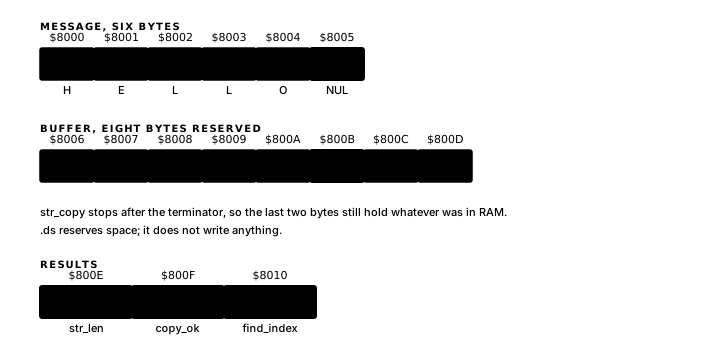
Running the string routines
examples/03_string_length.asm should leave str_len = 5, copy_ok = 1 and find_index = 2:
| File | What to verify |
|---|---|
examples/03_string_length.asm | str_len = 5, copy_ok = 1, find_index = 2 |
azm examples/03_string_length.asm
azm --rc warn examples/03_string_length.asm
A single-step trace of strlen_u8 shows B incrementing only for non-zero bytes and HL stopping on the null.
Exercise
Sentinel walk. With message changed to .db "AZM", 0, a prediction should give str_len and the indices returned when C is 'M', 'A' and 'Z'. A RAM check can verify all four results, and the explanation should state the traversal invariant at the top of str_find_char.