Stack and Subroutines
Larger programs need to reuse logic (the same comparison, the same output routine, the same byte-copying sequence) called from a dozen different places.
Subroutines
call and ret are the Z80's entire subroutine mechanism. The CPU stays in the same mode throughout, the bytes of a subroutine body are ordinary instructions like any others, and the stack is the only record of how deep the calls have gone.
The call instruction
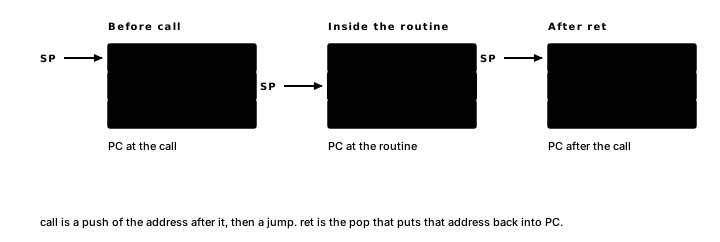
call label is a push of the return address followed by a jump, two operations in one opcode. Concretely:
- Pushes the address of the instruction following the
callonto the hardware stack (this is the return address). - Jumps to
label.
The instruction is always 3 bytes long.
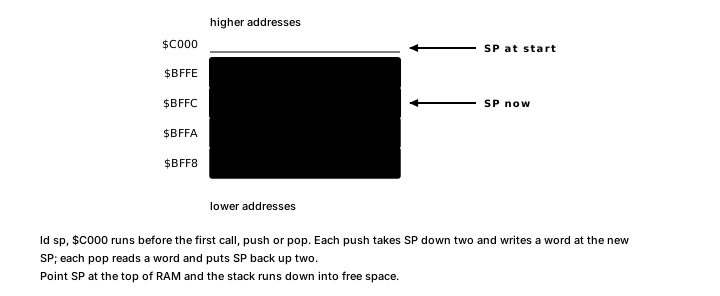
The hardware stack is a region of RAM used as a last-in-first-out buffer. When call pushes a word onto the stack, SP decreases by two (the stack grows downward in memory on the Z80). The return address is stored at the new SP.
The ret instruction
ret is equivalent to pop pc, if such an instruction existed. The CPU reads the top two bytes of the stack into the program counter, increments SP by two and execution resumes at the instruction after the original call.
The hardware stack
The program determines where the stack lives by loading SP with a starting address before any call, push or pop instruction. A common choice is the top of available RAM: ld sp, $BFFF (or whichever address marks the last byte of RAM on the target).
Each push decreases SP by two and writes a 16-bit value. Each pop reads two bytes and increases SP by two.
Passing values through registers
A calling convention on the Z80 is an agreement between a routine and its callers, kept by the code on both sides. The conventions used in these chapters are:
- A carries a single byte result or input value.
- HL carries a 16-bit result or input value.
- BC and DE carry secondary input values.
The comment header records which registers a subroutine reads on entry and which it modifies on exit. This record is the contract between the subroutine and its caller.
; add_bytes: add two byte values.
; In:  B = first byte, C = second byte
; Out: A = B + C
; Preserves: BC, DE, HL
; Clobbers: F
add_bytes:
  ld a, b
  add a, c
  ret
Preserves means those registers hold the same values after the call that they held before. Clobbers names the registers the routine may leave holding something else.
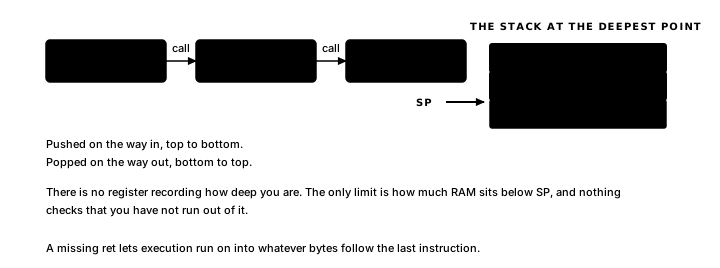
Every subroutine in AZM is a plain label followed by instructions, ending with ret. If you forget ret, control falls through into whatever bytes follow the last instruction, which is almost always wrong.
push and pop: saving and restoring registers
push hl: SP is decremented by two, then the contents of HL are written to the two bytes at the new SP address, as if ld (sp), hl were an instruction.
pop hl is the inverse: two bytes are read from the address in SP into HL, then SP is incremented by two, as if ld hl, (sp) were an instruction.
The operand can be any of AF, BC, DE, HL, IX or IY.
A subroutine uses push / pop to preserve registers it needs to modify internally. The pattern:
example:
  push bc          ; save caller's BC on entry
  ; ... use BC for internal work ...
  pop bc           ; restore caller's BC before returning
  ret
The critical rule is that SP must have the same value at ret that it had immediately after the corresponding call, unless the routine deliberately implements a different calling convention. A pushed word may be popped into a different register, but every path to ret must remove all temporary stack entries. Otherwise ret reads a temporary value as its return address.
Cross-register moves through the stack
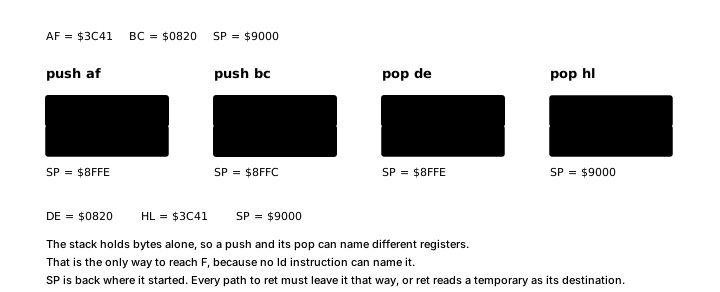
You can push one pair and pop into a different pair: the stack holds two bytes, and the pop decides where they land. That gives a route between any two register pairs:
  push af         ; save AF onto the stack
  push bc         ; save BC onto the stack
  pop de          ; DE <- what was in BC
  pop hl          ; HL <- what was in AF
The second transfer (AF into HL) is particularly useful. The stack is the one route out of F: push af puts the flags byte in memory, and any pop can collect it.
If you swap the pop order above, DE gets AF and HL gets BC, the reverse of what a top-to-bottom reading suggests.
Shadow registers: saving state with exx
In a tight interrupt handler or innermost loop, saving BC, DE and HL via push and pop costs six instructions (three pushes, three pops) and takes six bytes of stack space. exx does the same job in a single instruction: it swaps BC, DE and HL with a second hidden set of registers (BC′, DE′, HL′) simultaneously. A second instruction, ex af, af′, swaps A and F with their shadow counterparts.
These are the shadow registers: a second, hidden copy of A, F, B, C, D, E, H and L. exx and ex af, af′ are the only way in: a shadow value has to be swapped into the main set before an instruction can use it.
The trade-off is that there is only one shadow set. If both the main code and an interrupt handler rely on exx, the interrupt can silently destroy the values stored by the main code. Shadow registers are therefore suitable only when speed matters and one context has exclusive use of them.
Conditional return: ret cc
The Z80 also provides conditional return instructions: ret z, ret nz, ret c, ret nc and so on. ret z pops the return address and returns only if Z is set; otherwise it falls through to the next instruction.
This is useful for early-exit patterns:
check_nonzero:
  or a          ; test A for zero
  ret z         ; return immediately if A is zero
  ; ... rest of the subroutine runs only when A != 0 ...
  ret
When using ret cc, the stack must be balanced at the conditional return point just as it must be at the final return.
Nested calls and stack depth
A subroutine can itself call another subroutine. Each call pushes another return address; each ret pops one.
The only limit is the size of the RAM region allocated to the stack. A program that calls too many levels deep, or forgets to pop before returning, will overwrite RAM used for other purposes.
The example: learning/book2/examples/06_subroutines.asm
.org $8000
result_add: .db 0
result_max: .dw 0
The program has a main entry point and two helper subroutines.
add_bytes: the simplest subroutine.
; add_bytes: add two byte values.
; In:  B = first byte, C = second byte
; Out: A = B + C
; Preserves: BC, DE, HL
; Clobbers: F
add_bytes:
  ld a, b
  add a, c
  ret
The subroutine modifies only A, so BC, DE and HL are naturally preserved. The caller passes 20 in B and 10 in C:
  ld b, $14
  ld c, $0A
  call add_bytes        ; A = 30
  ld (result_add), a
After the call, result_add holds 30 ($1E).
max_word: push/pop for preservation.
; max_word: return the larger of two 16-bit values.
; In:  HL = first value, DE = second value
; Out: HL = larger value
; Preserves: DE
; Clobbers: F
max_word:
  push de
  or a
  sbc hl, de
  jr c, max_is_de
  add hl, de
  pop de
  ret                ; HL held the original (larger) value
max_is_de:
  pop hl             ; saved DE is the larger value; DE itself is unchanged
  ret
or a and sbc hl, de modify F; the comment header documents this.
The or a before sbc hl, de clears the carry flag. sbc hl, de subtracts DE from HL including the carry bit, so carry must be clear before the instruction for a pure 16-bit subtraction.
After sbc hl, de, the carry flag indicates the comparison result:
- Carry clear: HL was greater than or equal to DE (no unsigned borrow). HL now holds
original_HL - DE.add hl, derestores the original HL, andpop deremoves the saved word while restoring DE. - Carry set: HL was less than DE (unsigned borrow occurred). The saved DE value is the larger word.
pop hlloads that saved value directly into HL. DE still holds its incoming value, so the declared preservation holds.
The or a / sbc hl, de pair performs an unsigned 16-bit comparison. Each path then obtains the required result while consuming the saved stack word.
The caller passes 80 ($0050) in HL and 200 ($00C8) in DE:
  ld hl, $0050
  ld de, $00C8
  call max_word         ; HL = $00C8
  ld (result_max), hl
After the call, result_max holds 200.
Stack balance in max_word. The subroutine pushes one word. The carry-clear path removes it with pop de; the carry-set path removes it with pop hl. Both paths reach ret with the temporary word gone and DE unchanged.
An advanced trick: reading the program counter
call pushes the address of the next instruction onto the stack, which allows code to obtain the current PC:
  call next_instr       ; pushes address of next_instr onto the stack
next_instr:
  pop hl                ; HL = address of this instruction
call next_instr targets the instruction immediately after the call, so its only useful effect here is pushing that instruction's address. pop hl retrieves the address of next_instr.
Balance is all the stack requires: call pushed one word and pop hl consumed it, so execution carries straight on into the next instruction.
Exercise
Stack trace. With SP = $C000, AF = $1234 and BC = $5678, a four-instruction trace should give SP and the two bytes written or read at each step, followed by final DE, HL and SP.
push af
push bc
pop de
pop hl