Counting Loops and DJNZ
The dec b / jp nz loop from Chapter 5 uses two instructions for one repeated operation: decrement B, then branch while it is non-zero. DJNZ combines those steps. This chapter uses it in counted, sentinel and flag-exit loops.
The two-instruction loop
The earlier counted loop had this shape:
ld b, Limit
loop_top:
  ; ... body ...
  dec b
  jp nz, loop_top
DJNZ: decrement B and jump if not zero
djnz label performs three steps:
- B decreases by one.
- If B is now non-zero, jump to
label. - If B is now zero, fall through to the next instruction.
The single instruction replaces dec b / jp nz, label. It is one byte smaller than the dec b / jr nz form (2 bytes vs 3) and two bytes smaller than dec b / jp nz (2 bytes vs 4).
djnz is a relative jump, like jr. Its signed displacement is measured from the address after the instruction, giving a target range of 128 bytes backward to 127 bytes forward from that address. If the loop body is too long, the assembler reports an error and the loop requires dec b / jp nz instead.
The loop structure with explicit labels
Every DJNZ loop has the same three parts:
- Init: load B with the iteration count before the loop.
- Body: the instructions that run each iteration.
- Branch-back:
djnzat the end of the body, targeting the body label.
ld b, 5           ; init: B = iteration count
loop_top:
  ; body
  djnz loop_top   ; branch-back: B--; if B != 0, go to loop_top
The label loop_top sits at the first instruction of the body, not before the ld b initializer. With the ld b init missing, B holds whatever the previous code left in it and the loop runs that many times.
The zero-count hardware semantic
djnz uses B as an 8-bit counter, and ld b, 0 is the case worth knowing about.
On the Z80, DJNZ decrements B before testing. If B starts at 0, the decrement wraps to 255 ($FF), the result is non-zero and the jump is taken. The loop continues from B = 255 and runs a further 255 times before B reaches zero again. Total: 256 iterations.
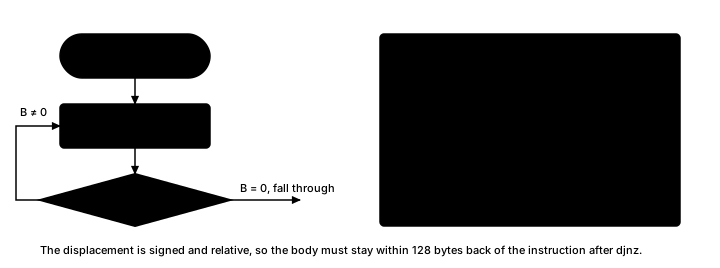
ld b, 0 before djnz is valid Z80; it gives 256 iterations and some programs use it deliberately for exactly that reason.
A DJNZ loop must not receive B = 0 when zero iterations are intended. A runtime count that may be zero requires a test before the loop:
ld a, (count_value)
or a               ; test whether count_value is zero
jr z, skip_loop    ; skip the entire loop if count is zero
ld b, a
loop_top:
  ; body
  djnz loop_top
skip_loop:
A count known at write-time to be between 1 and 255 can go straight into B.
Register State After a Loop
The counted loop from Section A of the example below sums the five bytes 3, 7, 2, 8, 5:
ld hl, addends
ld b, TableLen      ; B = 5
ld a, 0
djnz_loop:
  add a, (hl)
  inc hl
  djnz djnz_loop
ld (total), a
When the loop exits: B is zero (that was the exit condition). A holds 25 (the accumulated sum). HL points one byte past the last element: it was incremented after reading each entry, so after five elements it has advanced five positions beyond the base.
If another variable is stored immediately after the table, HL now points at it. A stray ld (hl), a at this point would overwrite that variable, and the hardware would carry out the write like any other.
Sentinel loops
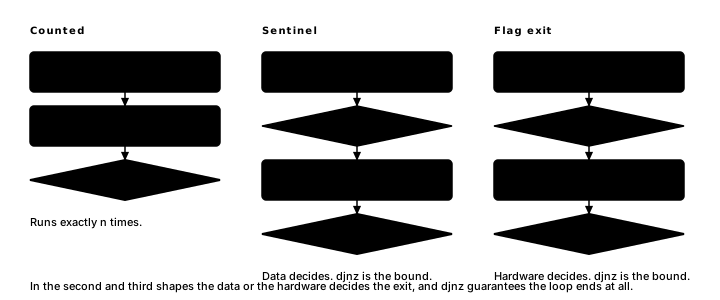
A sentinel loop tests each element against a known value. The data tells it when to stop.
The structure uses cp and jr z instead of DJNZ as the exit mechanism:
ld hl, table_base
sentinel_loop:
  ld a, (hl)
  cp sentinel_value
  jr z, found        ; exit when the sentinel value is seen
  inc hl
  jr sentinel_loop   ; keep going (no bound check here)
found:
The value test is this form's only exit, so a table that never contains the sentinel sends the loop past the end. A safe sentinel loop pairs the value test with a DJNZ bound:
ld hl, table_base
ld b, TableLen       ; guard against overrun
sentinel_loop:
  ld a, (hl)
  cp sentinel_value
  jr z, found
  inc hl
  djnz sentinel_loop ; DJNZ as the overrun guard
  jr not_found       ; fell through without a match
found:
Flag-exit loops
A flag-exit loop runs until an arithmetic condition becomes true, then exits through the flag. A typical case: accumulate values until the sum exceeds a threshold.
ld hl, table_base
ld a, 0
ld b, TableLen
flag_loop:
  add a, (hl)
  inc hl
  cp threshold
  jr nc, done    ; exit when A >= threshold (carry clear means A >= threshold)
  djnz flag_loop
done:
The two conditions are independent: whichever fires first ends the loop.
The example: examples/04_djnz_loops.asm
TableLen .equ 5

.org $8000
total:   .db 0
scanval: .db 0
flagval: .db 0

.org $8010
addends: .db 3, 7, 2, 8, 5
Whether $8010 lands in ROM or in RAM is a property of your hardware; .org only says where the bytes go.
The program runs three loop forms side by side over the same five-element table.
Section A: DJNZ counted loop.
ld hl, addends
ld b, TableLen
ld a, 0
djnz_loop:
  add a, (hl)
  inc hl
  djnz djnz_loop
ld (total), a
ld hl, addends sets HL to the address of the first entry. ld b, TableLen sets B to 5. The body adds the current byte at HL to A and increments HL. After 5 iterations B = 0, the loop exits, and total receives 25 ($19): the sum of 3 + 7 + 2 + 8 + 5.
Section B: sentinel loop (cp / jr z).
ld hl, addends
ld b, TableLen
sentinel_loop:
  ld a, (hl)
  cp 8
  jr z, sentinel_found
  inc hl
  djnz sentinel_loop
  ld a, $FF
  jr sentinel_done
sentinel_found:
  ld a, (hl)
sentinel_done:
  ld (scanval), a
The loop scans the table for the value 8. cp 8 tests the current byte. When it matches, Z is set and jr z, sentinel_found exits the loop; A receives the matched byte. DJNZ provides the overrun guard: if 8 were not present, the loop would exhaust all five entries and fall through to ld a, $FF. Because 8 is the fourth entry, scanval receives 8.
Section C: flag-exit loop.
ld hl, addends
ld b, TableLen
ld a, 0
flag_loop:
  add a, (hl)
  inc hl
  cp $10
  jr nc, flag_done
  djnz flag_loop
flag_done:
  ld (flagval), a
The loop accumulates bytes until the sum reaches or exceeds 16 ($10). After adding 3, the sum is 3: cp $10 sets carry (3 < 16), so jr nc does not branch. After adding 7, the sum is 10, still less than 16. After adding 2, the sum is 12, still less. After adding 8, the sum is 20; cp $10 finds 20 >= 16, carry is clear, jr nc exits. flagval receives 20 ($14).
Choosing between DJNZ, sentinel and flag-exit
DJNZ is the right choice when you know exactly how many iterations to run before the loop starts.
A sentinel loop is right when the stopping condition is "find this value."
A flag-exit loop is right when the stopping condition is "some computed quantity has crossed a threshold."
In practice, most Z80 loops are counted loops, since DJNZ is compact and the iteration count is usually known before the loop starts.
Exercise
The zero-count case. A byte named iterations, incremented once in this loop body, makes the hardware behaviour observable. The prediction should give B and iterations after runtime counts 0, 1 and 255.
ld a, (count_value)
ld b, a
loop_top:
  ; increment iterations here
  djnz loop_top
A guarded version should make count 0 produce zero iterations while retaining the ordinary meanings of 1 and 255. All three emulator runs should agree with the prediction.