Arithmetic Foundations
Greatest common divisor on 16-bit values comes first, then 8-bit exponentiation. The complete program in examples/01_gcd.asm stores both results in RAM for inspection after halt.
Greatest common divisor
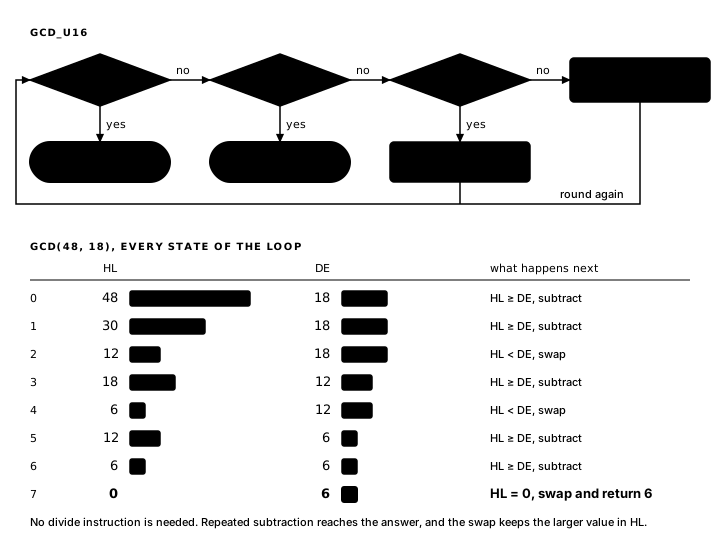
The greatest common divisor of two integers is the largest value that divides both exactly. For 48 and 18, the answer is 6.
Euclid's method gets there with subtraction alone:
- If the right value is zero, the left value is the answer.
- If the left is greater than or equal to the right, subtract the right from the left.
- Otherwise swap the two values.
- Control returns to step 1.
Book 3 calling convention (16-bit)
Book 3 adds a 16-bit family used in this chapter and reused later unless a chapter says otherwise.
| Role | Register | Notes |
|---|---|---|
| First 16-bit argument | HL | Unsigned, little-endian |
| Second 16-bit argument | DE | Unsigned, little-endian |
| 16-bit result | HL | Returned in place of first argument when possible |
| 8-bit count / exponent | B | Caller-save; consumed by djnz loops |
| 8-bit scalar operand | C | Often a small constant operand |
| 8-bit byte result | A | |
| Table base address | HL | Same as 16-bit arg — context disambiguates |
| Table length | B | Element count for byte tables |
Caller-save: A, F, declared outputs and registers listed in .routine clobbers may change across the call. An input is also caller-save when the contract says the routine consumes or clobbers it.
Callee-save: every register outside the output and clobber lists must retain its incoming value. A routine that uses one as scratch must restore it before every ret.
Every subroutine in this book documents its contract with the register-contract notation Book 1 Chapter 6 covers.
Subtractive GCD in AZM
; gcd_u16: greatest common divisor (Euclidean, subtractive)
.routine in HL,DE out HL clobbers AF,DE
gcd_u16:
_loop:
    ld a, h
    or l
    jr z, _right_answer
    ld a, d
    or e
    jr z, _left_answer
    push hl
    or a
    sbc hl, de
    pop hl
    jr c, _swap
    or a
    sbc hl, de
    jr _loop
_swap:
    ex de, hl
    jr _loop
_left_answer:
    ret
_right_answer:
    ex de, hl
    ret
Zero tests
ld a, h / or l sets Z when HL is zero. These are the base cases: if either argument is zero, the other register pair holds the GCD. _left_answer returns HL as it stands; _right_answer swaps DE into HL first, so the caller always reads the result in HL.
Unsigned compare via sbc hl, de
or a clears carry. sbc hl, de computes HL − DE with borrow. If carry is set afterward, HL was less than DE (unsigned).
If HL ≥ DE, the second sbc hl, de performs the Euclidean subtraction step and the loop repeats.
ex de, hl swaps the two 16-bit arguments in a single byte of code.
Trace: GCD(48, 18)
| Step | HL | DE | Action |
|---|---|---|---|
| start | 48 | 18 | 48 ≥ 18 → subtract |
| 1 | 30 | 18 | 30 ≥ 18 → subtract |
| 2 | 12 | 18 | 12 < 18 → swap |
| 3 | 18 | 12 | 18 ≥ 12 → subtract |
| 4 | 6 | 12 | 6 < 12 → swap |
| 5 | 12 | 6 | 12 ≥ 6 → subtract twice |
| end | 0 | 6 | HL zero → swap DE into HL, return 6 |
main: calling and storing the result
.org $0000
main:
    ld hl, 48
    ld de, 18
    call gcd_u16
    ld (gcd_result), hl
    ...
    halt

.org $8000
gcd_result:
    .ds word
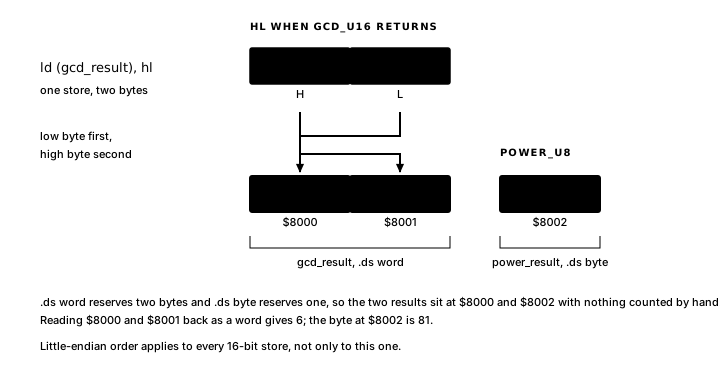
ld (gcd_result), hl stores a 16-bit little-endian value: low byte first, high byte second. After the program halts, the emulator shows $06 at $8000 and $00 at $8001.
Named constants keep the call site readable:
GCD_A .equ 48
GCD_B .equ 18
    ld hl, GCD_A
    ld de, GCD_B
Workspace RAM
Longer algorithms spill into workspace bytes reserved with .ds:
.org $8000
values:
    .db 9, 4, 6, 2, 8, 1, 7, 3
key_byte:
    .ds byte
sort_len:
    .ds byte
Book 3 follows four workspace rules:
- Workspace belongs in RAM and continues in the same
.orgblock as the data. Placement runs forward, so a later.orgbelow an earlier one leaves the cursor where it was, as Chapter 2 explains. .dsreserves the bytes and leaves whatever was there, so each byte must be written before it is read.- Each logical temporary has its own label naming what it holds, such as
key_byte. - Comments identify which routines touch each workspace label.
Chapter 2's insertion sort stores the current key in key_byte, placed after its table, because C, B and HL already hold indices, counts and addresses.
Second algorithm: power_u8
For small 8-bit operands, repeated multiplication is enough:
Contract: B = exponent, C = base, A = result (C^B). Zero exponent yields 1.
; power_u8: unsigned C^B into A (B may be 0 -> 1)
.routine in B,C out A clobbers F,B,E
power_u8:
    ld e, 1
_loop:
    ld a, b
    or a
    jr z, _done
    dec b
    ld a, e
    push bc
    call mul8_a_by_c
    pop bc
    ld e, a
    jr _loop
_done:
    ld a, e
    ret
mul8_a_by_c multiplies the accumulator in A by C using repeated addition, correct for the demo sizes (3^4 = 81).
The example stores the byte result at power_result. After halt, $8002 should hold $51 (81 decimal).
Memory diagram: results after main
Running the arithmetic example
examples/01_gcd.asm should reach halt with gcd_result = 6 and power_result = 81. These commands assemble it from book3/; the second also checks register contracts:
| File | What to verify |
|---|---|
examples/01_gcd.asm | gcd_result = 6, power_result = 81, then halt |
azm examples/01_gcd.asm
azm --rc warn examples/01_gcd.asm
Exercise
Euclid trace and invariant. A trace for inputs 270 and 192 should show HL and DE after the first five subtract-or-swap transitions. Its invariant should explain why each transition preserves the eventual answer, and a complete run should supply the returned GCD.