Cards
An arcade machine begins with an attract screen that blinks until a coin starts the game. Gameplay activates the rules, clock and score. After a loss, a result screen shows the outcome and offers another round. Most finished games have at least these three modes, with exactly one active at any instant.
In every program you have written so far, every block is in play on every frame. To hold three screens in one file with the toolkit you have, you would reach for a Mode fact and the same guard at the top of every body: compare Mode with the value for this screen. This chapter's game has thirteen blocks, so that is thirteen copies of one test. And the cost is worse than the typing: the headers, the design you have learned to read straight off the page, would leave each block's screen hidden in thirteen bodies.
Glimmer's word for a screen or mode is a card, borrowed from HyperCard, which built applications out of stacks of them. Exactly one card is active at a time. A card line starts a block-dispatch section: the blocks after it run only while that card is active. A card gates dispatch. State, pulses, timers and resources stay program-wide wherever you write them. Keeping them at the top of the file leaves the design in one place, while the card sections hold blocks.
Cards suit groups of blocks associated with mutually exclusive modes (screens, a pause, a round structure). Every program before this chapter had one screen, and one screen does fine on plain blocks.
Gate
The chapter's game is Gate, a small framework for three screens. At the splash, two pixels blink in the middle of the 8x8 RGB LED matrix, and any key starts a round. A round is 512 frames on a clock drawn as a shrinking green bar, and every press of GO scores a point on the seven-segment display. When the clock drains, the score appears as a red bar, and after a ninety-frame pause any key returns to the splash.
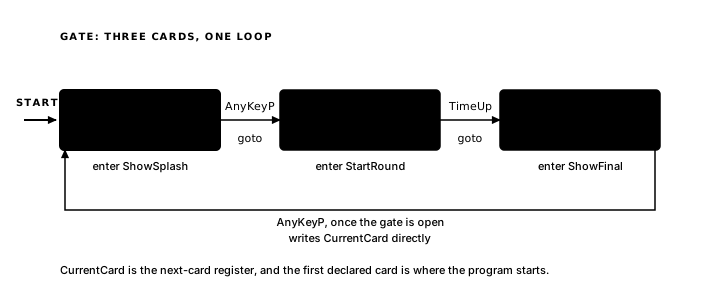
The complete game is one file, gate.glim. Above the first card line are the program-wide declarations (the facts, moments, and schedules every card shares):
program Gate

platform tec1g-mon3
display matrix8x8

state Score    : byte
state PromptOn : byte
state Armed    : byte

pulse AnyKeyP
pulse HitP
pulse BlinkTick
pulse TimeUp
pulse GateOpenP

timer Blink       : byte = 16 -> BlinkTick
timer PlayClock   : word = 0  -> TimeUp once
timer RestartGate : word = 0  -> GateOpenP once

bind key any    rising -> AnyKeyP
bind key KEY_GO rising -> HitP
PlayClock and RestartGate are one-shot timers holding zero: idle until a block writes them, and the blocks that write them arrive with their cards. The overlap in the bindings is deliberate: a press of GO fires both HitP and AnyKeyP because any runs alongside a matching named binding.
A card is a section
The first card line follows the globals, and the splash screen is everything from that line to the next one:
card Splash

enter ShowSplash
    updates PromptOn
begin
    call FbClear
    call HudBlankDig
    ld a,1
    ld (PromptOn),a
end

effect BlinkPrompt
    on BlinkTick
    updates PromptOn
begin
    ld a,(PromptOn)
    xor 1
    ld (PromptOn),a
end

render DrawPrompt
    on PromptOn
begin
    call FbClear
    ld a,(PromptOn)
    or a
    jr z,_done
    ld b,3
    ld c,3
    ld a,COLOR_WHITE
    call FbPlot
    ld b,4
    ld c,3
    ld a,COLOR_WHITE
    call FbPlot
_done:
end

effect StartGame
    on AnyKeyP
    goto Playing
end
card Splash is the entire declaration, one line long. It starts a section, and the section runs until the next card line, or the end of the file for the last card.
Every block in the section is card-gated: it dispatches only while Splash is the active card. BlinkTick fires every 16 frames forever (it is a global, and it ticks on every card), and BlinkPrompt answers it only at the splash. During a round the same tick fires, and with BlinkPrompt gated off it clears at frame end like any pulse. The block's position in the file is its entire mode test.
The three card lines also generate two names for use in code. Card is an assembler enum: Card.Splash, Card.Playing, Card.GameOver. CurrentCard is a built-in byte cell, a fact like any other, legal in on and updates. It starts at the first declared card, which is how Splash becomes the start card, and it starts marked changed, so frame one delivers it.
Arriving on a card
ShowSplash is an enter block: it runs once, on the frame its card becomes active, and that arrival is its trigger. It dispatches ahead of the card's other blocks in its phase, so the card is set up before any of its rules run. It takes updates, and, as you will see in a moment, it may take goto.
The body prepares a clean screen: clear the framebuffer, blank the seven-segment digits (HudBlankDig is the display's counterpart to FbClear), and set PromptOn. The updates line delivers PromptOn to the render phase in the same frame, so the prompt is lit on the very first frame of the card, with the blink timer controlling later changes.
Entry is edge-triggered: an enter block runs when the program changes to its card, not while the program sits on it. Frame one counts; the start card is entered like any other. Every later arrival counts too, so each trip back from the game-over screen repaints a fresh splash. Setup that runs once per arrival suits a title screen and a new round alike, and it is the behaviour you would have hand-built with a DidInit flag and a guard.
Leaving a card
effect StartGame
    on AnyKeyP
    goto Playing
end
goto in a block header is an unconditional transition: after the block runs, the program switches to the named card. StartGame's only job is that transition, and with goto in the header, begin is optional. A header-only routing block closes directly with end, and the goto compiles to an update of CurrentCard.
The round
card Playing

enter StartRound
    updates Score, PlayClock
begin
    xor a
    ld (Score),a
    ld hl,512           ; the round: 512 frames on the clock
    ld (PlayClock),hl
end

effect ScorePoint
    on HitP
    updates Score
begin
    ld a,(Score)
    inc a
    ld (Score),a
end

render ShowScore
    on Score
begin
    ld a,(Score)
    ld l,a
    ld h,0
    call HudWriteU16
end

render DrawClock
    on FrameCount
begin
    call FbClear
    ld hl,(PlayClock)
    add hl,hl
    add hl,hl           ; HL * 4: frames-left / 64 lands in H
    ld a,h              ; A = bar pixels, 8 down to 0
    or a
    jr z,_done
    ld b,a
_col:
    push bc
    ld a,b
    dec a
    ld b,a              ; B = x for this pixel
    ld c,3              ; C = y, the middle row
    ld a,COLOR_GREEN
    call FbPlot
    pop bc
    djnz _col
_done:
end

effect EndRound
    on TimeUp
    goto GameOver
end
StartRound zeroes the score and arms the clock on entry. With PlayClock : word = 512 declared instead, the countdown starts the moment the program boots, while the splash is still blinking. TimeUp fires into a frame whose one consumer, EndRound, is gated off, the clock settles at zero, and the round that eventually starts runs forever.
DrawClock reads the timer cell directly. A one-shot's cell is the countdown, so PlayClock is the frames remaining, and the two add hl,hl put frames-remaining divided by 64 into H: a bar of eight pixels down to none, one pixel per 64 frames left. Running on FrameCount, the block redraws on every frame the card is active, because the card gates it along with everything else in the section.
Card gating resolves the overlapping bindings from the top of the file. During a round, one press of GO raises HitP and AnyKeyP together. HitP finds ScorePoint; AnyKeyP's two consumers, StartGame and Restart, sit on the other two cards, gated off.
The gated restart
card GameOver

enter ShowFinal
    updates Score, Armed, RestartGate
begin
    xor a
    ld (Armed),a        ; close the restart gate
    ld hl,90            ; and schedule its opening
    ld (RestartGate),hl
end

render FinalBar
    on Score
begin
    call FbClear
    ld a,(Score)
    cp 9
    jr c,_len
    ld a,8              ; the bar tops out at the matrix edge
_len:
    or a
    jr z,_done
    ld b,a
_col:
    push bc
    ld a,b
    dec a
    ld b,a
    ld c,3
    ld a,COLOR_RED
    call FbPlot
    pop bc
    djnz _col
_done:
end

effect OpenGate
    on GateOpenP
    updates Armed
begin
    ld a,1
    ld (Armed),a
end

effect Restart
    on AnyKeyP
    updates CurrentCard
begin
    ld a,(Armed)
    or a
    jr z,_done          ; gate still closed: stay
    ld a,Card.Splash
    ld (CurrentCard),a
_done:
end
Repeated GO presses at the end of a round could otherwise skip the result screen. A restart gate prevents that transition. ShowFinal closes it and arms RestartGate; ninety frames later GateOpenP fires and OpenGate opens it, and only then can a key press restart the game.
Restart is the first transition that depends on a runtime test. goto is unconditional once its block runs, so a conditional transition writes CurrentCard itself. Its header declares updates CurrentCard, and the branch that leaves stores a Card value. The enum members are ordinary assembler constants, so ld a,Card.Splash is plain Z80 with a generated name in it.
Restart may look wrong when the gate is shut. The body branches to _done, yet updates CurrentCard still marks the cell changed. Entry is edge-triggered, though: an enter block runs only when the program actually changed to its card, so a raised flag on the card the program is already sitting on passes every enter block by.
Facts changed on another card
FinalBar draws the score, and it depends on Score, a fact whose last change happened during the round, frames before this card existed on screen. Score changed many times in that round, and each change was delivered exactly once in that frame, to the blocks active at the time, and the flag dropped at that frame's end. A card-gated block sees only the flags raised while its card is active. Left to itself, FinalBar would receive no trigger because the earlier flag has already cleared, and the game-over screen would show a blank 8x8 matrix.
The fix is in the enter block's header, which you already read past once:
enter ShowFinal
    updates Score, Armed, RestartGate
Score is in the updates list, though the body stores only to Armed and RestartGate. updates is a declaration, and Glimmer compiles the declaration: the generated wrapper after ShowFinal's body raises every listed flag, stores or no stores. From gate.main.asm:
        ld      a,(Raised0)          ; deliver to later phases this frame
        or      CHG_SCORE + CHG_ARMED
        ld      (Raised0),a
One of those two raises is a re-raise: Score holds the value it held a moment ago, and its flag goes up again, so FinalBar runs on the card's first frame and paints the result. When a card's renders depend on facts changed while another card was active, the enter block's updates list re-raises those facts.
Transitions land at frame boundaries
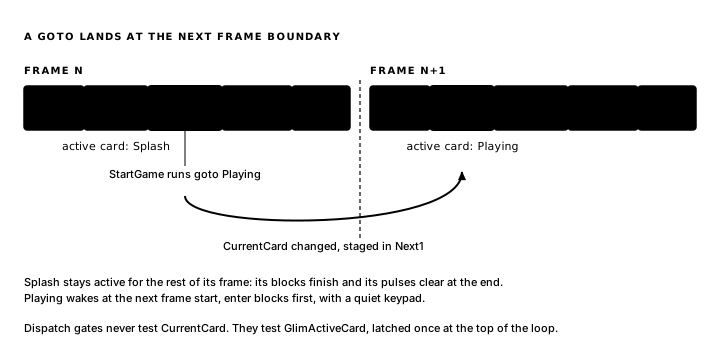
StartGame runs in the middle of a frame, in the logic phase, with Splash's other blocks still mid-frame around it. Splash remains active for the rest of that frame; Playing starts on the next.
First, CurrentCard is the next-card register. What goto Playing became, from gate.main.asm:
Glim_StartGame:
        ld      a,Card.Playing      ; goto Playing
        ld      (CurrentCard),a
        ld      a,(Next1)            ; a consumer already ran: defer to next frame
        or      CHG_CURRENTCARD
        ld      (Next1),a
retCurrentCard's consumers are the enter blocks, and they dispatch at the head of the phase. By the time any goto runs, they have had their turn this frame, so the change defers to Next1 and arrives at the next frame's start.
Second, dispatch gates test a copy of CurrentCard, latched once per frame at the top of the loop:
MainLoop:
        call    ScanFrame            ; show one full frame, then blank
        call    GlimPollBindings     ; game work runs in the blank window
        ld      a,(CurrentCard)    ; latch: card transitions land at
        ld      (GlimActiveCard),a  ; frame start, never mid-frame
So every card switch lands at a frame boundary. The frame containing the transition finishes as the old card: its blocks complete their phases, its pulses clear at frame end. The destination activates at the next frame's start, enter blocks first. The press that leaves the splash raises AnyKeyP (and HitP too, when the key is GO), but that frame's active card is still Splash, so ScorePoint is gated off, and both pulses are gone before Playing becomes active. A goto leaves its frame's triggers behind, so every round starts with a zero score, whichever key started it.
The card machinery
Building the file produces the output examined below:
glimmer build gate.glimIn the generated file, the cards are one enum and three bytes of storage:
Card .enum Splash, Playing, GameOverCurrentCard: .db Card.Splash ; writable next card, starts changed
GlimActiveCard: .db Card.Splash ; frame-latched card all gates test
GlimPrevCard: .db $FF ; enter edge detector ($FF = before any card)GlimPrevCard starts at $FF, outside the enum's range, which is how frame one registers as an entry to Splash. Gate's three states and five pulses fill all eight bits of Changed0, so CurrentCard's flag opens the second bank, and starts set:
Changed0:         .db %00000000   ; flags dispatch tests
Changed1:         .db %00000001   ; flags dispatch tests
A card gate is the familiar change-flag dispatch test with one comparison in front. Here is ScorePoint's, from the logic dispatcher:
        ld      a,(GlimActiveCard)
        cp      Card.Playing
        jr      nz,_skip_ScorePoint
        ld      a,(Changed0)
        and     GlimDep_ScorePoint__B0
        jr      z,_skip_ScorePoint
        call    Glim_ScorePoint
_skip_ScorePoint:
The wrong card skips the block; the right card continues to the flag test. Card gating adds three instructions before the familiar dispatch.
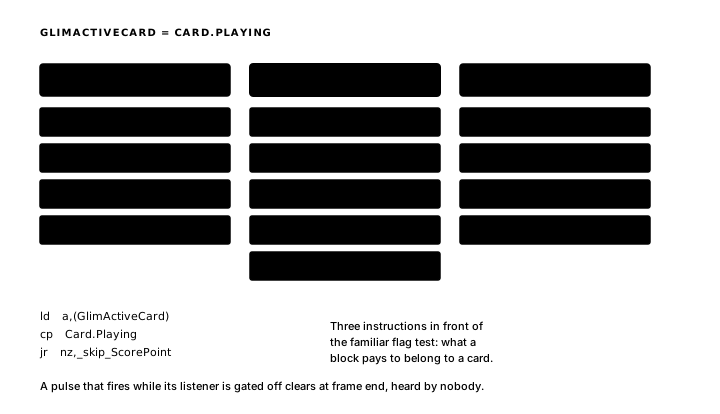
An enter dispatch adds the edge. ShowFinal's, together with the two instructions that follow the last enter dispatch in the phase:
        ld      a,(GlimActiveCard)
        cp      Card.GameOver
        jr      nz,_skip_ShowFinal
        ld      a,(GlimPrevCard)
        cp      Card.GameOver
        jr      z,_skip_ShowFinal
        ld      a,(Changed1)
        and     GlimDep_ShowFinal__B1
        jr      z,_skip_ShowFinal
        call    Glim_ShowFinal
_skip_ShowFinal:
        ld      a,(GlimActiveCard)
        ld      (GlimPrevCard),a
In order, the three tests say that the active card is GameOver; the previous card was anything else, which is your edge; and CurrentCard's flag is up. After all enter blocks have been tested, the code copies GlimActiveCard into GlimPrevCard, disabling the edge until the card changes again. That middle test is what makes the re-raise idiom and Restart's every-run change mark safe: a raised flag alone, with both card bytes equal, skips every enter block in the file.
Gate completes the language path that began with Mover. A Glimmer program can now hold structured state, respond to input and time, divide work into frame phases, organise source across files and restrict rules to the active card. Canvas showed how those facilities support one interactive program; Gate supplied its screen and lifecycle model.
Glimmer Book 2 begins by putting the full toolkit into Skyfall, a complete matrix game built from its design through to the finished source.
Exercise
A transition without a point. Why does pressing GO on the Splash card start Playing without also scoring the first point of the round?