Two Displays, One Language
The series began with one white pixel in the middle of the 8x8 RGB LED matrix. Those sixty-four pixels now run complete games, and Book 2 has moved from them to a video chip with sprites. Skyfall drops blocks down the 8x8 board toward a paddle you slide along the bottom row; Rushlight steers a white sprite through a night garden with a wasp on its tail. You built Skyfall and worked through Rushlight's design. Side by side, they are near twins: three cards joined in the same loop, a writable timer whose period is the difficulty, a one-shot guarding the restart, ApiRandom masked for every respawn and the same delayed game-over gate.
Their implementations separate at one early line. display matrix8x8 and display tms9918 determine what a render writes, how collision is calculated, how motion reaches the screen and the available scene size.
The two loops
The generated runtime loops make the comparison concrete. From skyfall.main.asm:
; --- runtime loop ---
Start:
        call    FbClear
        call    HudBlankDig
MainLoop:
        call    ScanFrame            ; show one full frame, then blank
        call    GlimPollBindings     ; game work runs in the blank window
        ld      a,(CurrentCard)    ; latch: card transitions land at
        ld      (GlimActiveCard),a  ; frame start, never mid-frame
        call    GlimTickTimers
        call    GlimRunLogicEffects
        call    GlimMergeRaised
        call    GlimRunRenderEffects
        call    GlimEndFrame
        jp      MainLoop
And from rushlight.main.asm:
; --- runtime loop ---
Start:
        call    VdpInit
        call    LoadResourcesVram
MainLoop:
        call    VdpWaitVBlank        ; pace on the status-register flag
        call    GlimCommit           ; flush shadows in the blank window
        call    GlimPollBindings
        ld      a,(CurrentCard)    ; latch: card transitions land at
        ld      (GlimActiveCard),a  ; frame start, never mid-frame
        call    GlimTickTimers
        call    GlimRunLogicEffects
        call    GlimMergeRaised
        call    GlimRunRenderEffects
        call    GlimEndFrame
        jp      MainLoop
From GlimPollBindings downward, the two loops run the same nine instructions: poll, latch the card, tick the timers, run the phases, roll the frame over. That identical tail is the language's reactive frame, unchanged under either display.
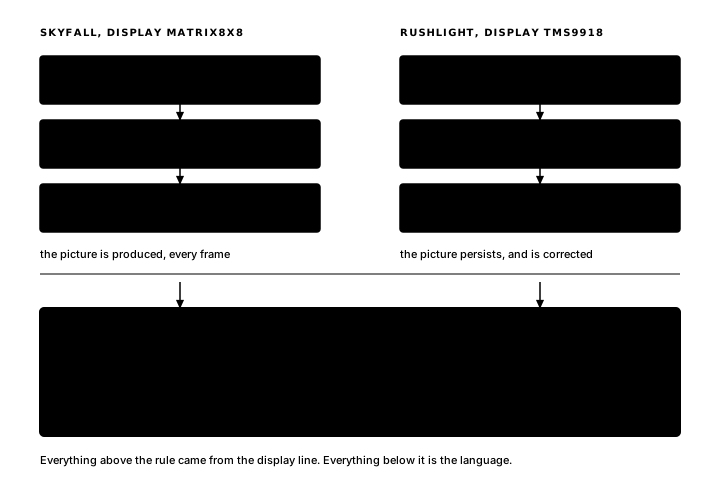
Everything above GlimPollBindings is profile-specific, and the two loop prefixes describe different relationships with a screen. Skyfall's frame produces its picture: ScanFrame drives all eight LED rows with a fixed dwell and returns with the 8x8 matrix dark, so the whole game (polling, rules, renders) runs inside the blank window between scans, and the scan is the frame's largest cost. Rushlight's frame begins by waiting for its picture: the VDP refreshes 256x192 pixels from 16 KiB of VRAM, VdpWaitVBlank detects the interval between two refreshes and GlimCommit moves the previous frame's changes into VRAM during that interval.
The board the program is
On the 8x8 matrix, the scene is 32 bytes of program RAM, and Skyfall's complete visible scene (drop and paddle) is in them. A render writes the framebuffer; the next scan shows it; and because the CPU re-presents those bytes every frame, the picture persists exactly as long as the bytes do.
With a scene that small, the cheapest render repaints all of it, and that is exactly how you wrote Skyfall's board:
render DrawBoard
    on PadX, DropX, DropY
begin
    call FbClear
    ld a,(DropX)
    ld b,a              ; B = x
    ld a,(DropY)
    ld c,a              ; C = y
    ld a,COLOR_YELLOW
    call FbPlot
    ld a,(PadX)
    ld b,a
    ld c,7              ; the bottom row
    ld hl,Shape_Paddle
    call ShapeDraw
end
Whatever moved (paddle, drop, or both), the block clears the canvas and repaints everything on it, and the cost stays trivial because everything on it is one plot and a three-pixel shape. FbClear erases the framebuffer before each redraw, so whatever vacated a pixel is gone before the plots begin.
The same smallness shaped your rules. Positions on the 8x8 are cells, so Skyfall's entire collision question (did the paddle catch the drop?) came down to one subtraction and one unsigned compare: sub b, cp 3, carry means caught. The repository's 8x8 matrix games push the board shape further in the same direction. Snake packs each body segment into a single byte, y*8+x, and walks a 64-byte ring buffer of them; Tetro keeps its settled board as occupancy and colour plane bytes, merged into the framebuffer a row at a time.
Timing came from the profile too: every rule and render shares the blank window between scans, and the scan paces the game, which is why Skyfall's difficulty lives in a timer period, counted in frames.
The scene the program describes
On the VDP, the scene outlives the frame that drew it. In Rushlight's splash card, you planted five reeds with five tile_at lines, once, in an enter block; the commit carried them to VRAM; and the VDP has refreshed them in every picture since from VRAM. An 8x8 matrix render repaints its whole layer whenever a fact changes; a VDP program writes each cell once and writes again only where a fact changed.
Your renders wrote that difference into shadow tables (ordinary RAM mirroring the VRAM the VDP reads), and the commit moves only the marked portions during the blank: all 128 sprite-attribute bytes if any sprite moved, and 32 bytes for each grid row whose dirty bit stands. On a frame where only the fly moved, the commit carries the sprite table, and the lantern's grid row besides, because Gather runs on every fly step and its updates re-mark the row it redraws. Splitting the test from the catch response removes that extra row. On a still frame the commit reads its dirty markers and returns. Moving the fly writes two shadow bytes, then the next commit sends the 128-byte sprite table.
That scale rewrote your rules. Positions are pixels now, so Rushlight's collision is the distance between two facts (absolute pixel difference per axis, each under a tolerance of 6), and the tolerance itself is a design decision the pixel scale brings with it: how much overlap counts as touching. The lantern pickup crosses the two coordinate systems on purpose: the fly lives in pixels, the lantern in grid cells, so Gather centres the fly (+4), divides by eight (three shifts), and compares cells. When Gather takes a lantern, it blanks the old grid cell itself, inside the effect, because four lines later the respawn overwrites LampCol and LampRow, and the old cell's address is gone with them.
The commit pacing sets this profile's motion cost: a held key reaches the screen two frames later (defer, shadow write, commit) at full rate, sixty-odd pixels a second. Skyfall's paddle reaches the next scan one frame after its pulse.
The main differences fit in one table:
| Skyfall, 8x8 matrix | Rushlight, VDP | |
|---|---|---|
| The scene | 32 bytes, redrawn on change | 768 cells + 32 sprites, persistent in VRAM |
| A render writes | the complete framebuffer | shadow cells, committed by dirty group |
| Display mechanism | ScanFrame, every frame | the VDP, from VRAM |
| Positions | cells on an 8x8 board | pixels on 256x192; grid cells, 32x24 |
| Collision | one subtract, one compare | pixel distance per axis, under a tolerance |
| Erasing | FbClear opens each redraw | an explicit blank of the old cell |
| Game budget | the blank window between scans | the vblank window between paintings |
One language
The display line leaves the game model alone. Skyfall and Rushlight declare their games in interchangeable sentences: state bytes and words for facts, pulses for moments, bind key ... held for steering and bind key any rising for the restart key, a writable oscillator as the difficulty screw (Gravity at 18 quickened to a floor of 6, Pace at 8 quickened to a floor of 1, the same dec and store in both), and a one-shot word timer armed at 90 frames to gate the restart. Three cards each, entered through enter blocks that re-raise what their renders need, left by goto or a conditional write to CurrentCard. The GameOver card moved between profiles verbatim.
Both games run compute, effect and render in that order; both stage changes through Raised0 and Next0 so one change reaches its dependents together, in a later phase or at the next frame's start; both print their design with glimmer --deps in the same report shape, raisers and triggers per fact. Skyfall uses 12 of the 32 change-flag cells, Rushlight 16, on the same budget.
The profile supplies the display-specific loop: scan or commit, framebuffer or shadow and FbPlot or SpriteSet. The language model remains the same across both display architectures: facts, moments, rules, pictures, phases and cards.
The next game's requirements determine its display. A game whose world is a board of cells that change together (pieces locking, lines clearing, a body growing) is a natural fit for the 8x8 matrix, where the whole scene is 32 bytes and cell arithmetic answers most questions. A game whose world is a place (standing scenery, a few movers gliding over it, room to travel) favours the VDP, where persistence and size require less Z80 work and a mover is two shadow bytes. Both displays have limits (sixty-four pixels on one side, sprite counts and colour rules on the other), and either way, the declarations you write first will read almost the same.
Further projects
The Glimmer repository's examples/ directory contains more programs readable with the model developed here. counter, dot, slide and trail are single-idea warm-ups. snake.glim is another 8x8 design: a growing body in a 64-byte ring buffer, with its body-scan and draw loops in an imported assembly engine. You have also read tetro.glim and sprite-chase.glim; each can be extended with a new piece or a smarter fleeing target.
When imported engine files grow from helpers into modules, the AZM books cover ops, routines, register contracts and the module system used by Glimmer's output. Debug80 Book 1 covers the workflow from project setup to sending a build to a physical board.
Every program in this book produced a HEX file containing the same assembled bytes that Debug80 runs. That file can be transferred to a real TEC-1G. If a board is within reach, Skyfall is one transfer away.
The series began with the ability to read ld a,(hl). You can now read, modify and extend complete Glimmer games on either display the TEC-1G offers. A new game can begin as Mover did: one fact, one picture and a connection between them.
Exercise
Choosing a display. Which display profile better suits an 8x8 cellular automaton, and which better suits a garden with persistent scenery and several independently moving insects? What property of each display determines the choice?