Pulses and Bindings
State describes values that persist across frames. Input events have a shorter lifetime: the instant GO goes down occurs on one frame. Glimmer represents such moments with a pulse. Mover introduced one pulse and one bind line; this chapter covers every key name, both binding modes and the generated keypad polling that runs each frame.
Rover is a white dot you steer around the 8x8 RGB LED matrix with 2, 4, 6, and 8 (the keypad's compass points), and GO recalls it to the centre. It feels like a game character the moment you hold a key.
program Rover

platform tec1g-mon3
display matrix8x8

state DotX : byte = 3 changed
state DotY : byte = 3

pulse Up
pulse Down
pulse Left
pulse Right
pulse Home

bind key KEY_2  held period 8 -> Up
bind key KEY_8  held period 8 -> Down
bind key KEY_4  held period 8 -> Left
bind key KEY_6  held period 8 -> Right
bind key KEY_GO rising -> Home

effect MoveUp
    on Up
    updates DotY
begin
    ld a,(DotY)
    or a
    jr z,_stop      ; at the top: stay
    dec a
    ld (DotY),a
_stop:
end

effect MoveDown
    on Down
    updates DotY
begin
    ld a,(DotY)
    cp 7
    jr nc,_stop     ; at the bottom: stay
    inc a
    ld (DotY),a
_stop:
end

effect MoveLeft
    on Left
    updates DotX
begin
    ld a,(DotX)
    or a
    jr z,_stop      ; at the left edge: stay
    dec a
    ld (DotX),a
_stop:
end

effect MoveRight
    on Right
    updates DotX
begin
    ld a,(DotX)
    cp 7
    jr nc,_stop     ; at the right edge: stay
    inc a
    ld (DotX),a
_stop:
end

effect GoHome
    on Home
    updates DotX, DotY
begin
    ld a,3
    ld (DotX),a
    ld (DotY),a
end

render DrawDot
    on DotX, DotY
begin
    call FbClear
    ld a,(DotX)
    ld b,a          ; B = x
    ld a,(DotY)
    ld c,a          ; C = y
    ld a,COLOR_WHITE
    call FbPlot
end
Half of this file is Mover. The second axis adds one state cell, two pulses and two rules with the clamp turned sideways. GoHome is an effect containing two constant stores. DrawDot now draws from both facts (on DotX, DotY), so movement on either axis redraws the dot.
Running Rover while holding 6 and tapping 2 demonstrates the difference. The dot runs right, steps up on each tap, and carries on running right. That feel of a steady run with single steps mixed in is what rising and held let you design.
The keypad, by name
The TEC-1G's MON-3 monitor gives every key a name, and bind uses those names directly:
| Keys | Names |
|---|---|
| The hex digits 0-F | KEY_0 through KEY_F |
| Plus and minus | KEY_PLUS, KEY_MINUS |
| GO | KEY_GO |
| AD (address) | KEY_AD |
Twenty keys, four of them off the hex pad. When you lay out a game's controls, the digits provide a useful arrangement: 2, 4, 6 and 8 make a compass, and 5 sits in the middle, in easy reach for fire or rotate. GO and AD serve as start and menu keys. The names compile to MON-3's key codes in the generated file, so the binding bind key KEY_2 ... in your source and the 2 key on the panel mean the same physical thing.
Rising or held
Every binding chooses one of two shapes, and the choice is a game design decision before it is a technical one:
risingfires once, on the frame the key goes down. Another press fires it again, which suits actions: fire, rotate, pause, start.held period Nfires on the press, then again every N frames while the key stays down. It suits movement, with N setting the pace: a small period is a fast walk, a large one a deliberate step.
In a falling-blocks game, one press of the rotate key should give one quarter turn; autorepeat would spin the piece out of control. The move-left key needs the opposite behaviour: holding the key keeps it sliding until release. Rover uses held compass keys and rising GO for the same reasons.
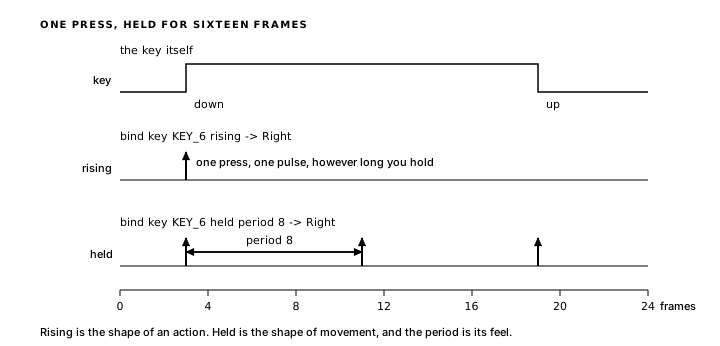
One property of the keypad shapes every control scheme: MON-3 reports a single pressed key at a time. Held movement runs one direction at once, and a fresh press takes over the autorepeat from the key before it. Rover's controls, and every game later in this book, are built on single-key movement, and the keypad's compass layout suits it. You saw the takeover while holding 6 and tapping 2 in Rover.
The any binding
A third binding form responds to every key:
pulse Wake

bind key any rising -> Wake
any fires its pulse on every new press, whichever key it is, and it fires alongside the named bindings. A press of GO therefore fires both Home and Wake in the same frame. It comes in the rising shape only, and it records one event: the player touched the machine. A title screen can use that pulse to start the game after any key press.
Generated polling
One generated routine produces all five of Rover's pulses and implements autorepeat with a counter, a reload value and release-edge handling. The top of the routine, from rover.main.asm:
; --- input polling (MON-3 _scanKeys) ---
.routine
GlimPollBindings:
        ld      c,ApiScanKeys
        rst     $10
        jr      z,_keydown
        ld      a,$FF                ; no key: disarm autorepeat
        ld      (Glim_HeldKey),a
        ret
_keydown:
        ld      b,a                  ; B = key code (DE unsafe: matrix kbd)
        jr      c,_newpress
        ld      a,(Glim_HeldKey)     ; held: autorepeat armed for this key?
        cp      b
        ret     nz
        ld      a,(Glim_HeldCount)
        dec     a
        ld      (Glim_HeldCount),a
        ret     nz
        ...
Once per frame, the routine calls MON-3's keypad scanner. _scanKeys returns its result in the flags (zero set means a key is down, carry set means the press is new this frame), and from those two flags the routine distinguishes the three input cases used in this chapter. A frame with no key down disarms autorepeat. A held key counts its repeat clock down and fires its pulse when the count runs out, reloading the period from your bind line; your period 8 lives down here as the reload value. A new press fires its pulse at once and arms the clock. The clock uses two bytes:
Glim_HeldKey:     .db $FF
Glim_HeldCount:   .db 0
Those bytes record which key is armed and how many frames remain until it repeats. When a pulse fires here, the poll writes the pulse's byte and sets its change bit directly, and because polling runs before any block, every phase of the frame sees the moment.
At the other end of the frame, GlimEndFrame clears every pulse byte. Between those two points, a moment is a fact like any other: one frame wide, one bit in Changed0, triggering whatever declared on it.
Later chapters produce moments from machine clocks. The next chapter follows a moment through the three block phases and explains their execution order: Compute, Effect, Render.
Exercise
Rising and held input. What difference would the player notice if Rover's KEY_2 binding changed from held period 8 to rising? Why is rising still the appropriate binding for the Home action?