Dependency Reports and Debugging
Canvas is the largest program in the book so far: a Point cursor, an eight-byte picture, five pulses, and six blocks connecting them. The chapters ahead double that, so the tools come now, on a familiar program before later examples double its size. A misdrawn pixel in Canvas might trace to the painting rule, the redraw, a movement effect, or a binding. The useful debugging question is which fact should have changed? Canvas now has seven candidate answers.
Every block you have built sits behind a .routine boundary for register-contract checking. Every build checks register contracts across the complete generated file, every debug map lands breakpoints in your source, and the dependency report prints the reactive graph on request. You will extend Canvas with a counter, then break it twice on purpose (once for a warning and once for a hard error) so each diagnostic can be examined against a known bug.
A count of marks
One byte now counts every pixel painted, and the seven-segment display shows the tally. One declaration joins the state:
state Marks : byte = 0 changedSpoken aloud, the declaration says: Marks is a byte, starting at zero, already changed, so the display reads 00000 on the first frame.
The painting rule gains a second job. It still sets the cursor's bit in the cursor's row; now it counts as well:
effect PaintPixel
    on Paint
    updates Picture, Marks
begin
    ld a,(Cursor + offset(Point, x))
    call MxMask     ; A = the column's pixel mask
    ld b,a
    ld a,(Cursor + offset(Point, y))
    ld e,a
    ld d,0
    ld hl,Picture
    add hl,de       ; HL -> the cursor's row byte
    ld a,(hl)
    or b
    ld (hl),a
    ld a,(Marks)
    inc a
    ld (Marks),a
end
The first eleven body lines are unchanged: mask the column, point HL at the row, OR the pixel in. The header names both facts the block writes, updates Picture, Marks, and when the block runs, both change flags rise together.
One render is new, using the existing HUD routine:
render ShowMarks
    on Marks
begin
    ld a,(Marks)
    ld l,a
    ld h,0
    call HudWriteU16
end
The cursor, movement effects and DrawCanvas remain unchanged. The file builds clean:
glimmer build canvas.glimWrote canvas.main.asm (register contracts checked by AZM)
Wrote canvas.main.d8.json (56 block segments attributed to .glim source)In a running Debug80 build, every press of GO sets a pixel and lifts the count.
The report at scale
The earlier four-fact dependency report repeated relationships visible at a glance. Canvas has eight facts, enough for the grouped report to make those relationships easier to trace:
glimmer --deps canvas.glimprogram Canvas
Cursor : state Point
raised by: MoveUp, MoveDown, MoveLeft, MoveRight
triggers: DrawCanvas (render)
Picture : state byte[8]
raised by: PaintPixel
triggers: DrawCanvas (render)
Marks : state byte
raised by: PaintPixel
triggers: ShowMarks (render)
Up : pulse
raised by: key KEY_2 (held)
triggers: MoveUp (logic)
Down : pulse
raised by: key KEY_8 (held)
triggers: MoveDown (logic)
Left : pulse
raised by: key KEY_4 (held)
triggers: MoveLeft (logic)
Right : pulse
raised by: key KEY_6 (held)
triggers: MoveRight (logic)
Paint : pulse
raised by: key KEY_GO (rising)
triggers: PaintPixel (logic)Each fact has a stanza containing its kind and type, the blocks that raise it and the blocks it triggers, with every dependent tagged by phase. Glimmer computes the report from your bind, on and updates connections, gathered into one place and sorted by fact.
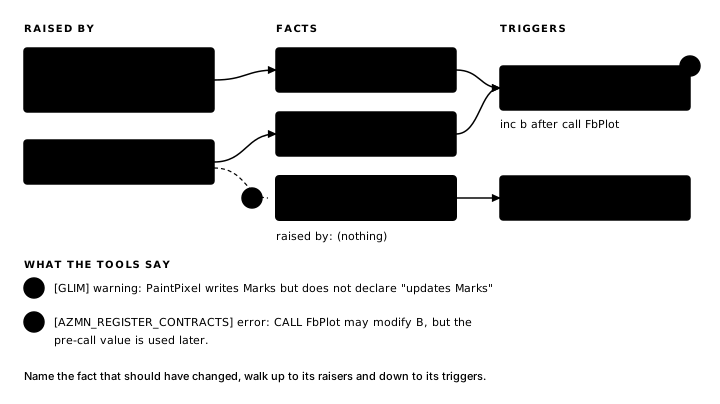
When something misbehaves in a reactive program, your first question is the one this chapter opened with: which fact should have changed? The report supplies both directions of that trace before you touch a debugger. Suppose the count on the display sits still while pixels keep landing. Downstream from Marks is one trigger, ShowMarks (render), so exactly one block draws the count. Upstream: Marks is raised by PaintPixel, which runs on Paint, which key KEY_GO (rising) fires. The investigation starts with the fact that should have changed, follows its raisers upstream and its triggers downstream, then places the first breakpoint where the chain is thinnest.
An undeclared write
The next version deliberately removes Marks from PaintPixel's updates list so the stuck count can be observed:
effect PaintPixel
on Paint
updates Picture
beginThe body still stores to Marks, and the header now lists Picture alone. This is a common reactive error: a store added to a block without updating the header to match. On the next build, the tool reports:
canvas.glim:75: [GLIM] warning: PaintPixel writes Marks but does not declare "updates Marks": the change flag will not be raised and dependent blocks will not run.
Wrote canvas.main.asm (register contracts checked by AZM)
Wrote canvas.main.d8.json (56 block segments attributed to .glim source)Glimmer scanned the body, found ld (Marks),a, checked the header, and reported the gap, naming the block, the missing declaration and the consequence, at line 75, the block's header line. A warning allows the build to finish: both artifacts were written. In the running program, the consequence is visible. Pixels paint, the board redraws, and the count reads 00000 no matter how many marks pile up. The store still executes on every press, and Marks climbs in memory; its change flag stays down, and ShowMarks runs only when that flag is set.
The report tells the same story from the declarations' side. With --deps, the broken program's Marks stanza reads:
  Marks : state byte
    raised by: (nothing)
    triggers:  ShowMarks (render)
A fact with a dependent and no raiser identifies this class of bug in two lines. The generated file shows the same gap: the wrapper after PaintPixel's body, which raised CHG_PICTURE + CHG_MARKS before the edit, now raises CHG_PICTURE alone. Restoring Marks to the header gives a clean build.
The scan behind that warning reads only stores that name their cell in the instruction itself: ld (Marks),a names Marks, so the header can be checked against it. PaintPixel's other write travels through a pointer (ld (hl),a, with HL aimed into Picture by arithmetic) and a build-time scan cannot determine where HL will point at run time. Removing updates Picture from the header instead leaves the build silent while the board freezes in the same way. The updates line therefore remains your declaration of intent: the one place that records where a block's writes land, whatever route they take.
The boundary around a block
Register checking happens in the generated file, and its unit of account is the block. The painting rule in canvas.main.asm begins:
; --- logic block PaintPixel ---
.routine
Glim_PaintPixel:
    ld a,(Cursor + offset(Point, x))
    call MxMask     ; A = the column's pixel mask
    ld b,a
    ld a,(Cursor + offset(Point, y))
    ld e,a
    ld d,0
    ld hl,Picture
    add hl,de       ; HL -> the cursor's row byte
    ld a,(hl)
    or b
    ld (hl),a
    ld a,(Marks)
    inc a
    ld (Marks),a
        ld      a,(Raised0)          ; deliver to later phases this frame
        or      CHG_PICTURE + CHG_MARKS
        ld      (Raised0),a
        ret

; --- render block DrawCanvas ---
.routine
Glim_DrawCanvas:
The .routine line is the boundary. It applies to the label below it and opens a region that the next .routine closes. The assembler checks that region as one unit: Glim_PaintPixel is a callable routine, and because the directive stands bare, the assembler infers the routine's register behaviour (what it reads on entry, what it may destroy) from the body itself. Your code sits inside verbatim; the wrapper closes the region with the compiled updates line and the ret; the next boundary opens DrawCanvas. Every block wrapper, every dispatcher, and every library routine in the file stands behind one.
A policy line near the top of the file turns inference into enforcement:
; Register contracts are declared with .routine and checked at
; strict strength over this whole generated file.
        .contracts strict
Under strict, the assembler checks every call in the file against the contract of the routine it calls, the inferred contracts of your blocks and the declared contracts of the library alike. FbPlot's declaration sits in the profile library:
; Set one pixel. B = x (0-7), C = y (0-7), A = colour bits
; (COLOR_RED/GREEN/BLUE, OR-combined). ORs into the framebuffer.
.routine in A,B,C clobbers A,B,DE,HL,carry,zero,sign,parity,halfCarry
FbPlot:
As a block header, the contract line says in A,B,C: the routine consumes those three on entry (colour, x, y). clobbers A,B,DE,HL and the flags: any of those may hold anything on return. A register the contract leaves out counts as preserved, and the assembler checks the routine's body against that contract too. FbPlot leaves C out of its clobbers list, which is a verified guarantee that y survives the call, proven on every build, and about to matter.
A register clobber
This time the bug reuses a register after a call that may clobber it. The assembler detects the stale-register use before the first byte runs.
DrawCanvas ends by plotting the cursor over the picture: x into B, y into C, white into A, call FbPlot. A tempting edit for a two-pixel cursor increments B after the first plot and calls FbPlot again.
    ld a,COLOR_WHITE
    call FbPlot
    inc b           ; one column right: a two-pixel cursor
    ld a,COLOR_WHITE
    call FbPlot
The next build reports the contract violation:
canvas.glim:116:5: [AZMN_REGISTER_CONTRACTS] error: CALL FbPlot may modify B, but the pre-call value is used later.An error this time, and the build stops. The generated assembly is on disk for reading, and the build halts short of the hex, the binary and the debug map. The assembler followed the code past the first call, found inc b consuming B's pre-call value, checked B against FbPlot's clobbers list, and refused. On the board, this bug is a second pixel landing wherever FbPlot happened to leave B. At build time, the diagnostic names the file, position, call and register.
The fix follows the contract. B is rebuilt from state after the call; C is preserved by FbPlot, so it carries y through:
    ld a,COLOR_WHITE
    call FbPlot
    ld a,(Cursor + offset(Point, x))
    inc a           ; one column right: a two-pixel cursor
    ld b,a
    ld a,COLOR_WHITE
    call FbPlot     ; C still holds y: it survived the first call
That version builds clean. Canvas keeps its one-pixel cursor for the chapters ahead. The example shows why a callee's clobbers list matters before a register is reused across the call.
The diagnostic's address, canvas.glim:116:5, points at the faulty call in a block body, and Glimmer carries every body line's origin through to the assembler, so the error arrives with your file, your line, and your column attached. A misspelling of the counter's name inside ShowMarks produces an assembler diagnostic in the same coordinates:
canvas.glim:122:5: [AZMN_SYMBOL] error: Unresolved symbol "Marsk" in 16-bit fixup.You write Z80 inside blocks, so assembler diagnostics are part of everyday Glimmer work, and they reach you on the line you typed.
Stepping through the bug
The same coordinates keep working while the program runs: the report identifies where the breakpoint belongs, and the debug map makes it land. A breakpoint on the or b line inside PaintPixel halts on that source line when GO fires Paint. The registers panel shows the current state: HL points into Picture at the cursor's row, B carries the column mask MxMask built, and A holds the row's current bits. The next step merges the new pixel into A; the following step stores it in the picture; three more steps advance the counter by one.
Past the body's last line, the debugger continues in canvas.main.asm, inside the wrapper you read two sections ago: ld a,(Raised0), then or CHG_PICTURE + CHG_MARKS, the updates declaration executing, watchable instruction by instruction. The crossing works in the other direction too: stepping into DrawCanvas's call FbPlot lands in the labelled and commented profile library.
The cursor's offset arithmetic appears in six of its seven blocks, retyped wherever a rule needs the cursor. The next chapter moves it into one routine: Routines, Parts and Imports, the structure used to organise a growing program.
Exercise
The stuck counter. In the broken Canvas example, Marks increases in memory while the display remains at zero. Why does ShowMarks stay idle, and which block header repairs the connection?