Recursion
A recursive routine calls itself with a smaller problem. Each unfinished call keeps its return address and saved values on the stack until the base case returns.
examples/recursion.asm computes 5! both recursively and iteratively, then sums a five-byte table with a recursive walk.
Set the stack first
The program establishes SP before its first call:
STACKTOP EQU 9FFFH

ORG 0000H
MAIN:
    LD SP,STACKTOP
The chosen region must be writable and must not collide with code, data or the machine's monitor workspace. The example data begins at $8000, so its stack grows down from $9FFF with ample separation for this bounded demonstration.
Recursive factorial
Factorial has one base case, 0! = 1, and one recursive rule, n! = n × (n−1)!.
FACTREC:
    LD A,B
    OR A
    JR Z,.ONE
    PUSH BC
    DEC B
    CALL FACTREC
    POP BC
    LD C,B
    CALL MUL8AC
    RET
.ONE:
    LD A,1
    RET
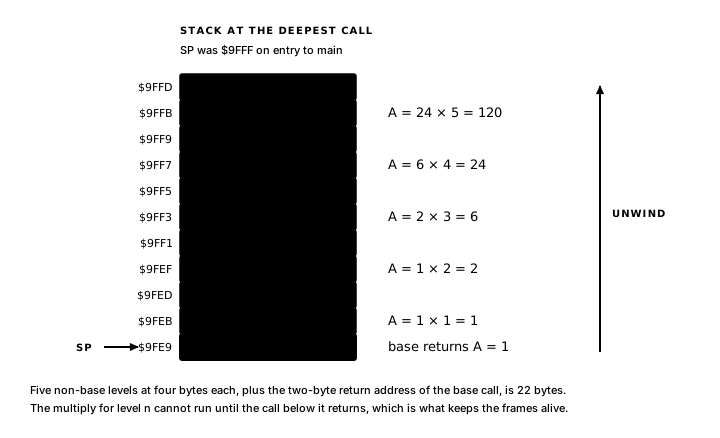
Each non-base level saves BC, then CALL FACTREC adds a return address. When the deeper call returns, BC restores the current n and MUL8AC multiplies the partial result by it.
Measure the stack budget
The source records the arithmetic behind its bound:
FACTN EQU 5
FSTEP EQU 4
FBASE EQU 2
FDEPTH EQU FACTN+1
FSTACK EQU FACTN*FSTEP+FBASE
Each of the five non-base levels contributes two bytes for saved BC and two for the recursive return address. The base-case invocation has no saved BC, but its caller still leaves a two-byte return address on the stack. The deepest occupancy is 5 × 4 + 2 = 22 bytes across six active calls.
The constants document the bound; Atom does not perform stack-depth analysis. Changing FACTN requires checking both the 8-bit result range and the available stack region.
Iterative factorial
FACTITER keeps the accumulated product in E and the remaining multiplier in C. One call frame handles every iteration, so its stack use does not grow with n. It produces the same byte result as FACTREC for inputs that fit.
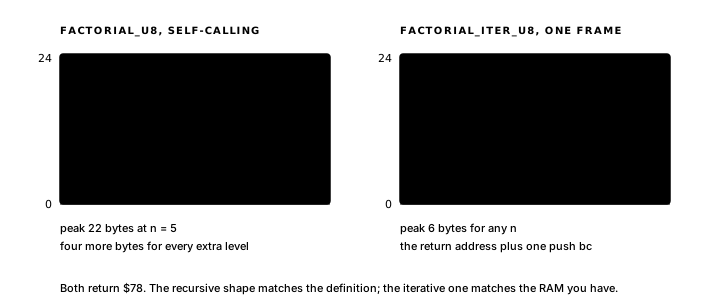
The recursive form mirrors the mathematical definition. The iterative form uses a fixed stack budget and avoids call overhead. On a small machine, that space difference is often decisive.
A recursive table walk
SUMREC consumes one byte before each recursive call, then adds that byte as the calls return:
SUMREC:
    OR A
    JR Z,.ZERO
    LD B,A
    LD A,(HL)
    PUSH AF
    INC HL
    DEC B
    LD A,B
    CALL SUMREC
    POP AF
    LD E,A
    LD D,0
    ADD HL,DE
    RET
.ZERO:
    LD HL,0
    RET
The input count in A supplies the bound. HL changes role across the call: it is the source pointer on the way down and the 16-bit sum on the way back up. The current byte is saved in AF before recursion.
After the program halts, FACTR and FACTI both contain $78 (120), while SUMR contains $001A (26).
Exercise
Trace FACTREC with FACTN EQU 3. Draw the stack immediately after the base call begins, including every return address and saved BC word, then list the three multiplications performed while the calls return.