Arithmetic Routines
The Z80 adds and subtracts bytes directly. Larger calculations come from short routines that combine those instructions with loops and calls. A greatest-common-divisor routine works over 16-bit values, while a power routine produces an 8-bit result.
The complete program is examples/arithmetic.asm. After it halts, GCDRES contains 6 as a little-endian word and POWRES contains 81.
A routine interface
The GCD routine receives its two unsigned inputs in HL and DE. It returns the result in HL and may change AF and DE:
; In: HL,DE. Out: HL. Clobbers: AF,DE.
GCDU16:
.LOOP:
    LD A,H
    OR L
    JR Z,.RIGHT
    LD A,D
    OR E
    JR Z,.LEFT
The comment records the agreement between caller and routine. GCDU16 fits Atom's eight-character symbol limit. Its private labels begin with a period and belong to that global routine until the next global label.
The first four instructions test the two base cases. LD A,H followed by OR L sets Z exactly when HL is zero. The same test on D and E detects a zero in DE. If one input is zero, the other is the answer.
Euclid by subtraction
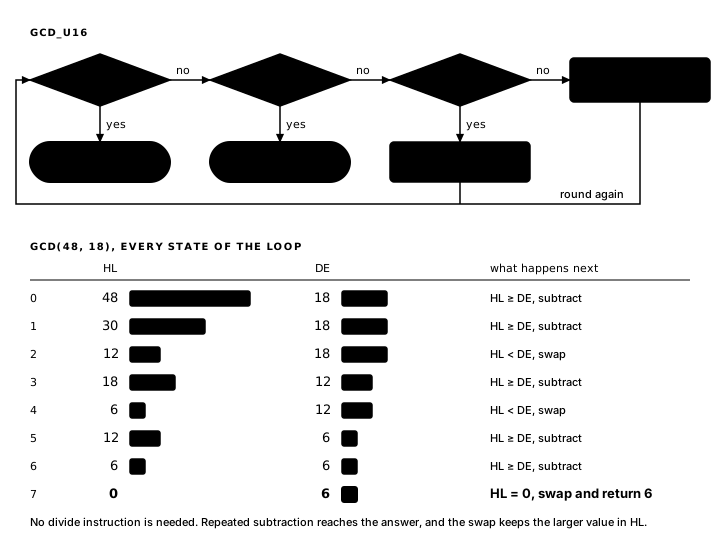
For two non-zero values, Euclid's method repeatedly subtracts the smaller from the larger. The pair eventually reaches a state where one side is zero.
    PUSH HL
    OR A
    SBC HL,DE
    POP HL
    JR C,.SWAP
    OR A
    SBC HL,DE
    JR .LOOP
.SWAP:
    EX DE,HL
    JR .LOOP
OR A clears carry without changing A. The first subtraction is a comparison: HL is saved, SBC HL,DE sets carry when HL is smaller, then POP HL restores the value. If HL is large enough, the second subtraction keeps its result. If HL is smaller, EX DE,HL swaps the operands before control returns to .LOOP.
For 48 and 18, the successive pairs are 48/18, 30/18, 12/18, 18/12, 6/12, 12/6 and 6/6. One final subtraction reaches 0/6 and returns 6.
Repeated multiplication
The power routine receives an exponent in B and a base in C. It starts with the multiplicative identity 1, then multiplies once for each exponent step:
POWERU8:
    LD E,1
.LOOP:
    LD A,B
    OR A
    JR Z,.DONE
    DEC B
    LD A,E
    PUSH BC
    CALL MUL8AC
    POP BC
    LD E,A
    JR .LOOP
.DONE:
    LD A,E
    RET
PUSH BC preserves both the remaining exponent and the base across the helper call. MUL8AC consumes B as its own loop counter, so the matching POP BC restores the caller's values before the next power step.
The helper computes A × C by adding C to a zero accumulator A times:
MUL8AC:
    OR A
    RET Z
    LD B,A
    XOR A
.LOOP:
    ADD A,C
    DJNZ .LOOP
    RET
The result wraps at eight bits. The demonstration uses 3^4, which is 81 and fits in one byte. A caller that needs wider or checked arithmetic must choose a wider result convention and detect overflow.
Exercise
Trace POWERU8 with B = 3 and C = 2. Record B, E and A immediately before and after each call to MUL8AC, then give the final byte returned in A.