Machine Code
A program is a sequence of bytes in memory.
Opcodes and operands
The opcode byte, sometimes with a prefix byte, identifies the instruction and its operand form. Some instructions consist only of an opcode. Others include additional operand bytes carrying a constant, memory address or displacement.
A few examples from the Z80 instruction set:
| Byte sequence | Instruction | What it does |
|---|---|---|
$3E N | LD A, N | Load the constant value N into A |
$06 N | LD B, N | Load the constant value N into B |
$47 | LD B, A | Copy A into B |
$80 | ADD A, B | Add B to A; result goes into A |
$32 LO HI | LD (NN), A | Store A at the 16-bit address NN |
$3A LO HI | LD A, (NN) | Load A from the 16-bit address NN |
$76 | HALT | Suspend execution until interrupt or reset |
Address operands follow the little-endian convention from Chapter 1: low byte first, high byte second. The address $8000 appears in the instruction stream as $00 $80. For a searchable reference of the full Z80 instruction set, see Z80 Instruction Reference.
A complete hexadecimal program
Here is a complete Z80 program written entirely as bytes, placed in memory starting at address $0000.
$0000:  3E 05        ; LD A, 5         - load 5 into A
$0002:  47           ; LD B, A         - copy A into B; B now holds 5, A holds 5
$0003:  3E 03        ; LD A, 3         - load 3 into A; B still holds 5
$0005:  80           ; ADD A, B        - A = A + B = 3 + 5 = 8
$0006:  32 00 80     ; LD ($8000), A   - store A at address $8000
$0009:  76           ; HALT
Stepping through it
The CPU starts with PC = $0000.
PC = $0000: The byte there is $3E. The Z80 recognises this as a two-byte instruction: "load the next byte into A." It reads the following byte, $05 and loads 5 into A. PC advances to $0002.
PC = $0002: The byte is $47: "copy A into B." One byte, opcode only. B becomes 5; A remains 5. PC advances to $0003.
PC = $0003: $3E $03 loads 3 into A. B is unchanged and still holds 5. PC advances to $0005.
PC = $0005: $80 adds B to A. The Z80 adds the contents of B (5) to the contents of A (3) and puts the result (8) into A. The flags register is updated: Zero is clear (8 ≠ 0), Carry is clear (8 < 256), Sign is clear (bit 7 of 8 is 0). PC advances to $0006.
PC = $0006: $32 $00 $80 stores A at a 16-bit address. The opcode $32 is followed by two address bytes: $00 (low) and $80 (high), giving address $8000. The value 8 is written to memory location $8000. PC advances to $0009.
PC = $0009: $76 is HALT. Normal instruction execution stops until an interrupt or reset. Address $8000 now contains $08.
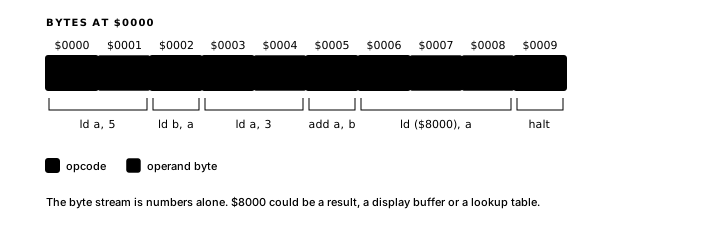
Why write assembly source?
The program above is only ten bytes, yet understanding it requires decoding every opcode and operand. Its byte stream does not say whether $8000 is a result variable, display buffer or table. Moving that value to $8100 means finding and changing the two address bytes by hand.
Jumps and calls make the maintenance problem worse. Inserting an instruction changes later addresses, including every branch that refers to them. Assembly source gives instructions readable names and lets symbols stand for addresses. The next chapter rewrites this program in Atom, leaving the assembler to calculate the operand bytes.
Exercise
Decode a byte stream. Decoding this program should place each instruction beside its starting address:
3E 12 47 3E 05 80 32 10 80 76The completed trace should also give the final values in A and B and the byte stored at $8010.