Strings
A null-terminated string stores its bytes in order and ends with zero. The terminator gives traversal routines a stopping rule, while the caller remains responsible for providing enough destination space.
examples/strings.asm measures "HELLO", copies it, compares the copy with the source and finds the first L.
Storage and capacity
ORG 8000H
MESSAGE:
    DB "HELLO",0
BUFFER:
    DS 8
MESSAGE occupies six bytes: five characters and the zero terminator. BUFFER has a capacity of eight bytes. A copy into it is valid only when the source length plus its terminator is at most eight.
Atom can also write the same representation with CSTR "HELLO". The explicit DB form keeps the terminator visible while the loop is being learned.
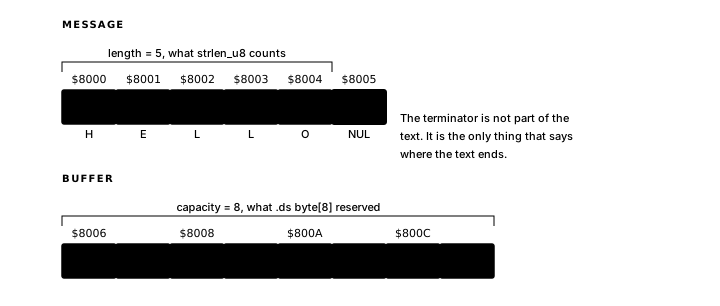
Measuring a string
STRLEN returns the count in A and advances HL through the source:
STRLEN:
    LD B,0
.LOOP:
    LD A,(HL)
    OR A
    JR Z,.DONE
    INC HL
    INC B
    JR .LOOP
.DONE:
    LD A,B
    RET
At .LOOP, B equals the number of non-zero bytes already passed. The zero byte ends the scan without being added to the count.
An 8-bit result limits the represented length to 255. The routine also assumes that a terminator is present before the address wraps. Those are interface conditions, even though the instruction sequence cannot prove them.
Copying through the terminator
HL points at the source and DE points at the destination:
STRCOPY:
.LOOP:
    LD A,(HL)
    LD (DE),A
    INC HL
    INC DE
    OR A
    JR NZ,.LOOP
    RET
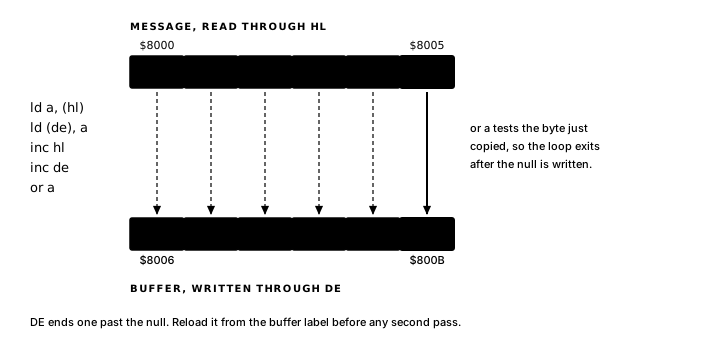
The store happens before the test, so the zero byte is copied too. On return, HL and DE both point one byte beyond their respective terminators.
Comparing two strings
Lexicographic comparison examines corresponding bytes until they differ or both reach zero. The routine returns 0 for equality, 1 when the HL string is greater and $FF when it is less.
.LOOP:
    LD A,(HL)
    PUSH AF
    LD A,(DE)
    POP BC
    CP B
    JR C,.GREATER
    JR NZ,.LESS
    OR A
    JR Z,.EQUAL
    INC HL
    INC DE
    JR .LOOP
The push/pop pair transfers the HL byte from A into B while A loads the DE byte. CP B compares the DE byte in A against the HL byte in B, which explains the apparent reversal of the carry branches.
Finding a character
STRFIND uses B as an index. It tests the terminator first, then compares the live byte with C. The result is the first matching index or $FF when the terminator arrives first.
After the program halts, STRLENB is 5, COPYOK is 1 and FINDIDX is 2.
Exercise
Change the search character to 'Z' and predict the return value. Then shorten BUFFER to five bytes and identify the address overwritten by the terminator.