Bit Patterns and Packed Flags
One byte can hold eight independent yes-or-no states. A mask selects one of those states for testing, setting or clearing.
examples/bit-flags.asm starts with ready and busy set, records the initial ready state, sets error, clears busy and extracts the error bit as the number 1.
Positions and masks
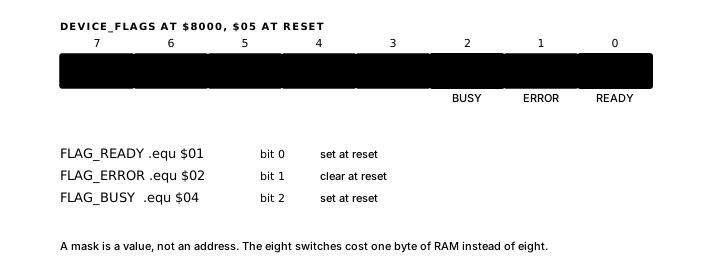
Atom has no enum directive, so the source assigns the three positions with ordinary constants:
READYBIT EQU 0
ERRORPOS EQU 1
BUSYBIT EQU 2
READYMSK EQU 1<<READYBIT
ERRORMSK EQU 1<<ERRORPOS
BUSYMSK EQU 1<<BUSYBIT
The masks are $01, $02 and $04. Deriving them with a shift keeps each bit position and mask tied to the same constant.
Testing a bit
AND clears every unselected bit. The Z flag then reports whether the selected bit was zero:
    LD A,(FLAGS)
    AND READYMSK
    LD A,0
    JR Z,.CLEAR
    LD A,1
.CLEAR:
    LD (READYLIT),A
LD A,0 does not change flags, so the branch still uses the Z result from AND. The sequence stores a literal 0 or 1 rather than the mask value.
Setting a bit
OR combines the selected 1 bits with the live byte:
    LD A,(FLAGS)
    OR ERRORMSK
    LD (FLAGS),A
Every existing 1 bit remains set, and the error bit becomes 1.
Clearing a bit
Clearing requires the inverse mask. The live value is preserved in B while A builds that mask:
    LD A,(FLAGS)
    LD B,A
    LD A,BUSYMSK
    CPL
    AND B
    LD (FLAGS),A
CPL turns $04 into $FB. AND with $FB clears bit 2 and preserves the other seven bits.
Extracting a numeric bit
The error mask leaves its bit in position 1. A rotate right moves it into position 0:
GETERROR:
    AND ERRORMSK
    RR A
    RET
The AND guarantees that every other bit is zero, so the returned value is exactly 0 or 1. After the demonstration halts, FLAGS is $03, READYLIT is 1 and ERRORBIT is 1.
The Z80 BIT, SET and RES instructions are useful when the bit position is fixed in the instruction. Masks remain useful when the position is represented as a value or when several bits must change together.
Exercise
Add an enabled flag at bit 7. Give its mask, the instruction sequence that sets it and the hexadecimal value produced when it is combined with the final FLAGS byte.