Counting Loops and DJNZ
Many loops know their iteration count before they begin. The Z80 gives this case its own instruction: DJNZ decrements B and branches while B is not zero.
A two-instruction count
Without DJNZ, B can be decremented and tested explicitly:
LD B, LIMIT
.LOOP_TOP:
  ; ... body ...
  DEC B
  JR NZ, .LOOP_TOP
DEC B sets Z when B reaches zero. JR NZ repeats the body while Z is clear. The branch must immediately follow the decrement unless every instruction between them preserves Z.
DJNZ: decrement B and jump if not zero
DJNZ LABEL performs three steps:
- B decreases by one.
- If B is now non-zero, jump to
LABEL. - If B is now zero, fall through to the next instruction.
The single instruction replaces DEC B / JR NZ, LABEL. It is one byte smaller than that pair and does not depend on the flags left by the loop body.
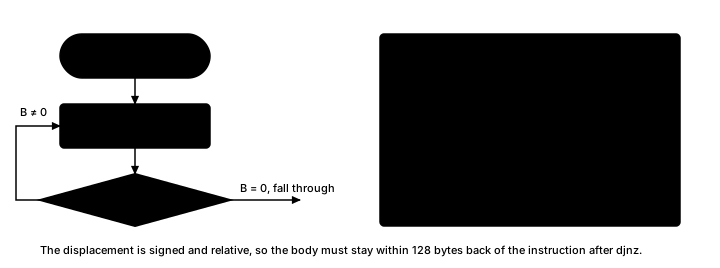
DJNZ is a relative jump, like JR. Its signed displacement is measured from the address after the instruction, giving a target range of 128 bytes backward to 127 bytes forward from that address. If the loop body is too long, the assembler reports an error and the loop requires DEC B / JP NZ instead.
The three parts of a counted loop
Every DJNZ loop has the same three parts:
- Init: load B with the iteration count before the loop.
- Body: the instructions that run each iteration.
- Branch-back:
DJNZat the end of the body, targeting the body label.
LD B, 5           ; init: B = iteration count
.LOOP_TOP:
  ; body
  DJNZ .LOOP_TOP   ; branch-back: B--; if B != 0, go to loop_top
The label .LOOP_TOP sits at the first instruction of the body, not before the LD B initializer. With the LD B init missing, B holds whatever the previous code left in it and the loop runs that many times.
The zero-count hardware semantic
DJNZ uses B as an 8-bit counter, and LD B, 0 is the case worth knowing about.
On the Z80, DJNZ decrements B before testing. If B starts at 0, the decrement wraps to 255 ($FF), the result is non-zero and the jump is taken. The loop continues from B = 255 and runs a further 255 times before B reaches zero again. Total: 256 iterations.
LD B, 0 before DJNZ is valid Z80; it gives 256 iterations and some programs use it deliberately for exactly that reason.
A DJNZ loop must not receive B = 0 when zero iterations are intended. A runtime count that may be zero requires a test before the loop:
LD A, (COUNTVAL)
OR A               ; test whether COUNTVAL is zero
JR Z, .SKIPLOOP    ; skip the entire loop if count is zero
LD B, A
.LOOP_TOP:
  ; body
  DJNZ .LOOP_TOP
.SKIPLOOP:
A count known at write-time to be between 1 and 255 can go straight into B.
Worked example
LIMIT EQU 5

ORG $0000
MAIN:
  LD A, 0
  LD B, LIMIT
.LOOP_TOP:
  INC A
  DJNZ .LOOP_TOP
  LD (TOTAL), A
  HALT

ORG $8000
TOTAL: DB 0
The initializer makes A zero and B five. Each pass increments A, then DJNZ consumes one count. After five passes, A is 5 and TOTAL receives 5. B is zero because DJNZ falls through only after its decrement produces zero. Other registers retain whatever values the body left in them.
When DJNZ is not enough
Use DEC B / JP NZ when the loop body is too large for the relative range of DJNZ. Use an explicit comparison and conditional jump when a value, rather than a count, decides when to stop.
Exercise
The zero-count case. A byte named ITERATIONS, incremented once in this loop body, makes the hardware behaviour observable. The prediction should give B and ITERATIONS after runtime counts 0, 1 and 255.
LD A, (COUNTVAL)
LD B, A
.LOOP_TOP:
  ; increment iterations here
  DJNZ .LOOP_TOP
A guarded version should make count 0 produce zero iterations while retaining the ordinary meanings of 1 and 255. All three emulator runs should agree with the prediction.