A Complete Program
A complete table program brings together DJNZ loops, subroutines, register-based arguments and conditional branches. Its data moves through MAIN and across two calls.
The integration goal
The program solves two related problems on the same byte table:
- The maximum value in the table.
- The number of entries strictly greater than 64.
MAIN supplies a table pointer and length to each subroutine, receives each result and stores it in named RAM. That structure connects the separate instruction patterns from earlier chapters into one flat Z80 program.
The complete source follows.
The full program
TABLELEN EQU 8

ORG $0000
MAIN:
  LD HL, VALUES
  LD B, TABLELEN
  CALL FIND_MAX
  LD (MAX_VAL), A

  LD HL, VALUES
  LD B, TABLELEN
  LD C, 64
  CALL CNTABOVE
  LD (ABOVE_64), A
  HALT

; find_max: scan byte table, return largest value
; In:  HL = pointer to first byte, B = count
; Precondition: B > 0
; Out: A = maximum value
; Clobbers: B, C, F, HL
FIND_MAX:
  LD A, 0
.MAXLOOP:
  LD C, (HL)
  CP C
  JR NC, .NOMAX
  LD A, C
.NOMAX:
  INC HL
  DJNZ .MAXLOOP
  RET

; CNTABOVE: count entries strictly greater than threshold
; In:  HL = pointer to first byte, B = count, C = threshold
; Precondition: B > 0
; Out: A = count of entries > C
; Clobbers: B, D, F, HL
; Preserves: C
CNTABOVE:
  LD D, 0
.CNTLOOP:
  LD A, (HL)
  CP C
  JR C, .CNTSKIP
  JR Z, .CNTSKIP
  INC D
.CNTSKIP:
  INC HL
  DJNZ .CNTLOOP
  LD A, D
  RET

ORG $8000
VALUES:   DB 23, 47, 91, 5, 67, 12, 88, 34
MAX_VAL:  DB 0
ABOVE_64: DB 0MAIN: the calling sequence
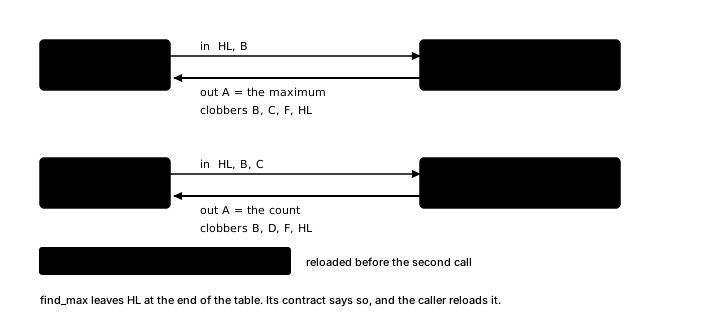
MAIN sets up registers, calls a subroutine, stores the result, then repeats for the second task. Every argument register is loaded immediately before its CALL, so the complete data flow is visible in the calling sequence.
The table base address VALUES must be loaded into HL again before the second call because FIND_MAX advances HL past the end of the table during its scan. The comment header records that side effect by listing HL among the clobbers. Reloading HL at the call site prevents the second routine from scanning the bytes after the table.
FIND_MAX: a counted loop with a conditional update
FIND_MAX scans the table and returns the largest byte in A. The loop body uses C as a temporary for the current element.
The flag-before-branch check on CP C / JR NC shows that CP C establishes the flag, JR NC reads it immediately, and nothing changes the flag between them. Carry clear after CP C means A ≥ C, so JR NC skips the update and the running maximum is left alone. LD A, C runs only when carry was set, meaning A was less than C and C is a new maximum. After eight iterations, A = 91 ($5B), the largest value in the table.
The comment header documents "Clobbers: B, C, F, HL". B is consumed by DJNZ, C holds the current element, comparisons modify F, HL advances past the last byte and A holds the result.
CNTABOVE: reusing comparison flags
CNTABOVE counts entries strictly greater than a threshold and returns the count in A.
The subroutine uses D as its running count. LD D, 0 changes only D, so B retains the loop count and C retains the threshold. The comment contract lists D among the clobbered registers and C among the preserved registers.
The loop body uses one CP C and two conditional branches on the same flag result. CP C sets carry when A < C and sets Z when A == C. To count only entries strictly greater than C, both conditions must be false: carry clear and Z clear. The code runs JR C, .CNTSKIP (skip if A < C) and JR Z, .CNTSKIP (skip if A == C) immediately after that single comparison. No instruction between CP C and those branches changes the flags, so both tests read the same comparison.
The two call boundaries
The program places VALUES, MAX_VAL and ABOVE_64 at $8000. Each routine receives a pointer and count, scans the same table and returns one byte. The comments above the labels record which registers cross each boundary.
Those comments are agreements rather than assembler checks. A caller must load the declared inputs, and the routine must leave every unlisted live value usable. Chapter 11 makes that responsibility precise and shows how to preserve a register when a routine needs it internally.
Exercise
A FIND_MAX trace. Every row of this table should be completed for the chapter's eight-byte input, including the carry result from CP C.
| Iteration | C (current) | A before CP | Carry set? | Update A? | A after |
|---|---|---|---|---|---|
| 1 | 23 | 0 | ? | ? | ? |
| 2 | 47 | ? | ? | ? | ? |
| 3 | 91 | ? | ? | ? | ? |
| 4 | 5 | ? | ? | ? | ? |
| 5 | 67 | ? | ? | ? | ? |
| 6 | 12 | ? | ? | ? | ? |
| 7 | 88 | ? | ? | ? | ? |
| 8 | 34 | ? | ? | ? | ? |
The final line should give A, B and HL on return and the byte stored in MAX_VAL.